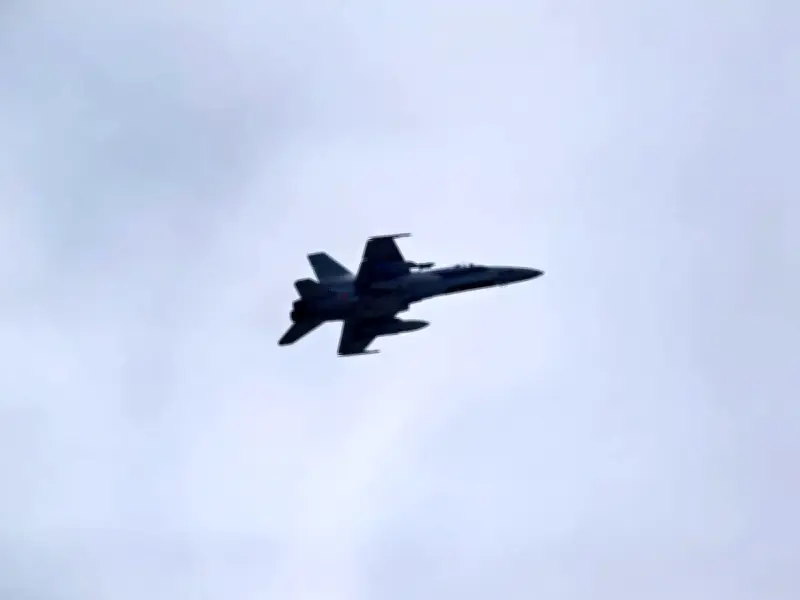
NATO scrambled fighter jets after Russia launched another massive overnight drone attack on Ukraine, triggering fresh air alerts along the alliance's eastern flank. Two Spanish F-18 jets operating under NATO command were deployed from a Romanian airbase after military radar picked up aerial targets near the Ukrainian border.
Radar detects aerial targets near Romanian border
The incident occurred overnight between October 9 and 10, as Moscow pressed ahead with its offensive against Ukraine, stoking concerns that the conflict could extend into NATO territory. Romania's Defence Ministry reported that its radar surveillance system identified an "aerial target" in Ukrainian airspace approximately 20km north of Periprava, in close proximity to the Romanian border.
The Spanish aircraft were launched from the Mihail Kogălniceanu airbase to assess the situation. Authorities issued an emergency RO-Alert notification to residents in northern Tulcea County at 12.17am local time, with the alert lifted at 12.40am.
Second aerial target triggers another alert
A second aerial target was later identified in Ukrainian airspace near Chilia, roughly 15km east of Vylkove. Another warning was sent to residents at 2.18am, with the alert standing down at 3.13am. Romania's Defence Ministry stated that no formal breaches of the country's national airspace had been identified.
The latest development highlights the mounting dangers facing NATO member states bordering Ukraine, where Russian drone and missile strikes have consistently prompted military action. Romania has found itself particularly vulnerable due to its close proximity to Ukraine and the Danube region, where Russian strikes on Ukrainian infrastructure have brought the conflict dangerously near to NATO territory.
NATO bolsters eastern defences
Several Russian drones have previously breached the airspace of NATO members, with wreckage and debris recovered in Romania. In response to the growing threat, the alliance has bolstered its eastern defences, deploying extra aircraft and air-defence systems to safeguard member states.
The heightened tensions have also prompted increasingly forthright warnings from NATO's top brass. On Monday, the alliance's supreme military commander, US Air Force General Alexus Grynkewich, declared that NATO stood ready to respond should Russia launch an attack on a member state. He emphasised that the alliance had no desire for war, but would be prepared to fight if it came to that.
While the latest Romanian alert did not involve a confirmed violation of NATO airspace, repeated incidents along the border risk further inflaming tensions between Moscow and the alliance as Russia's war against Ukraine grinds on.