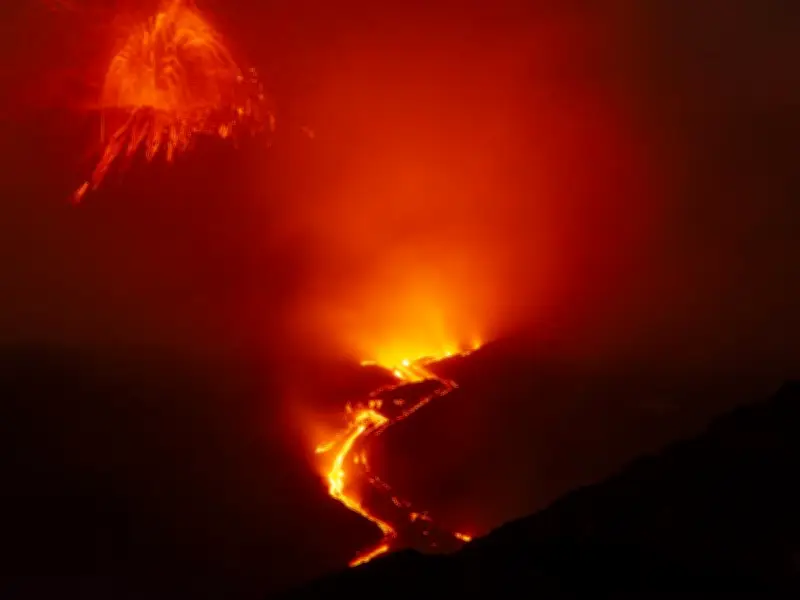
A red aviation alert has been declared and all flights at Catania Airport have been canceled following the eruption of Mount Etna in Sicily, which is spewing vast clouds of volcanic ash into the sky.
Eruption Details and Immediate Impact
According to local news outlet La Sicilia, Catania Airport has been compelled to cancel all incoming flights due to safety concerns as the volcano releases ash across Sicily. Flight monitoring service Flight Radar 24 is displaying all arriving flights at Catania Airport as canceled. Italy's flagship carrier ITA has announced that all its flights departing and arriving at the airport will be canceled or rescheduled in response to the ongoing situation, as reported by the Manchester Evening News.
Video shared on social media shows the active volcano on the eastern coastline of the Italian island, with ash reportedly beginning to rise from the volcano at around 7:45 a.m. local time on July 5, 2026, and intensifying shortly before 9 a.m.
Aviation Alert Raised to Red
The National Institute of Geophysics and Volcanology (INGV), through the Etna Observatory, has elevated the aviation alert from orange to red following summit activity. A red alert is issued when an ash cloud presents a potential hazard to aircraft. According to La Sicilia, significant volcanic ash emissions have triggered a warning that the phenomenon "is in full swing." Experts are continuing to monitor developments through visual and thermal cameras positioned on the volcano.
Background on Mount Etna
Mount Etna remains one of Europe's highest and most active stratovolcanoes, located on Sicily's eastern coastline between the cities of Messina and Catania. It exists in an almost perpetual state of activity, with its most recent eruption documented on January 1, 2026. During recent weeks, local reports observed a gradual lava flow from a fissure that formed around 3,000 meters at the base of the Northeast Crater. The INGV confirmed it detected activity in the upper Valle del Leone on June 26.