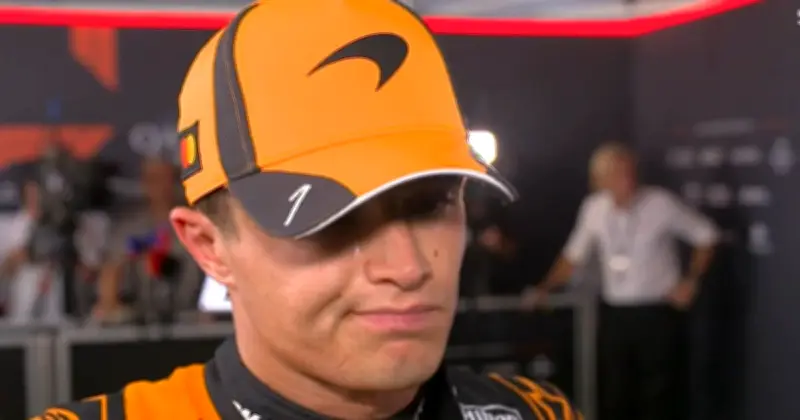
The biggest talking point from the Azerbaijan Grand Prix has been the crash at the safety car restart which took three drivers out of the race. Speaking in the TV pen minutes after the incident, defending champion Lando Norris suggested other drivers "shouldn't be in F1" and called for race bans for those who cause crashes at safety car restarts.
Norris did not name anyone, but he was clearly referring to Franco Colapinto, who was wholly responsible for the incident. Colapinto locked his front brakes entering the first corner too hot and took out both Norris and team-mate Pierre Gasly.
Colapinto's penalty
While Norris called for a more draconian punishment, Colapinto was given a 10-second time penalty for causing the collision. That will now be converted into a five-place grid drop for the next race, the Bahrain Grand Prix held in Malaysia next weekend, because he was unable to serve the original penalty due to the crash taking him out of the race too.
Whether Norris truly meant it, or if it was just because he was still seeing red about the crash, we do not yet know. At the time of writing, the McLaren driver has yet to make any public statements on his social media profiles – which is why tens of thousands of Colapinto's more unpleasant fans have instead commented their abusive messages under his most recent Instagram post, from 10 days ago.
Two ways to get a race ban
But Norris' request is grounded, a little, in reality. Reading through the FIA's penalty guidelines for stewards, refreshed for this 2026 season, you can see that there are two specifically-named rule breaches which can result in a driver being banned from the next race.
One of them is well-known: the accumulation of a dozen penalty points on a driver's racing licence over a 12-month period leads to an automatic one-race suspension. That has only happened once in F1 since the rule was introduced, back in 2024 when Kevin Magnussen missed the Azerbaijan GP after a collision he caused with Gasly took him over that threshold.
Very extreme cases
The other is also exceedingly rare. On page three of the penalty guidelines, it is made clear that race bans can indeed be imposed by the stewards when punishing a driver for causing a collision, though there are conditions. It must be a very serious incident for the stewards to even consider a race ban as a punishment. It must also happen in a race, rather than in a free practice or qualifying session. There is no provision for a race ban to be given as a penalty to any driver found guilty of causing a collision outside of a race, no matter the severity of the crash.
If such an incident happens in a race, the guidelines tells stewards that suspension from the next race is an applicable punishment for "very extreme cases", in which a driver has been deemed to have caused a collision "with apparent deliberate or reckless intent".
In this case, that clearly does not apply. While it was a particularly poor error from Colapinto, it certainly was not intentional. From the moment he locked his front brakes, he was a passenger. He also immediately apologised to Gasly and Norris for ruining their races, and also individually to Alpine staff in the team garage for throwing away what was likely to be a double points finish.
But, in general, a race ban is indeed not off the table for the most serious of crashes in Formula 1.