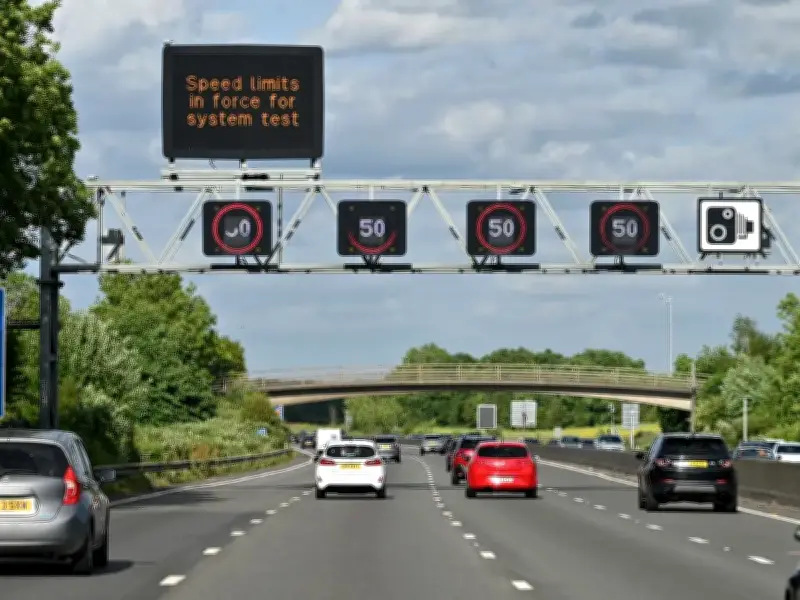
More than 36,000 speeding fines have been cancelled because of a fault with 154 speed cameras on UK smart motorways. The problem, which affects 12 motorways including the M1, M6, M5, M25, and M42, was discovered last October and has led to thousands of fines being dropped.
Police have refused to enforce more than 36,000 speeding tickets and have cancelled the fines, The Times reported. The issue stems from a “technical anomaly” identified last year with the cameras, causing a delay between camera activation and speed limit changes, meaning drivers were fined after the limit had changed and were not breaking the law.
Cameras Still Flashing but Fines Not Enforced
Officials confirmed the cameras are still flashing on the motorways, but police have lost confidence and are not enforcing the fines. National Highways, the government body responsible for England’s major roads, said it had identified 2,650 instances of “erroneous camera activations” since 2021. Police forces across the country were so concerned that they cancelled more than 36,000 ongoing and historic speeding cases related to the cameras.

The Times reported that more than ten months after the national issue was identified, the malfunctioning cameras are still undergoing testing by the Home Office and have not yet been approved for use. While they wait for approval, police forces are not issuing any enforcement notices for speeding motorists caught by the faulty cameras.
Affected Motorways and Leadership Change
In January, shortly after the camera flaws were exposed, Nick Harris resigned as chief executive of National Highways after five years in charge, with sources stating that he had lost the board’s confidence. The affected motorways with smart sections include the M1, M3, M4, M5, M6, M20, M23, M25, M27, M42, M60, and M62.
An independent review ordered by Heidi Alexander, the transport secretary, into the agency’s handling of the issue is due this summer but has yet to be published. Simon Williams, from the RAC, said: “It’s very concerning that this has not been fixed and that so many speeding drivers are not facing the consequences. We urge the government to address this as a matter of priority.”
Official Responses and Smart Motorway Background
A National Highways spokesperson said: “Speeding offences continue to be detected and prosecuted. A range of enforcement measures are in place to help keep road users safe. A fix for the impacted cameras is going through rigorous testing.”
In a statement at the time, the government said: “National Highways has confirmed an anomaly has been identified in the way some variable speed cameras interact with signs on some A roads and motorways. This has resulted in a very small number of people incorrectly facing enforcement action for speeding. The anomaly has meant there was at times a slight delay between cameras and variable speed signs, leading to some drivers being incorrectly detected as speeding after the limit had changed. As a result, National Highways have identified approximately 2,650 total erroneous camera activations on impacted roads since 2021, which is the equivalent of fewer than 2 a day. Anybody affected will be contacted directly by the relevant police force. They will be reimbursed and have points removed from their licence where relevant.”
Smart motorways use technology to manage traffic flow, with overhead signs informing drivers of speed limits and alerting them to accidents or hazards. There are three main types: controlled, dynamic, and all-lane running, each with different features regarding the hard shoulder and emergency refuge areas.