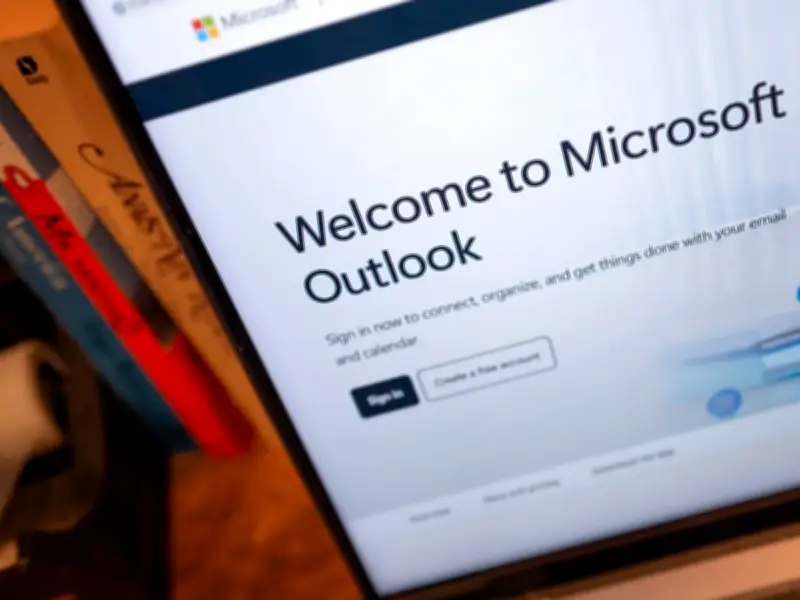
A global Microsoft outage has left users unable to access Outlook email, Teams, Copilot and other Microsoft 365 services since Thursday evening, with problems continuing into Friday morning. Reports of problems with Outlook on outage tracker Downdetector climbed to nearly 130,000, and outage reports reached 74 countries and territories in about an hour.
Experts warn of economic damage
One expert told Newspage the outage "could become one of the most economically damaging technology outages in history," while another warned that for small businesses, "a few hours without access can matter when there's a deadline."
At around 9am on Friday, Microsoft said in its latest update on the disruption to Microsoft 365 products that it was seeing "positive results for server stability." The group said on its status page: "We're seeing positive results for server stability after applying an upstream authentication/routing configuration component patch to a portion of our infrastructure. We'll continue to monitor its progress and are working to expand it to servers supporting active regions coming online."
"As of now, we are not aware of any malicious activity that is causing this incident. We will continue to treat this incident with urgency and priority until full resolution. Once mitigated, we will provide full details of the root cause, defence-in-depth repair items, and more within a post-incident Report."
Financial impact on businesses
Financial experts in the UK said the damage caused would be far-reaching and outlined how dependent the world had become on tech giants. Samuel Mather-Holgate, managing director and Independent Financial Adviser at Swindon-based Mather and Murray Financial, said: "This could become one of the most economically damaging technology outages in history. When Microsoft goes down, the world doesn't just lose its emails — huge parts of the global economy effectively grind to a halt."
"Businesses cannot communicate, transactions stall, productivity collapses and billions of pounds of economic activity could be disrupted. Yet wages, rents and overheads keep mounting. The financial losses could be astronomical and most businesses will recover little more than service credits from Microsoft."
"The really frightening part is how dangerously dependent we've become on a handful of technology giants. We've effectively handed them the keys to the global economy, with precious little backup. This isn't just an IT failure. It's a terrifying demonstration of how fragile our modern economy has become. And next time, it could be even worse."
Tony Sanchez, founder of Bridging Loan Directory, said: "For a small business, losing email can quickly mean losing time and opportunities. At BLD, we use it to receive stories, check facts with contributors and speak to advertisers."
"If that channel stops, work starts backing up. In property finance, the timing can be particularly awkward. A broker, lender and solicitor might all be waiting for a document or confirmation needed to complete a transaction."
"A few hours without access can matter when there's a deadline. The practical lesson is to have another way to reach people and access essential information. A phone call can keep a conversation moving, but it can't replace every document or approval. Small businesses don't need elaborate backup systems, but they do need a workable plan for when their main tools disappear."
Costs keep running, work stalls
Harvey Dhillon, founder and CEO at Zmartly, said: "For a small business, an outage like this means costs keep running while the work that pays for them stalls. The only compensation Microsoft's own terms allow is a service credit, capped at the affected service's monthly fee, and they rule out lost revenue."
"Credits aren't automatic: you have to claim by the end of the month after the incident, which here means December 31. Employers have to pay staff in full unless the contract allows unpaid or reduced-pay lay-offs, and docking pay without that right can be an unlawful deduction from wages."
"That's a bad deal for small firms: Microsoft's risk ends at a credit, while theirs runs to a full wage bill. For the wider economy, much of the work may be delayed rather than lost, but wages and rent fall due while invoices sit unsent, so the strain shows in cash flow. The risk in relying on a handful of tech giants is real, but it's cheap to cut. Keep customer phone numbers and a list of unpaid invoices outside the system that went down."
Riz Malik, Independent Financial Adviser at Southend-on-Sea-based R3 Wealth, said: "Friday the 13th spells doom for Microsoft and many of those that rely on their services. We don't know what and why, but most importantly, when this will be resolved, and Microsoft's statement isn't filling up with much confidence. This is a bad day for UK plcs productivity."
Tech experts react to Microsoft outage
Tech experts also outlined how the outage was a reminder of dependency on digital infrastructure. Marijus Briedis, chief technology officer at NordVPN, said: "Microsoft has confirmed there is no indication that this outage was caused by a cyber attack, but the disruption is a stark reminder of just how reliant we've become on digital infrastructure and how quickly everyday operations can grind to a halt when critical systems go offline. The scale of this outage highlights just how interconnected our digital world has become. When a major technology platform experiences disruption, the knock-on effects can spread rapidly across businesses, industries and essential services, affecting millions of people who rely on these systems every day."
"Technology platforms like Microsoft deliver enormous benefits in efficiency, communication and collaboration. But even the most sophisticated systems can experience unexpected failures. This incident demonstrates why organisations need to build resilience into their operations rather than assume the technology they depend on will always be available."
"This should be a wake-up call for every organisation. Businesses need to ensure they can continue operating when critical technology becomes unavailable, without relying entirely on a single system or provider. Secure backup communications, tested contingency plans and robust recovery procedures can make the difference between a temporary inconvenience and a major operational crisis."
Smitarani Tripathy, social media analyst at GlobalData, added: "The outage shows how a disruption to one service can quickly affect an entire working day, extending beyond email to collaboration, task management and AI tools. Influencers also highlighted potential implications for healthcare workflows, business communications and newsletter delivery, illustrating how dependent different activities have become on reliable access to digital platforms."
"With no confirmed cause or restoration timeline, speculation filled the information gap. For organisations relying on a single technology ecosystem, service reliability, alternative communication channels and clear, timely updates during an outage are critical to maintaining business continuity."