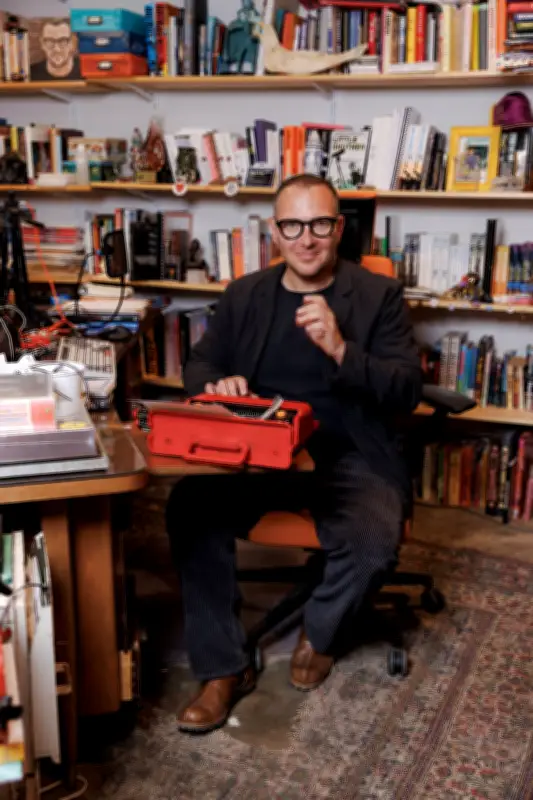
Cory Doctorow, the writer who coined the term 'enshittification,' has a stark warning about artificial intelligence: it will never deliver on its grand promises, but the bubble it has created could wreak global economic havoc. In his new book, The Reverse Centaur's Guide to Life After AI, Doctorow argues that the technology is a 'conjuring trick' that cannot and will not render humans obsolete.
The Reverse Centaur: Humans as Machine Assistants
Doctorow introduces the concept of a 'reverse centaur'—a human conscripted to assist a machine. He cites warehouse workers forced to urinate in bottles to meet algorithm-set targets, and future scenarios where lawyers on reduced wages check AI's legal research, or indie bands perform AI-generated hits. 'That, anyway, is the promise: AI is coming for your job, and it is coming for your kids’ jobs,' he says.
This vision is promoted by tech leaders like Elon Musk, who called AI the 'greatest threat to human civilisation,' and Sam Altman, who said it will 'most likely lead to the end of the world.' Dario Amodei, CEO of Anthropic, forecast that AI would view humans as animals—'cute to have around but ultimately a resource to be exploited.' Doctorow dismisses such claims: 'AI people claim they’re about to create God, by teaching words to a word-guessing programme. It’s grandiose.'
The $1.4tn Bubble and Its Dangers
Doctorow highlights the enormous investment fueling AI. 'When I wrote this book last year, it was a $700bn bubble. It’s a $1.4tn bubble now. The only thing worse than a $1.4tn bubble is a $2.4tn bubble, which we’re headed for,' he says. Nine US tech companies account for 35% of the entire US stock market valuation. He references Stein’s Law ('anything that can’t go on forever eventually stops') and Keynes ('the market can remain irrational longer than you can remain solvent') to underscore that bubbles inevitably pop.
The real threat, Doctorow argues, is not AI's capabilities but the economic fallout when the bubble bursts. 'We have a quarter of a century’s experience now with popped bubbles, and we use them as an excuse to do the austerity that our politicians dream of doing anyway,' he warns.
Why Bosses Push AI: Ending Co-Determination
Doctorow contends that the motivation behind AI hype is not technological progress but managerial control. 'The one thing a boss does not want is co-determination,' he says. 'Bosses are haunted by the knowledge that even though they fancy that they’re driving the car, if they don’t show up, everything continues to work. Whereas if the workers don’t show up, everything shuts down.'
AI promises to 'wire that toy steering wheel directly into the drivetrain of the car,' enabling products without designers, workplaces without workers, and hospitals without doctors. This fantasy, he says, is as old as the loom—replacing workers with machines. Even when automation fails, as with Amazon’s staff-less grocery stores that required three human monitors per shopper, the narrative persists.
Criti-Hype and the Fear Factor
Doctorow criticises 'criti-hype,' a term he attributes to Lee Vinsel of Virginia Tech, where critique feeds hype and makes doomsday scenarios seem plausible. He notes that government ministers openly discuss automating routine tasks, and warns against poor 'object permanence'—forgetting that past tech bubbles (cryptocurrency, the metaverse) also promised to revolutionise everything but didn't.
He also points to veiled threats in AI rhetoric, such as 'let us experiment, otherwise Chinese companies will get there first.' Doctorow says, 'You don’t want a Confucian God. You want an Old Testament God. Different smiting.' Ultimately, he believes the big talk serves to keep investment flowing.
Billionaire Solipsism and the Need for Regulation
Doctorow links billionaire behaviour to solipsism. 'You cannot make billions of dollars without hurting lots of people. And you can’t hurt lots of people without, in some sense, believing that they’re not really people,' he says. He mentions Musk’s ketamine use, noting that the drug can make the world feel like a figment of one’s imagination. 'I don’t think it’s a coincidence that Elon Musk calls the people who disagree with him NPCs, non-player characters, because he doesn’t think they’re really real.'
To address AI's harms, Doctorow argues that investors must be convinced that companies like Musk's xAI cannot make money. 'If we want to actually target the harm that Musk is doing, we have to make his investors think he can’t make money.' He calls for regulatory action, but warns that the bubble's burst will cause widespread economic pain.
Doctorow’s book, The Reverse Centaur’s Guide to Life After AI: How to Think About Artificial Intelligence Before It’s Too Late, is published by Verso (£16.99). He urges readers to focus on the real-world economic dangers rather than dystopian fantasies of robot overlords.