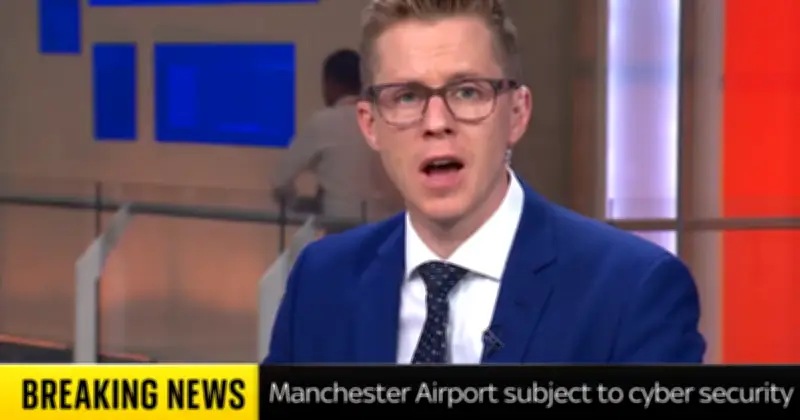
Sky News paused its programming on Thursday for a breaking update concerning a cybersecurity incident affecting the Manchester Airports Group, which operates Manchester, Stansted and East Midlands airports.
Journalist Gareth Barlow reported that the group had been subject to a cybersecurity incident by an unauthorised third party. Customer data obtained relates to car park, lounge and Fast Track bookings, and airport Wi-Fi signups at the three airports. The incident has not resulted in operational disruption, and operations remain unaffected.
No bank details stored
Barlow assured viewers that neither the Manchester Airports Group nor the systems used had stored customers' bank or payment details. Instead, customer email addresses, phone numbers, vehicle registrations and postcodes had been obtained.

The company said it was taking the matter extremely seriously and issued an apology for any inconvenience or concern caused.
Public reaction on social media
Following the announcement, viewers criticised the airport group on X. One wrote: "'No bank details taken is the new 'thoughts and prayers.' Still a total failure. How many times does this have to happen before these places actually spend money on proper security?"
A second tweeted: "Honestly, at this point, I'm more shocked when a big organisation doesn't get breached. What a joke." A third mused: "If people could sue for negligence over this, they'd think twice before asking for all the info they do." A fourth quipped: "Classic. Airports can charge you £40 for parking, but somehow can't keep basic customer data safe. Priorities, eh?"
Recent cyber threats to travellers
The incident follows a recent report from Microsoft revealing that Russian hackers had been hijacking hotel networks worldwide to spy on travellers. In a report published on July 31, the company urged travellers to stop using hotel Wi-Fi, with activity linked to Storm-2945, a sub-cluster of the Russian espionage group Midnight Blizzard.
Researchers stated that attackers had manipulated internet traffic on compromised networks, redirecting victims to fake Microsoft login pages or fraudulent browser and operating system update screens designed to deliver malware. Cybersecurity firm ReliaQuest confirmed that hotels and hospitality organisations across multiple US cities, as well as in India and Saudi Arabia, had been affected, with corporate travellers, particularly those using conference centres, appearing to have been primary targets.