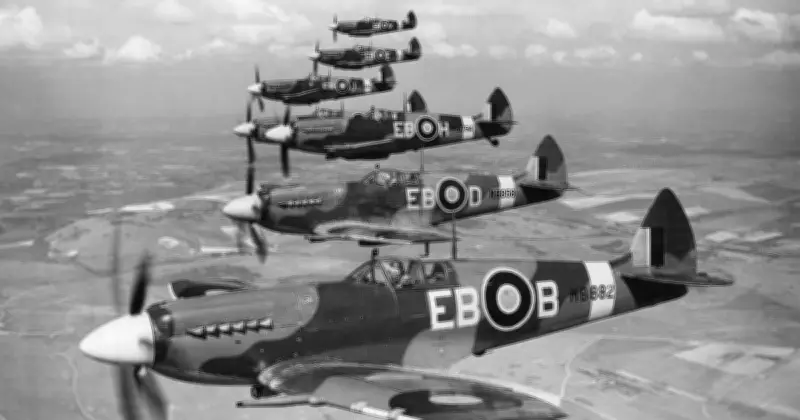
A new history book argues that Allied victory in the Second World War was far from inevitable, hinging on a series of pivotal battles where defeat remained a real possibility. In Battle: The Moments That Transformed Warfare from Ancient Greece to Ukraine, author Iain MacGregor explores how leadership, morale, innovation, subterfuge, timing and numbers decided the outcome of the greatest war in human history.
While retrospect suggests the industrial might of the United States, the manpower of the Soviet Union and the resources of the British Empire made Axis defeat inevitable, those living through it felt differently. The book identifies five campaigns that did not merely influence the war but transformed its direction, arguing that losing any one would have made the conflict immeasurably longer, bloodier and more uncertain.
Battle of Britain: Innovation as a Decisive Weapon
By the summer of 1940, Britain stood alone after the fall of France and the escape of the British Expeditionary Force from Dunkirk, which left most of its heavy equipment behind. Adolf Hitler believed victory was within reach, and the Luftwaffe entered the battle with battle-hardened pilots and combat experience from Poland, the Low Countries and France. Hermann Göring assured Hitler the RAF would be crushed in weeks.
What Göring failed to understand was Britain's revolutionary use of radar. Air Chief Marshal Hugh Dowding created the world's first fully integrated air-defence system, with radar stations detecting incoming raids, Observer Corps volunteers tracking them inland, and operations rooms directing fighter squadrons precisely where needed. For the first time in military history, information became a decisive weapon.
The Luftwaffe never achieved air superiority, making Operation Sea Lion, the planned invasion, impossible. Without Britain's radar network and Dowding's fighter-control system, there would have been no secure base for D-Day four years later.
Battle of Midway: Timing and Sacrifice
Six months after Pearl Harbour, Japan appeared unstoppable, having swept across the Pacific from Malaya to the Solomon Islands. Admiral Isoroku Yamamoto planned a trap at Midway Atoll to destroy America's remaining carrier force. But American codebreakers uncovered enough of the Japanese naval code to warn Admiral Chester W Nimitz, allowing him to position his carriers, the Enterprise, Hornet and the hastily repaired Yorktown, in ambush.
On the morning of June 4, US torpedo bombers attacked Nagumo's fleet and were slaughtered, yet their sacrifice distracted and delayed the Japanese. At the exact moment Japanese carriers were rearming and refuelling, American dive-bombers arrived overhead. Within minutes, Akagi, Kaga and Soryu were burning wrecks, with Hiryu following later that day. In less than an hour, Japan's carrier strength was destroyed and irreplaceable skilled aircrews killed. The Pacific War continued for three more bloody years, but Midway ensured Japan was fighting a war it could no longer win.
Stalingrad: Morale in the Ruins
By autumn 1942, the Wehrmacht's Case Blau offensive had reached the River Volga, and Stalingrad, stretching 20km along its western shoreline, seemed merely the final obstacle. After bombing and artillery bombardment, the Sixth Army entered the ruins to find perfect defensive terrain. Every factory, apartment block, cellar and staircase became a fortress in what became known as the 'War of the Rats' or 'Rattenkrieg'.
The city became a symbol as much as a military objective. Despite horrific casualties and German control of 95% of Stalingrad by winter, each day the city survived proved the Wehrmacht could be resisted. Operation Uranus on November 19, 1942, encircled more than 250,000 Axis troops, and the Sixth Army surrendered in February 1943. Strategically, Hitler lost a key formation and control of the war in the east; psychologically, across the Soviet Union, people began to believe they could win.
Operation Bagration: Deception on a Colossal Scale
Three weeks after the Normandy landings, on June 22, 1944, Stalin unleashed Operation Bagration against Army Group Centre, the most devastating defeat ever suffered by German forces in the Second World War. The Soviet Union had perfected maskirovka, strategic deception on a colossal scale, with fake radio traffic suggesting an offensive towards Ukraine and dummy camps designed to be spotted by German reconnaissance.
The Wehrmacht's intelligence concluded the decisive blow would fall against Army Group South and relocated armour, artillery and reserves away from the centre. Behind the front, Soviet commanders assembled more than two million men, moving only at night under rigid radio silence. German commanders remained convinced they occupied a relatively quiet sector. Hundreds of thousands of German soldiers were killed, wounded or captured. The battle was won before the first Soviet tank crossed the start line.
The Battle of the Bulge: Logistics and Time
By December 1944, the war in Europe appeared all but won, with Paris liberated and Allied forces on Germany's western frontier. Hitler's last gamble involved 250,000 fresh troops and refitted armoured columns, supported by the Luftwaffe's last reserves, launching a sudden offensive through the Ardennes to cross the River Meuse and capture Antwerp. Launched on December 16, it caught many US units unprepared, and a great bulge formed on Allied maps.
Hitler's plan contained a fatal weakness: time. German commanders needed key road junctions seized within days, bridges captured intact and fuel dumps taken quickly. Isolated American units fought desperate delaying actions, buying hours and days. Eisenhower swung an extraordinary logistical machine into action, rushing fresh divisions forward and pouring fuel, ammunition and supplies along crowded roads. When the weather cleared, Allied planes dropped vital supplies and attacked German columns suffering fuel shortages.
By Christmas, Hitler's timetable had collapsed. The Battle of the Bulge demonstrated an unavoidable truth about modern warfare: brilliant plans mean little if logistics cannot sustain them. The book, Battle: The Moments that Transformed Warfare from Ancient Greece to Ukraine, is published by Bloomsbury at £25 on October 8.