Europe's first operational geothermal lithium plant has launched in Cornwall, marking a significant step in the UK's efforts to challenge China's dominance in the global lithium market. Geothermal Engineering Ltd (GEL) opened the United Downs Deep Geothermal Power project on the United Downs Industrial Estate near Redruth in February, after more than a decade of development and drilling. The facility drills around 5km deep into the area's naturally hot granite, pumping hot brine to the surface, cooling it, and passing it through a modern lithium-extraction facility.
First Sellable Lithium in the UK
The mineral is essential for powering lithium-ion batteries used in smartphones, laptops, and electric vehicles (EVs). It is also used as a fluxing agent for welding and to lower melting temperatures in glass and ceramic production. Demand for lithium is expected to increase by 1,100% by 2035. Since the plant launched, engineers have been working to meet international specifications for lithium, achieving a breakthrough in August that allows them to sell the extracted lithium.
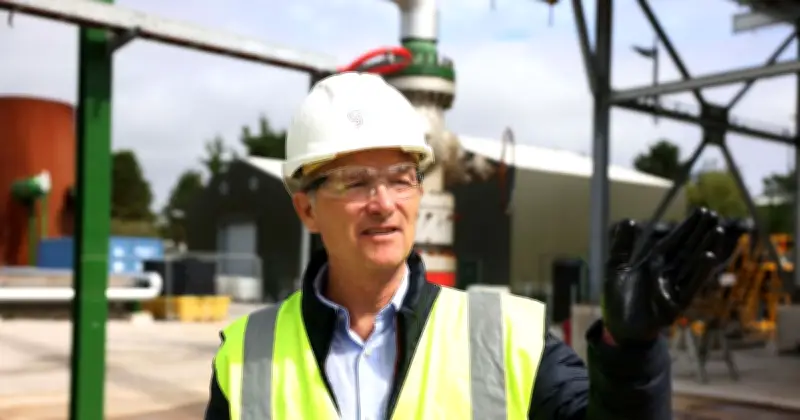
GEL Chief Operating Officer Tony Wilson told the Daily Express, "We have opened the UK's and Europe's only lithium extraction plant, which produces lithium carbonate from deep lines. Since then, we've been refining the product to the stage where you can sell it." He added, "That will be the first lithium sold anywhere in the UK. This plant can produce up to 100 tonnes a year, but it's still early days."
Three-Stage Extraction Process
Mr Wilson explained that lithium extraction at the plant involves three main stages. "The first is conditioning the brine, which means making sure you have the right pH range, that you haven't got any contaminants in it, filtering it, and generally concentrating the lithium in it," he said. "The second stage is the actual attraction of the lithium itself out of the brine, which is the tricky bit. How that works is the lithium, which is in a solution, sticks to a resin in a container, and once it sticks to that resin, you get rid of all the other liquid, and then you wash it off with water."
"Once you've done that, you've got lithium chloride, which is a solution. You then have a carbonation phase where you get the lithium out of the water, and it becomes a white powder."
Challenging Global Producers
The global lithium production market is currently dominated by China, Chile, Argentina, and Australia. Mr Wilson highlighted the ecological, economic, and sustainability challenges faced by each major producer. "In China, they import a rock called spodumene from Australia, where around 1% of the rock on a ship is lithium," he explained. "The rest of the rock is probably used to create Chinese military islands or fund other projects that we don't know about. That's massively environmentally unfriendly."
South American producers extract lithium from underground saltwater pools beneath vast desert plains using a slow solar-evaporation method, which takes up vast amounts of land and can be time-consuming. "Whereas our process takes up no land, we use zero water because we recycle our own water, and we use water to wash the chemical off the resin, so there are very few chemicals involved," Mr Wilson said. "This is as clean as you could possibly get."
Future Expansion and UK Targets
Statistics show that China produced around 62,000 metric tonnes of mined lithium in 2025, while the UK aims to produce 50,000 tonnes domestically by 2035. "This plant can produce up to 100 tonnes a year," Mr Wilson said. "Our next plant which we're currently raising money for (one same industrial estate) will be able to produce 1,500 tonnes a year. So you start becoming a bit of a global player at this figure. If you can reach 10,000 tonnes a year, then you're a major worldwide player."
He continued: "The UK's target for lithium is 50,000 tonnes domestically produced by 2035. So, for each one of our three plants, which we hope to open by the early 2030s, there will be 10,000, so we hope to produce over half of this figure." It was recently confirmed that GEL would invest around £43 million in a second extraction facility in Cornwall, creating nearly 50 direct jobs and supporting a further 80 across the supply chain. However, the company is calling for further support to create an efficient UK supply chain.
"If you look at some other countries, the government just piles money into things like this," Mr Wilson said. "For the same reason, we want to domestically produce lithium so that we don't want have to import it from China. We really want to have a UK supply chain for lithium - from the start all the way through to the finish. We're massive supporters of it all being about the UK, but it's very difficult as you're starting a new industry from scratch."
Cornwall's Mining Heritage
Business Secretary Jonathan Reynolds said GEL is "helping to write its next chapter in unlocking the South West's industrial potential" and dubbed the new site a "big step towards building our industrial resilience." The facility has enabled Cornwall to remain deeply connected to its rich mining heritage, which spans thousands of years.
"It's the granite we have here. Around 5km underground, where there's deep radioactivity, there are these wonderful and rare chemical elements," Mr Wilson explained. "We have one of the best concentrations of lithium in the world because it's so deep. The concentration improves as you go down, which we want to exploit." While granite containing lithium exists in other regions of the UK, it is often found at greater depths, making drilling difficult and risky. "If you're drilling through seven or eight kilometres, you have all sorts of risks starting to creep in just because of the depth," Mr Wilson added. "So you could do it elsewhere, but Cornwall is the obvious place."
Mining in Cornwall dates back over 4,000 years, beginning with Bronze Age tin streaming around 2100 BC. The county later became a global powerhouse in copper and tin production before foreign competition in the late 19th century caused prices to crash, forcing miners to migrate worldwide. The King Edward Mine Museum, located just seven miles from the United Downs project, pays homage to this history. Tour guide Graham May said, "Cornwall was a huge player in the Bronze Age. Bronze is made from tin and copper, and they're the two metals we've got in abundance. They reckon Cornwall supplied about a third of the world's tin in the Bronze Age, which, if we were a country, would have been an achievement, but for a county to do it is absolutely astonishing. Nowhere else in the UK compares."
The release of Poldark in 2015, which portrayed 18th-century Cornwall and its reliance on tin and copper mining, helped bring greater attention to the county's mining heritage. "A lot of people come because of the Poldark series," Mr May said. "They can stand where Aidan Turner stood! People come from all over the world; it's what we're known for. It's amazing how many people have got relatives who were miners." The museum also offers visits to the oldest complete turn-of-the-century tin mill site in Cornwall, a UNESCO World Heritage Site, which serves as a training centre for mining students.
South Crofty, the UK's last working tin mine, located between Camborne and Redruth, closed in 1998 following a sharp decline in global tin prices, ending around 4,000 years of continuous tin mining in Cornwall. Recent projects, however, have reignited the county's historic connection with the industry, with GEL planning to open further plants across Cornwall.