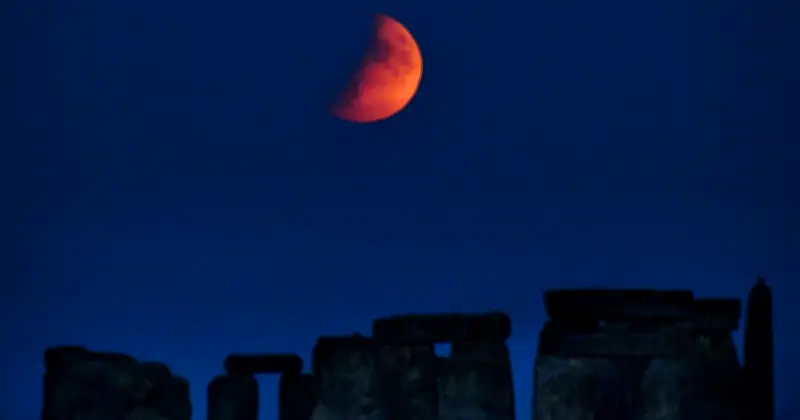
A deep partial lunar eclipse will be visible from the UK and Ireland in the early hours of August 28, with around 93% of the Moon covered by the darkest part of Earth's shadow at its peak.
This week, a partial lunar eclipse will occur as the Moon passes through Earth's shadow. Only part of the lunar surface will enter the dark central region known as the umbra, while the rest remains within the lighter outer shadow, or penumbra. Although the event falls just short of being a total lunar eclipse, the large portion of the Moon immersed in Earth's darkest shadow will make for a striking sight in the night sky.
What is a partial lunar eclipse?
A partial lunar eclipse occurs when the Moon moves through Earth's outer shadow, known as the penumbra, while only part of it enters the much darker central shadow, called the umbra. As a result, a section of the Moon appears noticeably darkened, while the remainder stays illuminated, creating the distinctive "bite" effect seen during this type of eclipse.

During the eclipse, the shadowed section of the Moon may also take on a reddish hue, a phenomenon often referred to as a "Blood Moon".
How and when to see it in the UK
The partial lunar eclipse will be visible across the UK and Ireland during the early hours of Friday morning, although viewing conditions may become more difficult as the event unfolds because the Moon will sink lower towards the horizon. To get the best view, observers should find an elevated spot with an unobstructed view of the south-western sky, allowing them to watch as much of the eclipse as possible before the Moon sets.
No specialist equipment or protective eyewear is needed, making it perfectly safe to observe with the naked eye, just as you would a full Moon. However, as with any astronomical event, visibility will ultimately depend on the weather, and cloud cover could prevent some people from seeing the eclipse.
The penumbral phase begins at 2.23am BST, marking the point when the Moon starts entering Earth's lighter outer shadow. The more noticeable partial eclipse will start at 3.33am BST as the Moon moves into the darker umbra. The event reaches its maximum at 5.12am BST, when around 93% of the Moon will be immersed in Earth's deepest shadow.
Observers in the UK and Ireland will not be able to see the eclipse through to its conclusion, as the Moon will set below the horizon before the event ends. In London, moonset is expected at around 6.15am, although timings will vary by location, while the partial eclipse itself is due to finish at 6.51am BST.
What to expect from the eclipse
During a partial lunar eclipse, the section of the Moon that passes through Earth's darkest shadow can take on a reddish or bronze tint. This striking effect is caused by sunlight being filtered through Earth's atmosphere and redirected onto the lunar surface, allowing warmer red tones to reach the Moon while other colours are scattered away.
The eclipse will be visible not only across the UK and Ireland but also from large parts of Europe, Africa, and the Americas. Depending on the observer's location and time zone, some regions will see the event unfold during the late evening of August 27 rather than in the early hours of August 28.