Aqueduct Racetrack, New York City's last thoroughbred racetrack, closed its doors for good on Sunday after 132 years of operation. The final day of racing drew 6,866 spectators, who filled the grandstand for a poignant farewell to a venue that had been a fixture of city life since the Gilded Age.
The New York Racing Association (NYRA) is consolidating downstate racing at the newly rebuilt Belmont Park in Elmont, Long Island, scheduled to reopen in September after a $455 million redevelopment. The move reflects economic realities in a sport reshaped by off-track and online wagering, but for many, Aqueduct's closure feels like the loss of a neighborhood institution.
Aqueduct's History and Significance
Aqueduct opened on September 27, 1894, drawing about 700 spectators and eight bookmakers for an unsanctioned six-race card. Built on former farmland in Queens, it lacked the polish of elite racecourses but evolved into one of the sport's most recognizable venues. Champions like Man o' War, Secretariat, and Seabiscuit raced there, and it hosted the Belmont Stakes for five years in the 1960s, the Breeders' Cup in 1985, and Pope John Paul II's Mass in 1995.
Former jockey Richard Migliore, Aqueduct's all-time leading rider with 2,238 victories, said: "Aqueduct has always been New York City's racetrack. It's part of the boroughs. It's in Queens." He described its gritty atmosphere: "There's a grittiness to Aqueduct that you don't get at Belmont, certainly don't get at Saratoga. At Aqueduct, you get the real fans. They're hardcore."
Final Day Celebrations
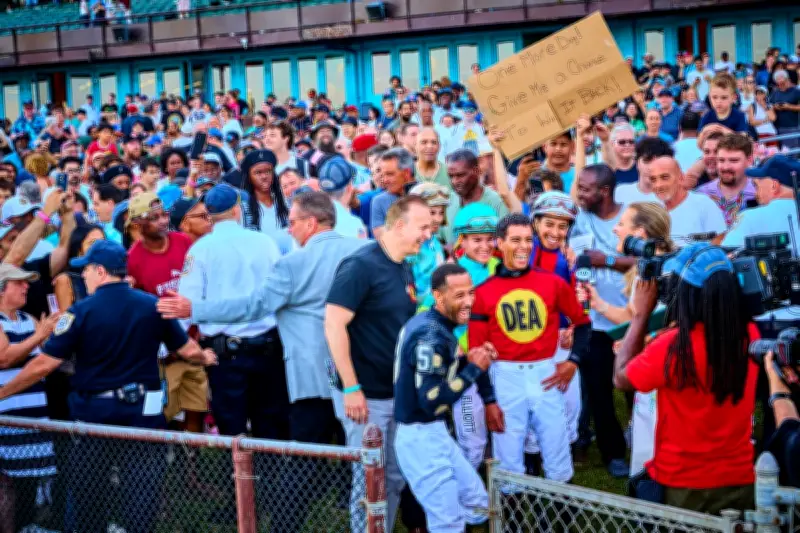
On Sunday, the track pulsed with energy. Longtime patrons, first-timers, and lapsed fans queued hours before the first post. A four-piece band greeted them, retired track announcer Tom Durkin returned for one final call, and lines snaked through the concourse. The final race, a $100,000 starter allowance, was won by Assume Nothing, an 8-1 shot ridden by Jaime Rodriguez, paying $18.42 to win.
After the race, jockeys lingered by the paddock, posing for photos and embracing fans. Kendrick Carmouche, a fan favorite with over 1,000 wins at Aqueduct, hopped the rail to join spectators. Stanley Wint, a 69-year-old Canarsie resident who had been coming for over 30 years, said: "I'm going to miss this place. Just the atmosphere and the people, the down-to-earth people."
Economic and Social Impact
Aqueduct's closure ends an era for New York City's last great third space. For generations, it served as a communal gathering spot where retirees, immigrants, and workers from all walks of life came to gamble and socialize. The track also played a vital role during crises: after Superstorm Sandy in 2012, its parking lots became a Red Cross staging area, and during the pandemic, it hosted a vaccination center that administered over 300,000 doses.
Robert Bourget, a 75-year-old retired horseman who visited for 62 years, noted the shift to off-track betting: "Now the handle isn't here. People sit at home in a recliner with a cocktail and make bets on their phones. If they do a million on track, they're doing four million off track."
Future Redevelopment
Under the legislation funding Belmont Park's redevelopment, NYRA relinquished its lease on the roughly 100-acre Aqueduct site. New York Governor Kathy Hochul's administration plans a mixed-use redevelopment of housing, retail, community facilities, and open space. Hochul said: "The Aqueduct site represents a significant opportunity, and through this community-driven process, we will ensure its future reflects the immediate priorities of Queens residents."
As the grandstand emptied, several hundred people lingered on the asphalt while "Love You 'Till the End" by the Pogues played. Migliore reflected: "Aqueduct's woven into the fabric of my life. It's where it all began for me." Bourget added: "It's sad to think. It's just like everything else in America. They can ruin something people don't even realize they have."