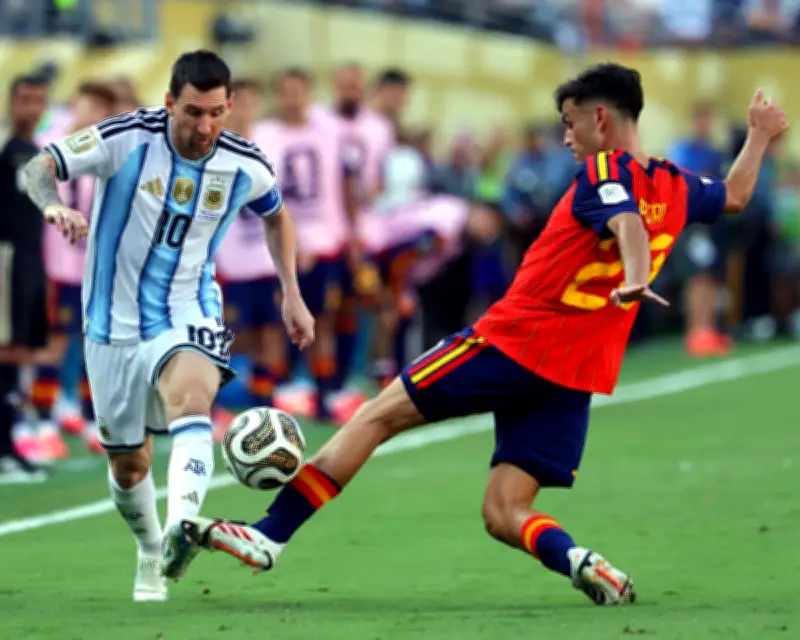
Spain won the 2026 World Cup final 1-0 against Argentina, with a substitute goal from Ferran Torres in extra time securing victory. The European champions maintained their composure against Argentina's physical approach, cutting off supply to Lionel Messi and dominating possession.
Argentina's physical tactics fail to disrupt Spain
Argentina tried to kill the spectacle by making it a physical battle, but Spain refused to take the bait. The Slovenian referee Slavko Vincic allowed lenient fouls, with Alexis Mac Allister escaping an early booking for a foul on Dani Olmo. The pitch was not conducive to flowing football, and Argentina's spoiling tactics created one of the most tedious World Cup finals. However, Spain stayed calm and trusted their process.
Spain's pressing stifles Argentina's buildup
Spain's expertly coordinated pressing stifled Argentina, who had problems passing out from the back, particularly from the left. Enzo Fernández and Mac Allister were outplayed in midfield, forcing coach Lionel Scaloni to make a half-time substitution: Nico González made way for Leandro Paredes. The change did not alter the mood. Paredes was booked for a needless barge on Rodri and was lucky not to be sent off until after full-time. Argentina were caught out by their own game when Fernández was sent off for two silly bookings at the end of normal time.
Overreliance on Messi and exhaustion prove costly
Argentina are a slow, ageing side and had already played two rounds of extra time. Their legs were heavy, and they lost both starting centre-backs to injury: Lisandro Martínez and Cristian Romero went off early, depriving Argentina of another outlet. Their reliance on Lionel Messi also hurt them. Spain cut off the supply to the 39-year-old, who was never able to find space or shake off more than one Spanish player. There was no repeat of the crosses that hurt England in the semi-final. Messi stood in the middle but could not hold the ball up; he was a passenger. Scaloni removed Julián Álvarez, who might have worried Spain more with his ability to run the channels.
Emi Martínez's heroics almost force shootout
Álvarez's departure was the cue for Scaloni to bring on Marcos Senesi and switch to a back five. Argentina's expected goals (xG) was 0.00 until conceding forced a desperate late flurry, increasing only to 0.22. It took until the 117th minute for Argentina to muster their first shot: Messi's hopeful long-range effort deflected wide. Spain, defending as a team, were unruffled. Argentina had 34.9% possession and six touches in the Spain area. Spain had 20 shots to two, but poor finishing and inspired goalkeeping threatened to leave them at the mercy of a penalty shootout. Emi Martínez made 12 saves, the most by a goalkeeper in a World Cup final, including a leap to push away a Lamine Yamal free-kick. Yet it was not enough.
De la Fuente's substitutes make the difference
Spain were deserved winners from a moral and tactical perspective. Rodri, excellent as the No 6 before making way for Martín Zubimendi in extra time, nullified Fernández. Coach Luis de la Fuente's substitutions were spot on: Pedri was incisive after replacing Fabián Ruiz, and Nico Williams came on for Álex Baena to stretch the play on the opposite flank. Now Spain had speed down both wings, and the pressure told. Mikel Merino should have scored at least once after coming on, but eventually a goal arrived. Pedro Porro sent in a deep cross from the right; Williams beat Nahuel Molina and pulled the ball back for another substitute, Ferran Torres, to score the winner.