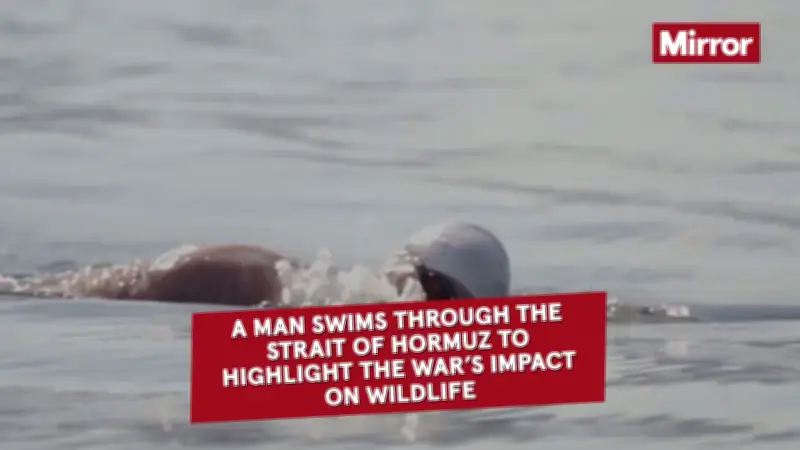
Plymouth endurance swimmer Lewis Pugh, 56, has completed a 9.3-mile swim in the Strait of Hormuz, one of the world's most dangerous waterways, as tensions mount in the US-Iran conflict. The former maritime lawyer and UN Patron of the Oceans is believed to be the first person ever to complete a long-distance swim in the strait, which is heavily mined.
A Swim Amid Conflict
Pugh, who broke the swim into three days and finished on November 18, described the dangers he faced. "You've got drones up in the sky, you've got missiles, you've got fighter jets. In the water, you've got oil pollution. Under the sea, you've got sea mines. I saw a missile strike and a gas tanker engulfed in flames. I was keen to get out of there and go home," he said.
The Strait of Hormuz became a conflict zone in February after the US and Israel launched strikes on Iran, who retaliated by shutting the vital waterway. Roughly 20% of the world's oil and liquefied natural gas is shipped through the strait, where maritime data shows reported attacks on vessels have reached their highest since the war began, as Iran tightens its grip on it.
Environmental Devastation
Pugh, who is going to meet world leaders to urge them to stop the war, said the conflict's impact on nature is severe. "I'll be going now to meet world leaders to urge them to do everything they can now to stop this war. We will never have peace if we destroy the very foundations of life on Earth," he said.
He added: "I saw first-hand the damage that this is continually doing. War has such a long-lasting impact on the environment. Each week now, vessels are being hit. And oil pollution, chemicals and toxins are just going straight into the sea."
"There have been significant oil spills in the region. Oil gets into mangrove forests, or covers coral reefs. When fish ingest it, it gets into the food chain. Somebody could eat that fish, not realising it's got those toxins inside it," he said.
Astonishing Scenery and Wildlife
Setting out from Oman's Musandam peninsula and taking a route from Musandam Island on November 16, Pugh swam to the Cape of Hormuz at the peninsula's northern tip, snaking through the dramatic landscape. He described the contrast between the conflict and the natural beauty.
"I take a breath to my right and I'm just seeing these convoys coming past me. But I breathe to the left, and I'm looking at the mountains of the Musandam Peninsula," he said. "You've got these fjords and big islands, which are just utterly amazing. On the other side, on the Iranian side, you've got incredible mangrove forests. And just around the corner, there are some of the most incredible coral reefs in the world, in the Gulf of Oman."
"Dolphins were coming up and wanting to swim with me. There are turtles in the water, and an osprey that would swoop down, just grabbing a fish, and then taking it up onto a rock to eat it. You've got these two sides. It couldn't have been more astonishing," he said.
Close Encounters with Attacks
The swim was Pugh's most extreme yet. On day one, an oil tanker was struck by a projectile about 2.5 miles away. "These convoys on the Omani side, the south side, are trying to keep as far away as possible from the Iranian side to avoid being attacked. A tanker, within 30 minutes of me starting, got hit. It was two immense bangs. It shook the water. Fighter jets are coming overhead. I immediately realised we needed to get out of here quickly. We went straight back onto land to assess the situation and decided to try again the next day," he said.
Setting off on November 17 from the same spot, he soon saw flames rising above a headland. "Again, a convoy is coming past. This time, an LPG carrier got struck. There was an island between us and the vessel and a missile struck it," he said. "I can see this smoke coming from behind the island and then, suddenly, above the island, which is 150 meters high, I see flames, fireballs, just shooting up into the sky over the back of the mountain."
Protected by the island between them, he stuck close to the shore. "You have this mind blowing contrast between the vessel that's just been struck, these dolphins, which just always want to swim with you, and the beautiful cliffs," he said. "It looks half like something out of Apocalypse Now and half like something out of a David Attenborough documentary. To get back to the harbour, we went past the vessel. We came around the corner and it was just an inferno. Even the water around the ship was on fire."
"The smell of the chemicals - and because of the way the wind was blowing - all that stuff was just going straight up that fjord where, just two days beforehand, I'd been swimming with dolphins. My immediate thought was for the seafarers. The terror of being on a gas carrier when a missile hits it," he said. "Also, imagine being in the convoy and realising that at any moment you could be next. These are civilians. These are merchant ships. There was no naval escort. They're just doing their job."
Pugh, whose swim was funded in part by the Lewis Pugh Foundation, which he launched in 2016, and partly by two generous donors, described his final stretch. "In the distance, we could hear fighter jets and loud explosions," he said. "People ask me if I was frightened, but we were careful and prudent. I had a safety kayaker next to me. I had a very experienced boat crew next to me. But in a conflict zone, you can never have 100% safety."
Pugh, married to dog trainer Antoinette Malherbe, who he met at school, and a dad-of-two, said his childhood shaped his attitude to war. "My father was a doctor in the Royal Navy and our home in Plymouth was actually inside the Naval Hospital," he said. "One of my memories as a little boy was seeing soldiers and sailors without limbs. Some had been injured in the Second World War, some as far back as the First World War. War has a very long-lasting effect."
"There are people who are being injured today in this Iranian conflict who will need medical care throughout their lives, maybe in 50 years' time or even longer. It's exactly the same when you damage nature. The impact on nature could well outlast all of us," he said.