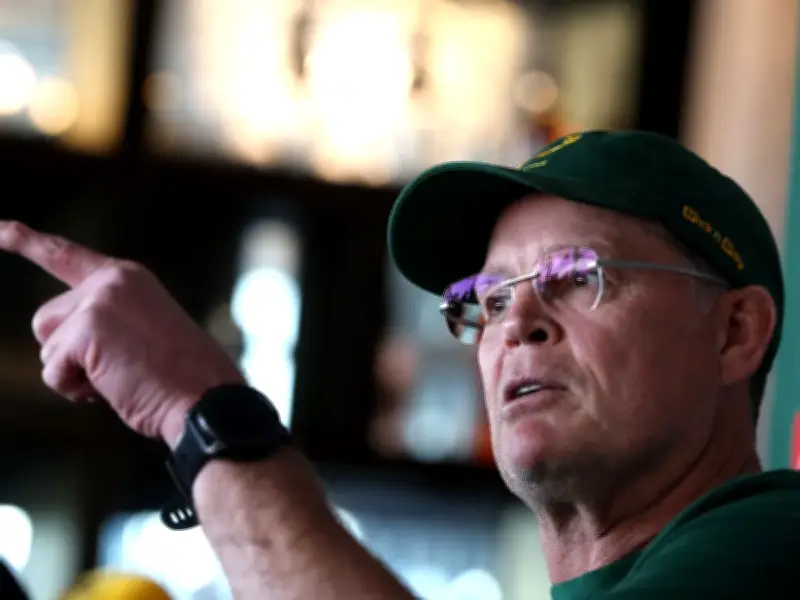
Springboks head coach Rassie Erasmus has been suspended for six Test matches with immediate effect, after questioning whether referees are "match-fixing".
The ban has been imposed following an interview by the two-time World Cup-winning coach at the start of this week, following last Friday's Nations Championship defeat to France in Paris. In that press conference, the South Africa head coach claimed that officials had missed 17 knee-drop tackles on his players, suggested that acts of foul play are not being picked up in what he called a "manipulation of the game", before adding that he felt referees were showing more leniency to sides from the northern hemisphere.
World Rugby's swift response
World Rugby have acted swiftly, having committed earlier this year to clamping down on comments that call officials' integrity into question. As such, Erasmus has been banned for six matches - meaning he will miss the Nations Championship finals weekend in London later this month.
This is not the first time Erasmus has been banned by the global governing body. Having targeted Australian referee Nic Berry during the 2021 Lions tour, he was given a two-month ban from all rugby involvement - while he was kept away from the Springboks on matchdays for 10-and-a-half months.
Statement from World Rugby
In a statement, World Rugby said: "An independent panel imposed the sanction under World Rugby’s Match Official Abuse Sanction Process. Introduced in July 2026 with national member unions, competitions, International Rugby Match Officials (IRMO) and International Rugby Players’ Association (IRPA) support, the process runs in parallel with Regulation 18 and provides a clear, consistent framework for addressing public criticism of match officials, particularly comments that may undermine the integrity of individuals or the sport, or fuel online abuse.
"In line with the process, the panel applied the Match Official Abuse decision making matrix. This is an objective test and assesses the comments against a defined list of characteristics. The outcome of that assessment determines the appropriate outcome, which ranges from no further action up to an automatic suspension."
"Having considered the comments which related to the match TMO, the standing Match Official Abuse committee, chaired by senior officer Adam Casselden SC (Australia) determined that the threshold for serious misconduct had been met. The panel determined that the comments suggest that match officials acted with bias/prejudice or deliberately influenced the outcome of a match, and when the conduct is considered as a whole a reasonable person would conclude that the conduct constituted an unacceptable attack on the credibility and competence of the match officials.
"In respect to the sanction, the panel determined that the conduct clearly amounts to disrespecting the authority of the match officials by impugning their integrity. Therefore, the panel reviewed a number of elements of the commentary including the timing and reach of the statements, combined with the allegations of bias or bad faith, and found that the comments attracted a six-match automatic suspension."
Scope of the suspension
The suspension applies with immediate effect, applies to international matches, and includes any match-day involvement including coaching, direct or indirect contact with team management or players on match days; entering the stadium, coaches’ box, playing enclosure, technical area, approaching and/or communicating with match officials on match day; engaging in any ‘feedback’ process with match officials; and engaging in media duties during the suspension.
"Respect is fundamental to rugby, and match officials are central to the sport. Protecting their wellbeing and integrity, and their right to perform without abuse or intimidation, is a responsibility World Rugby and unions take seriously. Coaches, players, unions and everyone in the game must uphold these standards."
"Robust, respectful debate is natural, but teams have access to well-established and supported channels and protocols for raising officiating matters before and after matches. Challenging a decision is not the same as questioning an official’s integrity or making comments that expose them to personal abuse. Erasmus is entitled to have the matter referred to a full misconduct hearing."
Context of the ban
Back in July, World Rugby launched a new match officials abuse disciplinary process in an effort to "reduce comments which often are the basis of the unacceptable increase in abuse and threats towards match officials". Sanctions ranged from a warning to a fine and suspension. In the summer, Italy’s head coach Gonzalo Quesada was hit with a one-match ban for saying "the refereeing team was partly to blame for the score in their defeat to New Zealand.
In Erasmus' press conference on Monday, ahead of this weekend's match against Ireland, he had predicted Irish fly-half Sam Prendergast would escape punishment for a hip-drop tackle against Fiji. Referring to the 17 knee-drop tackles he claims went unpunished, Erasmus said: "The TMO doesn’t come in once. I’m not saying he’s wrong. I’m saying if he didn’t see it, it must be a technology problem. If he saw it and he decided not to act on it, is that not match-fixing? Is that not interfering with the outcome of a game if you see this injury that happens there?"
Erasmus added: "If the TMO didn’t see it, maybe then technology must be better. If he saw it and he ignored it, what does that boil down to? Manipulation of the game or the result, or injured players getting injured." Erasmus added he was not making an "accusation" about the officials, and acknowledged there was "a drive in World Rugby that the TMO should stay out and not interrupt the game".