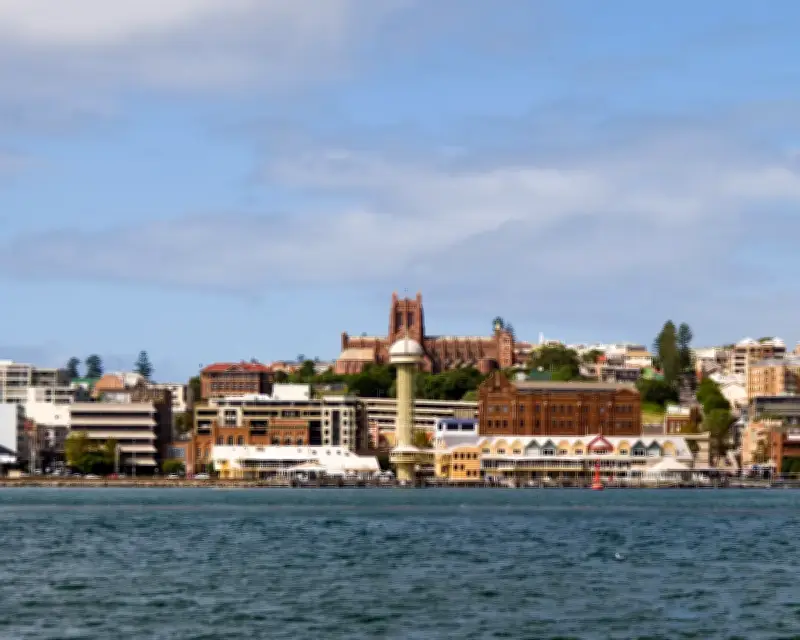
More than 80,000 people saw musician Daniel Arvidson sing about Newcastle's "big penis" at the city's foreshore in October 2001. The unfortunately shaped Queens Wharf Tower, which featured in the song, was torn down in 2018, reportedly because it had become an "embarrassment to the city" and needed to go in the name of urban renewal.
Arvidson's song about Newcastle and its dubious local landmarks found its way onto local radio that year, as the Newcastle Knights were making a run towards a second NRL premiership. "The station said: 'we'll play it every time the Knights get up' and then the Knights just kept on winning," says Arvidson, who sang the Newcastle song three times at a civic reception for the victorious team.
A city transformed
The lyrics, gleefully chanted by most in the crowd, catalogued the unvarnished parts of a working-class city: inside jokes, local tropes, 3am hamburgers, pub fights, snogging in the car park at the Strzelecki lookout, and "orange shit in the sky" from the glowing steelworks at Mayfield. One verse described getting out at Civic station, seeing the "big penis" and wondering where he was.
The nearby Civic station was left stranded a few years earlier, when the old heavy rail lines were controversially ripped up. Most of the pubs in Arvidson's song have since been shut or bulldozed. Islington and Carrington ("lock your doors") have gentrified and become trendy. East End ("party, party, party") residents banded together a few years back to voice concern about the noise from a Supercars race.
As the Newcastle Knights prepare for a first NRL grand final in 25 years, they will represent a city that in many ways looks and feels very different from the rough-around-the-edges place Arvidson sang about in 2001. The first wave of Knights successes came against a backdrop of uncertainty about what a post-industrial future might mean for the steel city. Two decades on, for better or worse, working-class Newcastle is now safer, more confident and outward-looking; also more expensive and exclusive.
"I deliberately wanted to tap into the locals' experience, for people who have lived here all their lives, just to paint it in from a place where only they're going to relate to," Arvidson says. "But those experiences we're talking about, they don't exist any more."
Steel city takes centre stage
For a brief moment about the turn of the millennium, grungy Newcastle might have seemed like the centre of the universe. Three teenagers became internationally famous in 1994, while still at Newcastle high school, with a song written in the bedroom of a house in Merewether. The frontman of the band, Daniel Johns, shared his surname with two other young local blokes, Matthew and Andrew, who came up through the ranks at the Knights. Within a few years, they would all be superstars.
Perhaps in the same way that struggle can inspire great art, the Newcastle of the 1990s was a community shaped by uncertainty and tragedy, a city forced through natural disaster and economic deregulation to reckon with its place in the modern world. Three days after Christmas in 1989, the Newcastle earthquake violently remodelled the city. The Newcastle Workers Club building collapsed, killing nine people. The quake left physical scars – there were an estimated 50,000 buildings damaged – and emotional ones.
In April 1997, BHP announced that the Newcastle steelworks – the town's largest employer, and at one point among Australia's largest – would close. Steelmaking had been central to Newcastle's identity and for many 1997 was a time of existential worry about what the town would become.
The community angst seemed to heighten the emotion around the football side's upstart run to the grand final against Manly. The owner of a home around the corner from the stadium painted the weatherboards red and blue. Those unable to get tickets lined the freeway to wave at the team bus.
"There was a lot of uncertainty in the community," says Craig Hamilton, a veteran sportscaster from Newcastle who called the 1997 grand final from the sideline. "I think there was a hope that the Knights might win, they were huge underdogs in that game. There were a lot in Newcastle who were just happy the team had made the grand final. But to win it changed the dynamic. What the Newcastle Knights did in winning that first grand final was to lift the whole town out of any doom and gloom they may have been feeling."
From boom to bust
Ask any Novocastrian now about 1997, and their defining moments are Darren Albert's last minute try, Andrew Johns skateboarding shirtless down King Street, Matthew Johns declaring on morning television that the victory was "better than Lego", and The Screaming Jets in Civic Park. The vivid memories of 1997 have overlaid much of this week's grand final hype.
There's a missing bit to this story: 25 often fraught years for the football club, and the city. On-field success became rarer, and the sale of the Knights to the coal baron Nathan Tinkler must have seemed like a good idea at the time. Then Tinkler went bust, leaving a trail of debts across town and the team at a low ebb.
The community seemed unable to decide on anything remotely contentious about the future of the city. The saga of the heavy rail line rumbled on for more than a decade, until it was finally cut and replaced with trams. Rosemarie Milsom, the founder of the Newcastle writers festival, began discussing the idea in about 2012, when there were "many, many empty shopfronts". "There was no light rail, and no discussions about an inner-city university campus. No one knew what a writers festival was. It was very hard going," Milsom says.
Nowadays working-class Newcastle is (whisper it quietly) almost trendy. There's a Japanese-inspired vinyl listening bar right across from where the infamous old strip club used to be. An influx of Sydney seachangers during the Covid years has put even more pressure on property prices, and on the city's blue collar and artistic roots.
"A lot of people don't like [some of the changes to the city]," Milsom says. "My husband is one of them. They don't like this idea that they can't just pull up at the ocean baths and get a park. It irritates people. The concern for me is what happens with gentrification everywhere is you lose the artists, you lose the musicians, you drive them out. You can't have an artistic practice and afford to live."
Milsom says Newcastle still retains some of its blue collar ethos. "It's still the type of place you can be hanging out, get a coffee and Kalyn Ponga will be there with his dog. You can move among the strata of people – the high income earners, the academics, the business leaders, the sports people, your daughter's teacher – all very easily. You can see them naked in the change rooms at the ocean baths. When someone from Newcastle does well, there's a collective pride. That buoys you. You feel very lifted by it."
A return to old roots
Newcastle's first grand final since 2001 is, for many fans, an opportunity for nostalgia about the place where they grew up. There is a petition for Silverchair to reform and play at the grand final – although on Wednesday Daniel Johns appeared to quash the idea. Arvidson's Newcastle song has been revived on social media. He says he's had a few offers to play it at local pubs on grand final day.
Hamilton says part of that nostalgia springs from the way the team played last weekend – backs to the wall, a player down, and with a grit that in some ways reflects the old Newcastle. "Even though Newcastle has changed, the fans have fathers who worked in mines, grandfathers who worked in the steelworks … that blue collar attitude, that never give up, never give in attitude has been handed down through the generations. When the Knights run out on Sunday they'll realise who they're playing for."