What is the most inspiring rugby team you ever saw? It is a subjective question, but one worth pondering as the autumn mists descend. This is not necessarily about the absolute best sides, but those who, in addition to stringing together a few wins, had something about them that still captures the imagination even decades later.
Timing and circumstance shape these things. You never forget the first international you attended, or how that experience made you feel. For anyone who has stood in the Shed for years, the sight of Gloucester sitting atop the English Premiership table may stir similar emotions. That said, it may still take a while for this year's squad to nudge past Teague, Fidler and Blakeway in the Cherry & Whites' hall of fame.
In South Africa, many argue the best of times are right now. Should Siya Kolisi and his team claim an unprecedented third successive men's Rugby World Cup triumph next year, the sense of pride will ripple beyond rugby into the hearts of every South African. Similar sentiments applied to the All Blacks when their nation defined itself by weekend results, or England approaching their 2003 World Cup destiny. Even now, people still pretend to be Jonny Wilkinson in their back yards. The wave of public enthusiasm could be colossal in Australia next year if the Wallabies come storming up on the outside rail.
The proposed top six
With caveats — no teams containing or coached by family members, and no judgment for veering off piste — the proposed top six begins with France, specifically the team who won the 1977 Five Nations grand slam. Like the Pontypool pack of the late 1970s, that French team sheet sent a shiver down the spine before a ball was kicked. If the back row of Jean-Pierre Rives, Jean-Claude Skrela or the giant Jean-Pierre Bastiat didn't flatten you, the props Gérard Cholley, Robert Paparemborde and locks Jean-François Imbernon and Michel Palmié had already done so. The diminutive Jacques Fouroux and half-back partner Jean-Pierre Romeu supplied the tactical garnish.
Next is the Wallaby touring side of 1984, who sliced and diced the home unions. Mark Ella, David Campese, Michael Lynagh — has any attacking side ever moved the ball so sweetly? Except, perhaps, a free-flowing Fiji in the 2016 Olympic sevens final in Rio de Janeiro. Watching Ben Ryan's side fulfil their gold-medal destiny before a global audience was to witness the rarely-glimpsed unicorn of sporting perfection.
Then come the Barbarians, even if their ideals of self-expression, camaraderie and shared adventure have been bruised by professional reality. At heart, they reflect the essence of why so many take up rugby. And after a million views, Gareth Edwards diving full-length into the corner in Cardiff in 1973 still raises the neck hairs. What a player, what a score!
Only two podium spaces remain. The biggest domestic cup upset in history: it will be 40 years this January since the John Player Cup third round tie between Old Reigatians and Saracens, a David v Goliath encounter that no longer exists. As the Daily Telegraph's Old Boys' Rugby correspondent, the writer had covered the former pupils of Reigate Grammar School and knew a few of them. Their improbable 12-10 win over Sarries — having already defeated Exeter in round two — proved how far close friendships, smart coaching, endless desire and no fear, with a touch of luck, can propel you.
The number one: Sherborne School
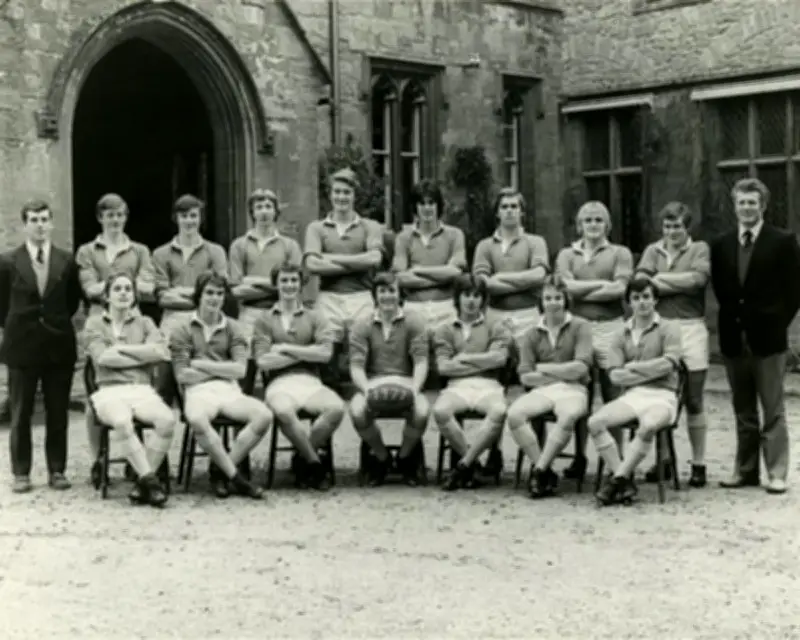
Last Saturday evening in Dorset, the 50-year reunion of the best team you've never heard of took place. For almost five years between December 1974 and late autumn 1979, absolutely no one could beat the pale-blue-shirted 1st XV of Sherborne School, an astonishing unbeaten run spanning more than 40 matches. They beat all-comers from as far afield as Wales and Ireland with a beguiling mix of power, guile and panache.
They possessed two outstanding coaching mentors. The forwards were tutored by Mike Davis, an England coach at the time and a teacher at the school, while the backs were taken by Phil Jones, a former Bath fly-half who later became headmaster of Christ College Brecon. Davis would lead his "honey monsters" down the field, lie in the mud clad in the jersey of their fiercest local rivals, and invite them to ruck the living daylights out of him. Jones would fine-tune tactics and encourage talented fly-half David Dally — the Stephen Larkham of his day — to keep forwards on the front foot or release the greyhounds outside him.
The high point, reckons Jones, was when an unbeaten Clifton College were swept aside by the most complete performance he had seen any schoolboy side produce. At one stage, he told the reunion, the team were playing so sublimely well he slipped away behind the pavilion and had a quiet weep. Enlightened coaching, great players, a supportive environment, shared passion — maybe it was not totally by chance that an impressionable kid on the touchline grew up to be a rugby correspondent. Fifty years on, the four key ingredients for oval-ball nirvana remain largely unchanged.
Bonus point changes and Harlequins' woes
These are interesting times for bonus point obsessives. Once it was simple in the Premiership: score four tries for an extra point, or lose by seven points or fewer for the same reward. Now the second-tier Championship has switched to the French system, requiring teams to end up three tries clear of their opponents for an attacking bonus point. In theory it encourages both teams to keep playing to the end. In reality it is not that clear cut. In Worcester's win at Richmond on Saturday, the Warriors went 95 metres in the last minute to score a seventh try against Richmond's four. All well and good for the visitors, but arguably rough on their part-time hosts, who have done extremely well to put four tries past Ealing and Worcester, two fully-stacked pro sides, without receiving anything.
It is the same for every club at the bottom end, but leaving aside the more complicated maths — should the try count be reintroduced on the scoreboard as in the old days? — it makes life even harder for teams who will never have the depth and muscle of the leading clubs. The French arrangement might work better in the Premiership than in the more widely-spread Championship.
These are already uncomfortable days for Harlequins. Two defeats in their opening two games is less than ideal, and the 48-0 margin of defeat against Gloucester at Kingsholm was ominous. As head coach Jason Gilmore bluntly put it: "The performance was unacceptable. The players are embarrassed with it." Quins now prepare to head to Salford to face a pumped-up, physical Sale pack this Sunday.