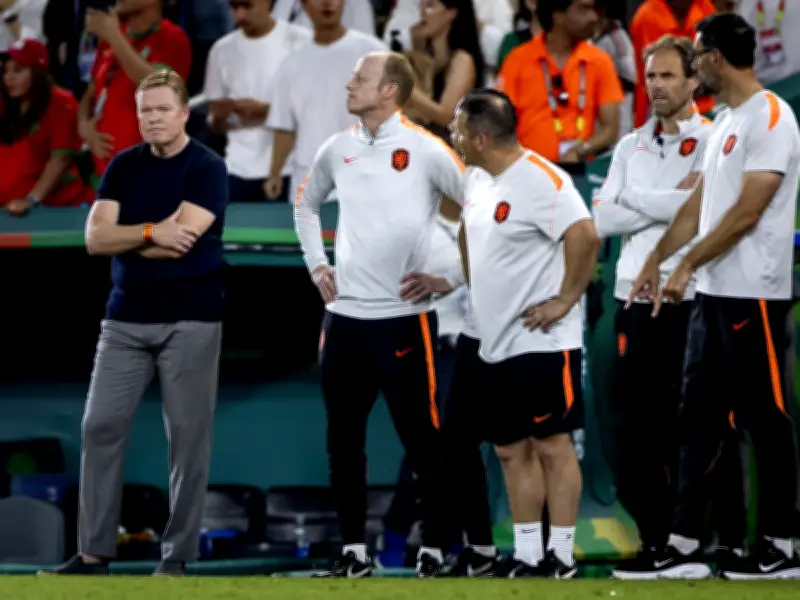
Ronald Koeman has resigned as manager of the Netherlands for the second time after their penalty shootout exit from the 2026 World Cup at the hands of Morocco. The 63-year-old, who previously led the national team between 2018 and 2020 before leaving for Barcelona, announced his decision in a statement released by the Dutch Football Federation on Instagram.
Koeman said: 'Precisely because I have worked so closely and intensively with this coaching staff and this group of players for such a long time, this was not an easy decision to make. I am grateful and would like to express my sincere appreciation for the dedication shown by everyone involved with Oranje during both of my periods as head coach. I have decided that now is the right time to spend more time with my wife, children, and grandchildren. At this moment, it feels like the right and most natural decision.'
Netherlands' World Cup Campaign
The Netherlands had sailed through to the last 32 after topping Group F, which included a commanding 5-1 victory over Sweden. They were within a minute of progressing to the last 16 before Issa Diop's stoppage-time equaliser forced their encounter with Morocco into extra time, where they ultimately lost on penalties.
Iran Criticizes US Official's Remarks
In a separate development, Iran has criticised the 'hostile remarks' of a top US official who admitted he celebrated the team’s elimination at the group stage of the World Cup. Iran failed to qualify for the last 32 after being forced to undertake gruelling daily trips for their three group matches, while a number of team officials were still denied entry to the US.
Markwayne Mullin, the Secretary for the US Department of Homeland Security, said he was 'so happy' that Iran were out. 'I was so happy when we were able to pull their visas and said they could leave the US soil, and I might’ve sung a song or two or maybe even danced a happy dance,' he said at a security briefing.
Iran’s football federation responded with a statement in which it said it was unsurprised by the US comments, and said it underscored the fact they had never been welcome at the tournament in the first place. The statement read: 'Iranians are used to the mistreatment and lies of U.S. officials, so no one in Iran is surprised by these hostile remarks. When they kill 168 children and lie to the whole world about it, nothing this person says is surprising to any of us. These remarks once again demonstrate that US officials have no commitment to international law or the principles expected of a host nation capable of organizing a global sporting event. The fact that he openly celebrates Iran’s elimination says far more about him than it does about our team. It reflects a level of pettiness that cannot even tolerate the presence of a football team competing on the world’s biggest stage. After our match against New Zealand, our head coach said that the United States did not want Iran to remain in this tournament because of the inhumane and unprofessional treatment our team experienced. These latest comments only reinforce that belief.'
Iran's World Cup Experience
Iran played three draws against New Zealand, Belgium and Egypt respectively, but failed to advance as one of the best-placed third-placed teams. They were denied an injury-time winner by a tight offside call in their final group game against Egypt which would have earned them a place in the last 32. Having been forced to move their training base from Arizona to Tijuana at the last minute, Iran left a hand-written note to the people of Mexico, in which they said their treatment at the World Cup 'undermined the sense of fairness'.
The note read: 'True hosting is about respect, humanity, and dignity. We will never forget the kindness of the people of Tijuana. From this day forward, Mexico will always be more than a host nation to us; it will be our second home and our second team. We leave this World Cup with pride, but also with one fundamental question: Did every team truly compete under equal conditions and equal professional standards? What we experienced was a series of decisions, logistical arrangements, and circumstances that undermined the sense of fairness – an impression only reinforced by the events of the final matchday of our group. Perhaps one day history will judge who genuinely welcomed Iran’s presence at this World Cup, and who would have preferred our journey to end much sooner. For us, Fair Play is not a slogan printed on advertising boards; it is the very identity of football. Yet this tournament reminded us that there is still a significant distance between inspiring words and meaningful actions. We leave Tijuana believing that football fans around the world witnessed not only the hardship endured by Iranian football, but also the resilience of a nation that refused to trade its dignity, honour and values despite every challenge. And we will never forget that those who celebrated Iran’s elimination were the same people who had previously celebrated the suffering and loss of innocent Iranian lives. That alone reveals the difference in how humanity is understood. World Cups come to an end. Administrators change. But civilisations such as Iran, Egypt, and Mexico – built upon truth, respect, and human dignity – endure through history. Match results become part of football history. The honour of nations becomes part of human history.'
FIFA has been contacted for comment.