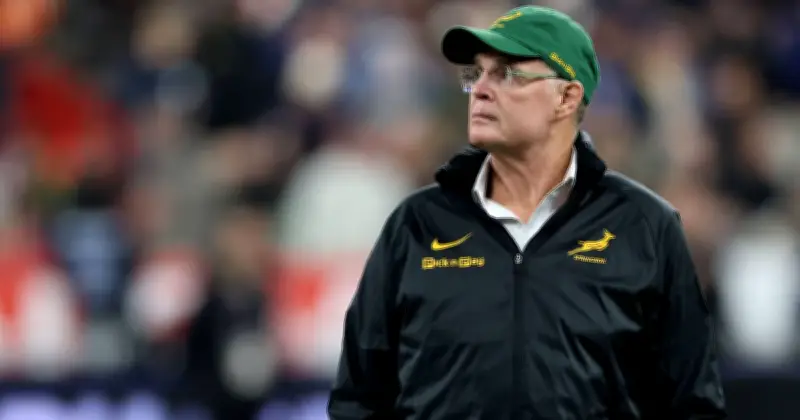
South Africa head coach Rassie Erasmus admitted his side's Nations Championship ambitions are virtually finished following their dramatic 21-19 loss to France, but declined to offer excuses for his team's display. The Springboks endured their first defeat of the tournament in Paris on Friday evening.
Erasmus accepts blame after disciplinary issues
Erasmus refused to criticise a succession of disciplinary rulings, including a 20-minute red card for Jasper Wiese and two additional yellow cards. Instead, he conceded his players had not delivered sufficiently and that their poor discipline had proved extremely costly.
"We didn't play well, so don't find a lot of excuses," he said. "I don't think there's much more to blame than ourselves."
Nations Championship hopes suffer major blow
He proved equally honest about the damage the result had inflicted upon South Africa's hopes of claiming the inaugural Nations Championship trophy.
"I think we basically killed our dreams for the Nations Championship tonight with this performance and not getting the win and the four tries," he said.
The frank evaluation followed an evening which had already seen him attract scrutiny before kick-off, having once more made sweeping alterations to his starting front row merely an hour before the fixture.
Front-row changes raise questions
Erasmus altered all three front-row berths shortly before kick-off, elevating Jan-Hendrik Wessels, Gerhard Steenekamp and Thomas du Toit into the starting XV while relegating Ox Nche, Malcolm Marx and Wilco Louw to the replacements bench.
The Springboks had originally selected Nche, Marx and Louw as their starting trio, but the eleventh-hour adjustment reflected a strategy Erasmus had deployed during the Rugby's Greatest Rivalry series against New Zealand. In that instance, the coach clarified that the move had been shaped by the weather forecast, with the Springboks convinced that an alternative front-row unit would be more appropriate for the prevailing circumstances.
Doubts have subsequently emerged about whether such alterations are permissible in official international tournaments, with certain supporters and commentators claiming that Erasmus has violated the ethos of the sport and demanding that World Rugby provide clarity on its rules.
World Rugby Regulation 15.1.2 stipulates that participating unions must declare and exchange their starting XV, along with up to eight replacements, 48 hours prior to kick-off in an international fixture. Uncertainty persists over whether designated replacements can be advanced to the starting XV so close to the match, with World Rugby having the authority to impose penalties for violations of its regulations and agreements with unions.
France dominate first half, South Africa fight back
On the field, France delivered a magnificent first-half display to establish control of the match. Aaron Grandidier-Nkanang, Theo Attissogbe and Louis Bielle-Biarrey all touched down for converted tries to hand Les Bleus a dominant 21-7 half-time advantage, with Wessels registering South Africa's sole try of the opening period.
South Africa's challenge grew even harder early in the second period when Wiese received a yellow card for a dangerous tackle, which was escalated to a 20-minute red card after a bunker review. Lood de Jager had also been yellow-carded for a high tackle, with South Africa giving away 11 penalties throughout the encounter, eight of them in their own territory.
Yet despite being reduced to 14 men, the Springboks mounted a remarkable comeback, with Cobus Reinach crossing after 50 minutes to narrow the gap to seven points. France were compelled to endure wave upon wave of pressure, with the hosts also losing players to the sin-bin as the encounter grew increasingly frenzied.
When replacement prop Regis Montagne was dismissed for 10 minutes with the match approaching its closing stages, South Africa appeared to have shattered the home side's resolve. Restored to 15 players, the visitors capitalised on their numerical superiority when replacement hooker Marx crossed from a driving maul.
Nevertheless, while Sacha Feinberg-Mngomezulu had successfully converted South Africa's opening two tries, replacement fly-half Manie Libbok was unable to add the extras, leaving France holding onto a two-point lead. The Springboks continued to press forward in the dying moments, but France stood firm to claim a memorable win.
Table implications and next fixtures
It marked their first victory over South Africa at the Stade de France since 2005, with the Springboks having prevailed in nine of the previous 10 encounters between the nations, including their dramatic 29-28 success in the 2023 Rugby World Cup quarter-finals.
The result has also carried substantial consequences for the Nations Championship table. France assumed control of the Northern Hemisphere standings on 21 points, bolstering their position ahead of their final group encounter against Argentina next week.
South Africa remain atop the Southern Hemisphere rankings, also on 21 points, but their position now faces genuine jeopardy from New Zealand, who sit just one point adrift with a match in hand. The All Blacks meet Wales in Cardiff on Saturday before confronting England the following weekend, meaning they could leapfrog the Springboks with victory.
South Africa, meanwhile, travel to Ireland next week for their concluding group fixture, with Erasmus conceding that the prospect of claiming the inaugural Nations Championship trophy has suffered a significant blow.