England have been forced into six changes to their 36-man squad after a series of injury blows, with Immanuel Feyi-Waboso and Tom Curry ruled out for the remainder of the Nations Championship. Meanwhile, former Ireland and British and Irish Lions centre David Hewitt has died at the age of 87.
England's injury crisis deepens
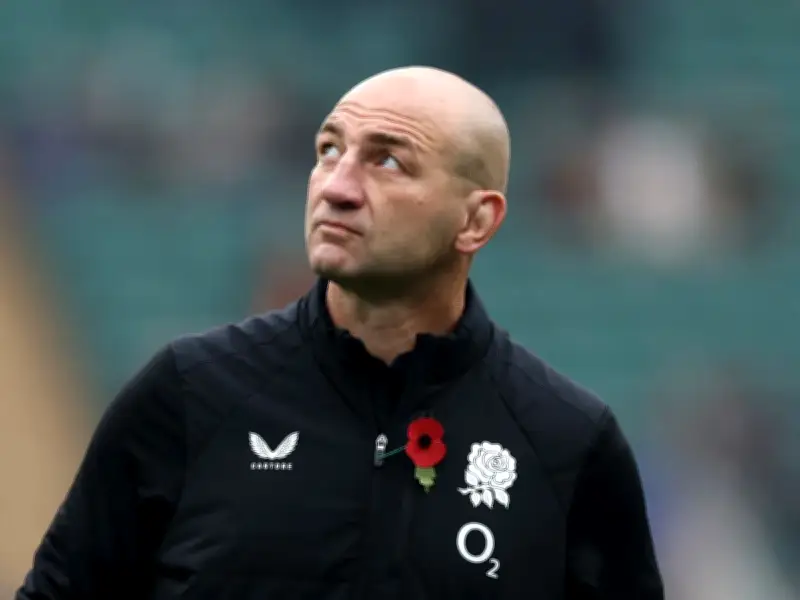
Head coach Steve Borthwick has made six changes to his squad following Sunday's 45-22 victory over Australia at Allianz Stadium, with five players sidelined through injury. Exeter Chiefs winger Feyi-Waboso suffered an ankle injury during the win over the Wallabies following an illegal knee-drop tackle by Australian prop Angus Bell.
The 23-year-old had been causing Australia problems and even had a try ruled out after just 80 seconds because of a forward pass in the build-up. He managed to continue until half-time before being replaced by Henry Pollock, but has now been ruled out for the rest of England's autumn campaign.
Flanker Curry will also play no further part in the Nations Championship after suffering a hip injury during a non-contact training session at Pennyhill Park ahead of the Australia fixture. Ollie Chessum (shoulder), Seb Atkinson (hip) and George Furbank (groin) have also dropped out of the squad preparing to face Eddie Jones' Japan at Twickenham on Saturday.
New faces called up
Borthwick has responded by calling up several players who impressed for England A in their 59-24 victory over Argentina XV on Friday night. Saracens winger Noah Caluori, who scored twice in that match, has earned a promotion to the senior squad alongside Bath centre Max Ojomoh, who also crossed the whitewash.
Back-row forwards Max Hicks and Jack Cunningham have been drafted in as cover for the injured forwards, while Saracens' Tobias Elliott has also been called up. There has also been a change at scrum-half, with Archie McParland returning to fitness and Harry Randall dropping out of the squad.
The disruption comes at a frustrating time for Borthwick, whose side produced one of their most convincing performances of the year against Australia, scoring seven tries to register England's highest-ever points total against the Wallabies. England now face a short turnaround before welcoming Japan to Allianz Stadium on Saturday.
'Generational' Lions star dies
Former Ireland and British and Irish Lions centre David Hewitt, regarded as one of the finest players of his generation, has died at the age of 87. The legendary Ulster midfielder represented the Lions on two tours, in 1959 and 1962, and enjoyed a remarkable international career before retiring from rugby at just 26 to pursue a career in law.
Hewitt made his Lions Test debut as a teenager and finished the famous 1959 tour of Australia and New Zealand as the tourists' leading scorer. The British and Irish Lions confirmed his passing in a statement on Monday, paying tribute to the former centre.
"All our thoughts are with the family and friends of former Ulster, Ireland and British & Irish Lions centre, David Hewitt," the statement read. "David played on two Tours in 1959 and 1962 and will be greatly missed."
Hewitt was just 19 years and 270 days old when he made his Test debut during the 1959 tour, going on to finish that trip with 13 tries and 112 points. He would ultimately make six Test appearances for the Lions across that tour and the subsequent expedition to South Africa in 1962.
Born into a family steeped in rugby tradition, Hewitt followed his father, two uncles and two brothers into the Ireland international set-up. Having captained Royal Belfast Academical Institution to Schools' Cup glory in 1957, he made his Ulster debut against Connacht later that year while still a schoolboy.
By January 1958, he had earned his first Ireland cap against Australia, beginning an international career that would see him make 18 appearances for his country over the following seven years. At club level, Hewitt represented Queen's University, Instonians and North of Ireland, with the Belfast Telegraph describing him as "one of the best players of his generation".
In later life, Hewitt also served as a member of Northern Ireland's Parades Commission, which dealt with contentious public processions, including those associated with Drumcree. He stepped down from the role in 2000.