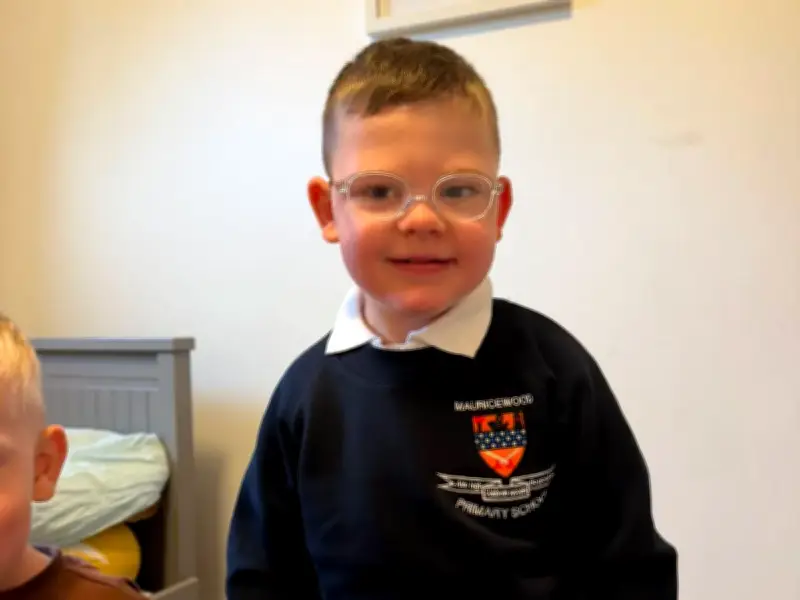
A five-year-old boy from Midlothian who overcame a rare brain tumour is set to deliver the match ball at Scotland's rugby union match against Australia at Murrayfield on Sunday.
Joey Sharp will join Scottish Commonwealth swimmer and brain tumour research campaigner Archie Goodburn in presenting the ball to the teams. Scottish Rugby has arranged for Joey and his mother, Sam Sharp, to meet the Scotland players and provided accessible seating for what will be his first visit to Murrayfield.
A first trip to Murrayfield
Ms Sharp said Joey is looking forward to the day out and that it will be his first time at Murrayfield. The family are keen Scotland rugby supporters, and Ms Sharp, 39, holds a season ticket, but Joey had previously been unable to attend because he was too unwell.
Joey, who lives in Penicuik, was diagnosed with a brain tumour at just 11 days old after losing weight rapidly, becoming increasingly sleepy, and experiencing little twitches. His type of brain cancer, a glioblastoma, is more commonly diagnosed in adults and carries a prognosis of 12-18 months.
Treatment and recovery
Joey underwent three surgeries and nine rounds of chemotherapy, experiencing 30 seizures a day. As a result of the treatments, he lives with cerebral palsy, visual impairments, and weakness down his right side.
Ms Sharp said it is really good that he is doing so well just now, but there is still the anxiety that comes with follow-up scans. She described Joey as a "little ray of sunshine," adding that he is mischievous, really caring, and well-behaved. The five-year-old has just started school and already has a "wee fan club," his mother said.
Support for brain tumour research
Joey is looking forward to meeting Goodburn, who lives with three brain tumours and has campaigned for research into the disease. Goodburn's recent meeting with the Prime Minister resulted in a commitment from the Government to transform outcomes for brain tumour patients.
Supporters at Murrayfield will have the chance to donate to Brain Tumour Research and the Astro Brain Tumour Fund. Ms Sharp said more donations mean more money for research and kinder treatments, noting that not much was available to Joey and that all of his treatment was like clinical trials.
Dr Karen Noble, director of research and policy at Brain Tumour Research, said Joey's story is a "powerful reminder" that brain tumours are indiscriminate and can affect anyone, at any age. She noted that 62 per cent of children who survive a brain tumour live with life-long disabilities, yet funding for research remains critically low and there has only been one new treatment approved for childhood brain tumours since 2000. Dr Noble called on the Government to support an increase in the national investment in research into brain tumours to at least £45 million a year to improve survival rates and patient outcomes in line with other cancers such as breast cancer and leukaemia.