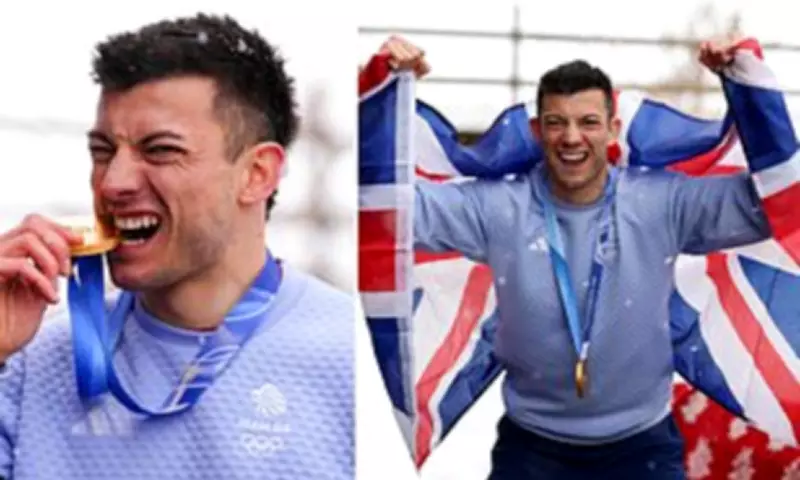
Matt Weston's first instinct upon waking on Saturday morning was to verify the contents of his bedside drawer in the athlete's village. After the extraordinary events of Friday evening, he needed confirmation that his mind had not deceived him overnight. 'I had kind of tucked the medal in there, very safe, and then as soon as I woke up, I was like, "Still there, not a dream",' he shared with a small group, having firmly established his status as the Olympic skeleton champion.
A Precious Cargo in a Sock
'It's been living inside a sock for the last couple of hours because I haven't got the boxes yet from the medal ceremony,' Weston explained. 'I want to keep it as fresh as possible. I'm terrified of it falling off the end of the ribbon, like I've seen happen to some people, and I'm cradling it half the time like my little baby.'
There was undeniable joy in Weston's voice, a sentiment richly deserved, much like his celebratory Margherita pizza enjoyed just after midnight. While no alcohol touched his lips, he found immense satisfaction in setting four track records across four descents down the icy chute in Cortina. His performance was so commanding that it instantly became a case study in handling the immense pressures of a major sporting moment.

Team GB's Golden Outlier
If managing such pressure has been a weakness for Team GB at these Winter Olympics, then Weston, aged 28, has emerged as their shining exception. However, even in the frigid world of ice sports, one must seize opportunities swiftly—he competes again on Sunday in the mixed skeleton event.
Given the strong performances by British women in skeleton, there is considerable optimism that Weston might be checking his socks for a second medal by Monday. Whether Tabitha Stoecker, Freya Tarbit, or Amelia Coltman takes the first run, a gold in the mixed event would make Weston the first Team GB winter athlete ever to leave the same Games with two gold medals.
'I did one team race right in the last World Cup event of the year, and I think we've got a silver medal,' he noted. 'We're in a good position. I haven't forgotten how to do it.'
Britain's Skeleton Success Story
It is uncommon for Britain to achieve significant success in the snowy arenas of winter sports, which is why Team GB skeleton athletes capture attention every four years. Yet, there is no element of chance in these results. Over the past four years, UK Sport has invested £5.7 million of lottery funding into this niche sport during the current Olympic cycle.
While the debate over whether such a fringe sport should receive this level of support compared to more accessible activities like snowboarding is valid, the outcomes are undeniable. Weston's victory extends a golden lineage that includes Lizzy Yarnold and Amy Williams, solidifying Britain's status as the most successful skeleton nation in Olympic history with a total of 10 medals.
Sophisticated Training and Resilience
Much attention has been given to the team's training on a 140-meter push-track in Bath for half the year, as well as the frugal resources that sometimes require Weston and teammate Marcus Wyatt to share a bed on trips. Despite these constraints, the British skeleton program is highly advanced and sophisticated.
In August 2022, the team recruited Martins Dukurs as coach, a Latvian holder of six world titles widely regarded as the greatest slider in history. This appointment influenced Weston's decision to continue racing after a disappointing 15th-place finish at the Beijing Games earlier that year.
In a recent interview, Weston revealed it was 'touch and go' whether he would walk away from the sport. He only took up skeleton in 2017 after attending a talent-spotting day where his height, speed, and power metrics—honed as a world-level junior in taekwondo—were identified as ideal for the sport. His biology and character, which he self-described on Saturday as a 'performance animal,' made him a perfect fit.
Overcoming Adversity
By choosing to stay in the sport after 2022, Weston benefited from a program that heavily invests in research and design. This includes aerodynamic testing at a secretive wind-tunnel facility in Manchester and the use of a converted flight simulator, partly developed by the University of Southampton, to replicate tracks worldwide.

'We try to maximize everything we can do off track,' Weston said on Saturday. 'Obviously, we've got some stuff there, but I think a lot of it's secret, so I don't want to go into detail. It's definitely helped me get to this position now.'
Despite occasional setbacks, such as the team being foiled when they unveiled a new helmet design for the Olympics and Weston suffering a 12cm tear in his quadriceps at the season's start, he remained unflustered. The gold medal now nestled in his sock is a testament to his unwavering confidence and resilience.