Laila Edwards: US Hockey's Trailblazing Star Set for Historic Olympic Debut
Laila Edwards is preparing to make sporting history next month when she represents Team USA at the Milan Cortina Winter Olympics, set to become the first Black female to compete in ice hockey for the United States at the Games. The 21-year-old defender's remarkable journey from Cleveland to the global stage has captured attention across the sporting world, with her talent heralded as transformative for women's hockey.
A Moment of Validation and Family Celebration
During a casual family gathering at her childhood home in Cleveland, an excited shriek pierced the air as Edwards and her longtime friend and teammate Caroline Harvey discovered something extraordinary on a mobile phone. The cause of their breathless giggling and repeated exclamations of "Oh, my God" was a social media post showing Cleveland Cavaliers forward Larry Nance Jr. arriving for an NBA game proudly wearing Edwards' No. 10 US hockey jersey.
Edwards, who remains well-versed in Cleveland's rich sports heritage despite leaving the city years ago to pursue her hockey career, reacted with an emphatic "Whoa". She reflected: "He's born in Ohio. His dad played for the Cavs. Legend. I thought it was super cool for him to do that, when he didn't have to." Just one day later that November, Edwards herself graced the ice at the same downtown arena, taking the ceremonial opening face-off and contributing an assist in a decisive 4-1 Rivalry Series victory over Canada.

Physical Presence and Exceptional Talent
Standing at 6ft 1in (185cm) and weighing 195lb (88kg), Edwards presents an imposing physical presence on the ice that belies her youth. She possesses a rare combination of attributes that has marked her as exceptional: a powerful shot, exceptional speed, and deft play-making ability that makes her a versatile threat in multiple positions.
Her talent has drawn high praise from established stars of the sport, with team captain and the face of US women's hockey, Hilary Knight, declaring unequivocally: "Laila is the future of the sport. I think you're seeing someone who's coming into her skill set and just scratching the surface." This endorsement from one of hockey's most respected figures underscores the significant expectations surrounding Edwards as she approaches her Olympic debut.
A Deliberate Homecoming and Poignant Return
Recognising Edwards' growing significance, USA Hockey deliberately scheduled their Cleveland game to create what became a poignant "coming out party" for the player who is completing her senior college season at top-ranked Wisconsin. The four-day visit allowed her to practise at a rink she knew intimately from her childhood and, crucially, to reconnect with her family, who have largely watched her remarkable development from afar.
Reflecting on the emotional resonance of returning to her roots, Edwards remarked: "The idea of going from a 400-seat rink to the biggest sporting event in the world, it's like, wow. It feels like a full-circle moment to be starting the launch of my Olympic career here in Cleveland with my family."
Early Beginnings and Sacrificial Journey
Edwards' hockey journey began at the tender age of three, introduced to the sport by her father, Robert, following in the footsteps of her older brother, Bobby, and sister Chayla, who also played at Wisconsin. By age eleven, her exceptional development led coaches to recommend she play with girls two and three years her senior, prompting the difficult decision for her to leave Cleveland for more established developmental programmes.
This path included joining an elite girls team in Pittsburgh, followed by high school at the Bishop Kearney Selects Academy in Rochester, New York, before her eventual move to Wisconsin. Her father, Robert, reflected on the emotional toll of her early departure: "The thing that we didn't expect was to miss her as much as we did, and the loss of not seeing her grow up. I don't regret doing that, but that is something that I feel was not the best part of her going away." He noted her maturity and academic strength as key factors in their decision.

Navigating Challenges and Breaking Barriers
Edwards faced significant personal challenges during her time away from home, including rapid growth spurts that saw her gain approximately five inches during her years at Kearney. She also made considerable sacrifices, such as having to forgo her high school graduation ceremony to compete at the Under-18 world championships.
Perhaps most significantly, she has navigated her path as a Black athlete in a sport predominantly played by white players, bringing unique pressures and responsibilities. Addressing these challenges, Edwards stated: "To get through some of the things you have to get through in this sport, you've got to be strong. There's a lot that goes on in the locker room, outside, coaches, practice, fans," she added, declining to elaborate on specifics. "You definitely have to be strong. And I think it's huge in terms of representation and being a role model."
Adaptability and Competitive Resilience
Her resilience extends to her on-ice adaptability, including a successful switch from forward to defence that demonstrates her versatility and team-first mentality. US coach John Wroblewski lauded her strength in facing challenges, describing her as "an inspiring person to be around. I think it's just innate. It's just Laila. She's a gamer. She's the real deal."
In her U.S. national team debut playing as a forward, Edwards was named MVP at the 2024 world championships, where the Americans narrowly lost the gold medal game to Canada. At the world championships this past year, Edwards admitted she "struggled making the transition to defence," though she still contributed a goal and three assists, and ultimately secured a gold medal.
Reflecting on that experience, Edwards noted: "I didn't have my best tournament, but to me that wasn't what it was all about. We won, and I learned a lot, so that was a win as well. I think my expectations are a little higher now." Indeed, Edwards has consistently thrived on adversity, explaining: "The word 'challenge' is fine because I don't look at it as a negative. I see it as something that I can learn from. So I'm always trying to push myself to be a great athlete and player. But more importantly, a good person, role model, teammate."
Family Support and Future Prospects
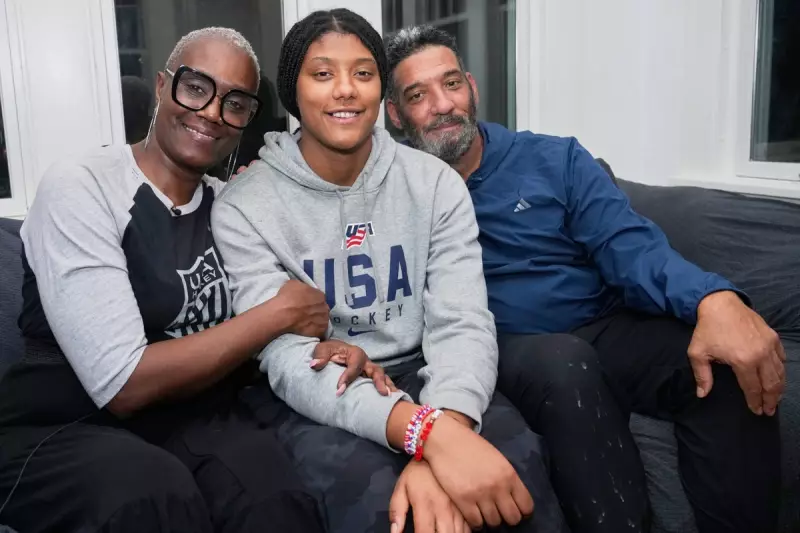
Back home in Cleveland, squeezed between her parents on the family's den couch, Edwards found a moment of peace amidst her demanding schedule. The living room's bookshelves, laden with plaques, trophies, and medals, hinted at a future brimming with further accolades that seems almost inevitable given her trajectory.
Yet for Robert and Charone Gray-Edwards, the focus on this night was simply to cherish precious moments with their now grown-up daughter, poised to step onto the world's biggest sporting stage. Her mother, Charone, encapsulated their unwavering love and support with poignant simplicity: "We tell her we love her regardless. You're not going to be perfect. You're not always going to win. You're not always going to be the top scorer. But you're always our Laila."
As Edwards prepares to make history in Milan Cortina, she carries not only the hopes of a nation but also the quiet confidence that comes from knowing she has already overcome significant obstacles to reach this point. Her story represents more than athletic achievement—it signals a broadening of representation in a sport ready for new heroes, with Edwards positioned to become one of its most significant.