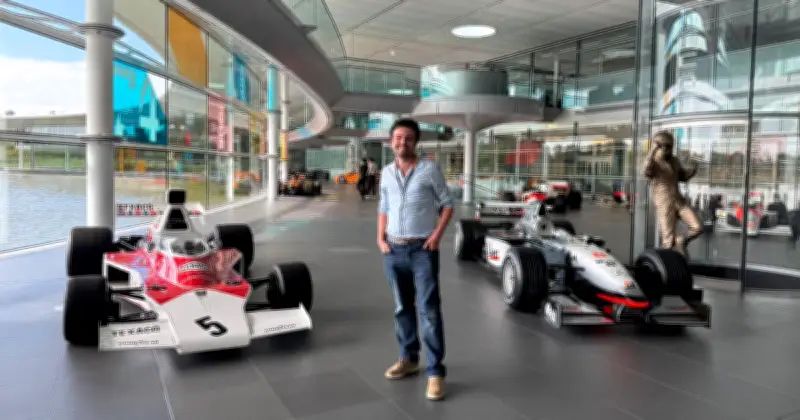
Walking into the Norman Foster-designed McLaren Technology Centre in Woking, it is immediately clear why this building is one of the most secretive in Formula 1. Under the leadership of former boss Ron Dennis, the facility was closed to outsiders, and even on a rare tour arranged by team partner Allwyn, cameras were often banned.
The secrecy is justified: this is where McLaren has turned around its 2026 season. After a difficult start, Lando Norris claimed his first win of the year in Hungary, following months of struggle under new regulations. The car's upgrades, designed in these very rooms, have pushed McLaren back to the front. Collaboration is at the centre of the team under Zak Brown and Andrea Stella, with a 'no blame culture' helping to close the gap quickly.
A challenging season, then a breakthrough
Norris's victory in Budapest came just months after he had stood under the floodlights in Abu Dhabi, celebrating McLaren's first Drivers' Championship in 17 years. The previous title, in 2008, had been won by Lewis Hamilton. But the new rules shook up the order, with engine partner Mercedes gaining the upper hand across the first 10 races of 2026.
That all ended in Hungary. For the staff at the Technology Centre, the turnaround felt like winning the lottery - a fitting comparison given that Allwyn, which operates the National Lottery, helped open the doors for the tour. Smiles were everywhere, with the whole squad clearly pulling in one direction.
Inside the race bays
Downstairs, the race bays are where the magic happens. They do not look like traditional garages; the space resembles a hospital operating theatre, with F1 chassis placed on gloss white ceramic tiles. There is not an oil stain or a piece of debris in sight.
These bays are where McLaren's major upgrades were developed. A revised front wing has been identified as a key factor behind the improved pace, along with recent tweaks to the leading edge, floor footplate and bargeboards. These changes have improved airflow and pushed the car to the front in Budapest. McLaren has also made adjustments to the turning vanes on the rear brake ducts and updated the main cooling exit in recent weeks.
Mission Control: Houston in Woking
On race weekends, attention shifts to the NASA-esque Mission Control room upstairs. It is Houston in Woking. The soundproofed office is built in tiered rows, where up to 30 engineers work in real time on everything from tyres to engine settings on the MCL40 as it races more than 1,000 miles away.
The strategists sit at the back of the room, making quick decisions that are passed to race engineers Will Joseph and Tom Stallard at the circuit. It is here that the famous 'papaya rules' are cooked up.
Boulevard of champions
McLaren's place at the top of Formula 1's history is evident throughout the building. The Boulevard is a time capsule of the team's achievements, featuring cars piloted by Emerson Fittipaldi, Mika Hakkinen and Ayrton Senna. It is an F1 fan's dream.
A prediction against the odds
Before qualifying for the Hungarian Grand Prix, visitors were invited to make their predictions in the Allwyn League, where fans can win prizes as impressive as Paddock Club tickets. I chose Lewis Hamilton for pole - a decision that felt almost traitorous while sitting next to McLaren's world championship-winning cars. As it turned out, I was wrong.
The thrill of watching the session with something at stake was palpable, much like waiting for the lottery balls to roll out on a Saturday night while holding a game slip. The excitement inside the Technology Centre was through the roof when Norris took pole.
McLaren appears to have closed the gap to its rivals, and the engineers are already preparing the next big upgrade to take the fight to Mercedes and Ferrari.