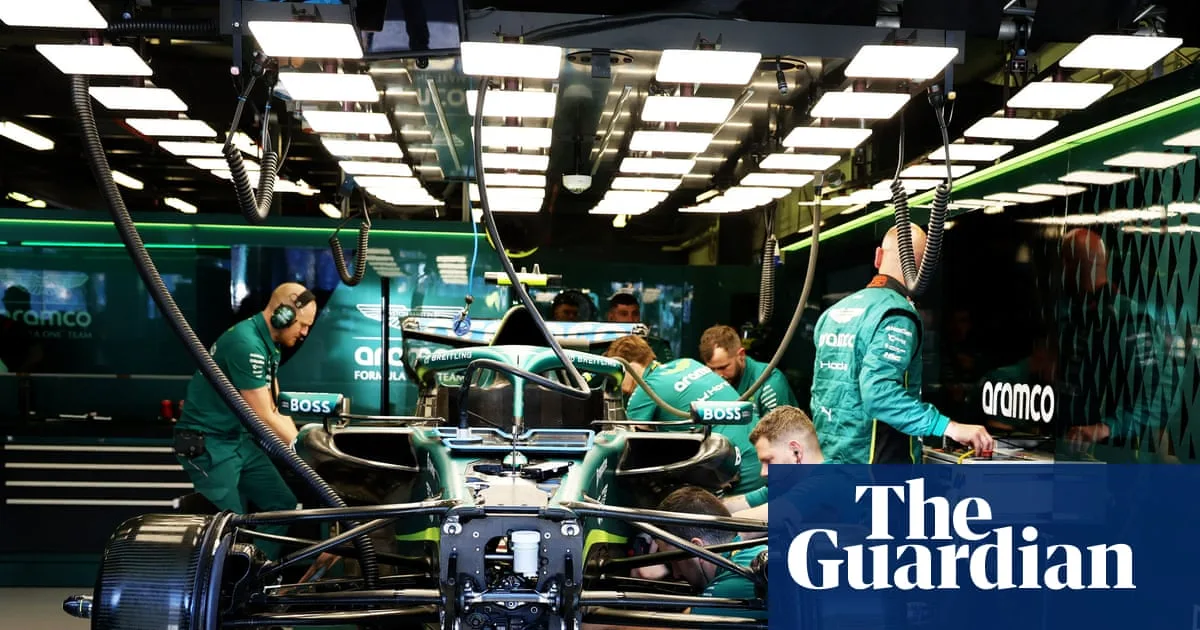
Aston Martin's Australian Grand Prix Participation in Jeopardy
One of Formula 1's most ambitious teams, Aston Martin, may find themselves unable to start the Australian Grand Prix this weekend due to a little-known regulation. The 107 per cent qualifying rule could pose a significant threat to the team, which has endured a disastrous pre-season marked by unreliability and a lack of speed.
New Era of F1 Brings Uncertainty
The 2026 season heralds a new era for Formula 1, with entirely new engine regulations mandating a 50/50 split between internal combustion and electrical power. This shift has sparked unease within the sport, as concerns mount that increased reliance on battery power, requiring frequent 'harvesting', might force drivers to hold back during races.
Experts predict a much wider field spread compared to recent seasons, where qualifying often saw the entire field separated by less than two seconds. This season, gaps could expand to five or six seconds depending on the circuit, increasing the likelihood that the 107 per cent rule will come into play.
Understanding the 107 Per Cent Rule
The rule stipulates that every driver must set a lap time within 107 per cent of the fastest time recorded during the first part of qualifying (Q1). For example, if the quickest lap time is one minute 30 seconds (90 seconds), the calculation would be: (90 x 107) ÷ 100 = 96.3, or 1 minute 36.3 seconds. In this scenario, all drivers would need to achieve a lap time in Q1 within 1 minute 36.3 seconds to qualify.
Teams most at risk of breaching this rule include newcomers Cadillac and the big-spending Aston Martin squad. Aston Martin, now powered by a Honda engine after parting ways with Mercedes, has struggled significantly during pre-season testing.
Aston Martin's Pre-Season Woes
Despite boasting vast resources, including design wizard Adrian Newey as its managing technical partner and two-time world champion Fernando Alonso as its lead driver, the team appears to be in chaos. Honda has attributed engine problems to 'abnormal vibrations' that have literally shaken their batteries to breaking point.
Honda's chief operating officer, Ikou Takeishi, recently stated: 'If we could identify a single cause, it would be easier to fix, but because multiple linked factors generate the vibration, we don’t know whether fixing just one will solve it.'
These issues have severely restricted Aston Martin's track time, leaving them with far less data than their competitors. With a points finish almost certainly out of the question, the Melbourne weekend is likely to serve as little more than a glorified test session for the team.
Potential Consequences and Embarrassment
Cars that fail to meet the 107 per cent requirement may still be allowed to start the race if deemed competitive enough by race stewards. However, even a close call would be massively embarrassing for Aston Martin and Honda, highlighting their ongoing struggles.
The situation is compounded by the team's high-profile lineup and significant investment, making any exclusion from the grid a stark contrast to their ambitions. Fernando Alonso, now 44, faces another frustrating season if these issues persist.
Looking Ahead in the 2026 Season
Round two of the championship takes place just a week later in China, with Honda's home race, the Japanese Grand Prix, scheduled for the end of March. However, doubts linger over April's rounds in Saudi Arabia and Bahrain due to the ongoing conflict in the Middle East.
Meanwhile, George Russell and Mercedes are the pre-season favourites for the drivers' and constructors' titles. Ferrari, Red Bull, and reigning world champions McLaren are also expected to be in the mix for race wins, setting the stage for a competitive season despite Aston Martin's early setbacks.