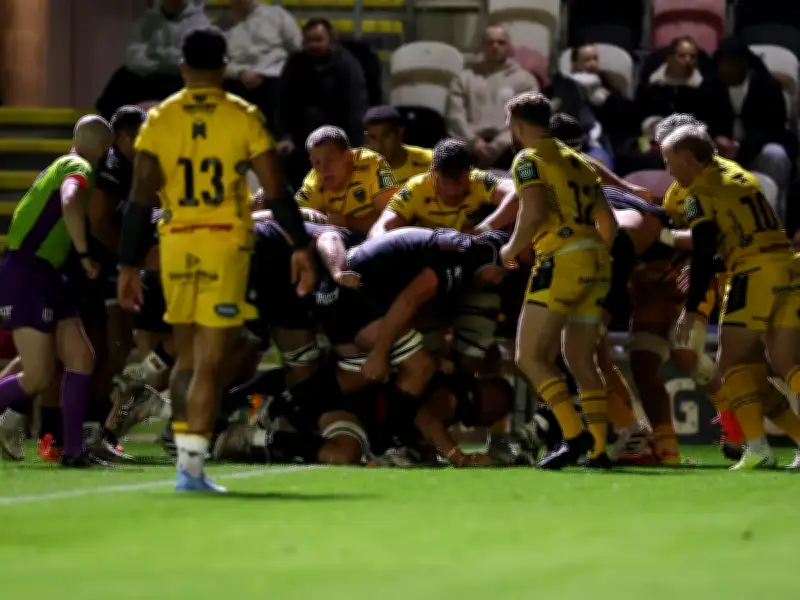
The driving maul has become a major weapon in rugby, with a large number of tries now coming from that area of the game. After Friday's Welsh derby at Rodney Parade, Elliot Dee joked that a try-scoring bonus would be a part of his next contract discussions at the Dragons. While he was laughing when he said it, his representatives were probably already having that exact thought. The United Rugby Championship's top try-scorer with five scores so far this season, there's a good chance Dee will continue to find himself on the scoresheet.
Dee wasn't the only hooker this weekend troubling the scoresheet. In the same match, fellow Wales international Sam Parry went score for score with Dee, while Glasgow hookers Gregor Hiddleston and Seb Stephen also steered driving mauls to the line on the same night.
Maul tries dominate the stats
The driving lineout is a massive weapon in rugby right now. On Friday, 10 tries came directly from a driving lineout in the URC's two matches. Over the course of 13 matches in the URC and Gallagher Prem last weekend, 115 tries were scored - with the driving maul laying the foundation for 35 of them. As such, it's not just hookers that should be considering clauses in their next contract. If things remain the same, heavy second-rows - or anyone in the front-five with a bit of power - will once again be a pricey commodity moving forward.
But just how did it come to this? Well, it all started with an amendment to the maul by World Rugby earlier this year. While there were no actual law changes, law application guidelines introduced in June following World Rugby's shape of the game conference have turned the maul into a fairly overpowered weapon. South Africa and France were among the nations to drive the change, with Rassie Erasmus having been vocal around the time about the value of mauls as a pure pushing competition.
How the change works
Essentially, the amendment saw referees stricter on not allowing players from the defending team to remain in the maul if they had moved past the ball, forcing them to detach and go to the back before joining again. Previously, players were able to essentially swim around the sides, providing they didn't change their bind - making mauls a lot easier to disrupt. One former player said how teams would talk about "two-for-ones" - essentially, if you were exiting the maul as a defending player, you'd take two bodies with you. Previously, all that mess would result in the ball being unplayable, leading to a scrum.
Not everyone was as enthusiastic about the amendment, with Ireland in particular perhaps penalised as a nation recently well-versed in defending mauls in the above manner. They have been caught out a little by the change. Just four teams in the United Rugby Championship, according to Opta, have failed to score from a driving lineout. Three of them - Leinster, Ulster and Connacht - are Irish. Given the explosion of maul tries in the opening weeks, that's a damning statistic in some ways.
Welsh sides benefiting
On the flipside, the Ospreys are leading the way - with six tries coming from it. The Dragons are just behind, with five. Given the respective strengths of the two sides' driving lineouts, it's little wonder in hindsight that the third quarter of Friday's Welsh derby effectively became a 'We maul, you maul' scenario. Following the law amendment, the Dragons have focused on that area of the game building up to the new season.
"It was a weapon last season and working hard at the things you are good at usually pays dividends," said Wales hooker Dee. "We were disappointed Ospreys also scored a few off the driving maul. It definitely gives the attacking team an advantage, as soon as you slip up the side you have to get out of there now. It's hard to stop because you are retreating to the back and it gives a second or two of less weight [for the defending team]. It's a good rule, and it's good for the game."
As for the Ospreys, they are reaping the benefits from being a side that traditionally drove quite square previously. What you will find is that teams that tend to drive square - trusting their technique and power - also defend square, giving them an advantage in the current climate. That will be why Erasmus and South Africa pushed as hard as they did. Whereas a lot of sides would have a blanket system that would have three or four players centrally, then a couple on the edges. Their role was the swim around and anchor down, so the attack couldn't roll around them. Now, those players need to have a realistic chance of pushing or they will get pulled out. As such, teams that perhaps relied on swimming around the maul can be blown out of the maul fairly quickly.
Little subtleties and future balance
There are other little nuances that have made it so hard to defend recently. You're seeing backs join in a lot of mauls from close-range now, either as part of the initial lineout or joining later. The Ospreys' first try on Friday had Keiran Williams, Evardi Boshoff and Keelan Giles all in a 10-man lineout to begin with - lending their weight immediately. The minute there's even a slight weakness - be it a gap on the corner or whatever - in the Dragons' maul defence, the bodies are there to flood through. The Dragons went a slightly different route, with centre Aneurin Owen and wing Anzelo Tuitavuki joining after the initial lineout had ended.
Another reason for mauls being so strong is that teams seem to be mauling longer. Whereas referees have perhaps been hot on telling sides to use it once the initial drive has ended, you maybe aren't getting that any more. A five-second maul can easily become a 25-second maul - just like the Ospreys' third try - providing you're creeping forward and then, once that weak spot appears, it's once again so hard to defend. The Dragons do little wrong initially for Parry's first try, but there was still a sense of inevitability. Just one little spin or shift of weight, with the Ospreys' backs joining late, makes a try almost a certainty.
It could also be argued that these maul changes have come at a time when attack is besting defence more often than not. Across those 13 matches in the URC and Prem on the weekend, 20 of the 26 sides managed to pick up a four-try bonus point. Only two of them - Leinster v Cardiff and Saracens v Bristol - produced fewer than 40 points.
Intriguingly, the highest-scoring match of the weekend bucked the trend in spectacular fashion. Despite amassing 119 points between them, Northampton and Bath rarely turned to the driving maul. There were just 12 lineouts in the whole match, considerably less than the average of 30 across the other matches. And just one of the 18 tries came from a driving maul. Even then, it was from a carry around the fringes that had some woeful defence - rather than any real dent made by the lineout. Both teams like high ball-in-play time, looking to move the ball. Those two teams did most of their damage in the wider channels. That's perhaps reflective of the Prem at the moment, having drawn comparisons to the attack-first Super Rugby of yesteryears.
The URC, being an amalgamation of different nations, is maybe more indicative of certain trends. Over 30 maul tries across three weekends is one obvious one. It's impossible to escape from it, with it likely to impact on selections in the next year - starting with Wales' Nations Championship squad next week. Wales scored four tries from driving lineouts against Fiji and Argentina this summer, proving their efficiency in the red-zone. Perhaps where they were lacking was their inability to turn the maul into a useful weapon around midfield in order to generate more 22 entries and penalty opportunities.
Right now, it feels like every time a side gets a penalty, there's a strong chance they'll go to the corner and score. Unless it's late in the game, going for three points off the tee seems futile right now. Statistically, there's more value in going for seven points time and time again. World Rugby are unlikely to meddle with the maul between now and the World Cup, but - as is often the case with these sorts of changes - things will likely balance out over the coming weeks and months. Already, last week's Bledisloe Cup between Australia and New Zealand saw the Wallabies penalised for obstruction at the front of an attacking maul in what proved to be a turning point in that match, perhaps paving the way towards officials looking more at the attacking side, too. Things like how attacking teams enter the maul - particularly backs - and calls to use it could be pushed by coaches before long to balance the playing field. Until then, expect Dee and his like to continue popping up on the scoresheet.