Lionel Messi's White House Visit with Donald Trump Ignites Political Speculation
Lionel Messi, the global football superstar renowned for his on-field brilliance, has long maintained a deliberate distance from political engagements. However, his recent visit to the White House alongside former U.S. President Donald Trump has sparked intense debate about whether this marks a significant shift in his carefully curated public image.
A Surprising Appearance with Political Implications
Assisted by a glittering pink soccer ball, Messi crossed what many considered a final frontier with his White House appearance. Until Thursday's event, the Argentine icon had demonstrated equal skill in evading defenders on the pitch and political figures off it, particularly within his home country. There were genuine questions about whether he would join his Inter Miami teammates to celebrate their MLS Cup victory at the presidential residence.
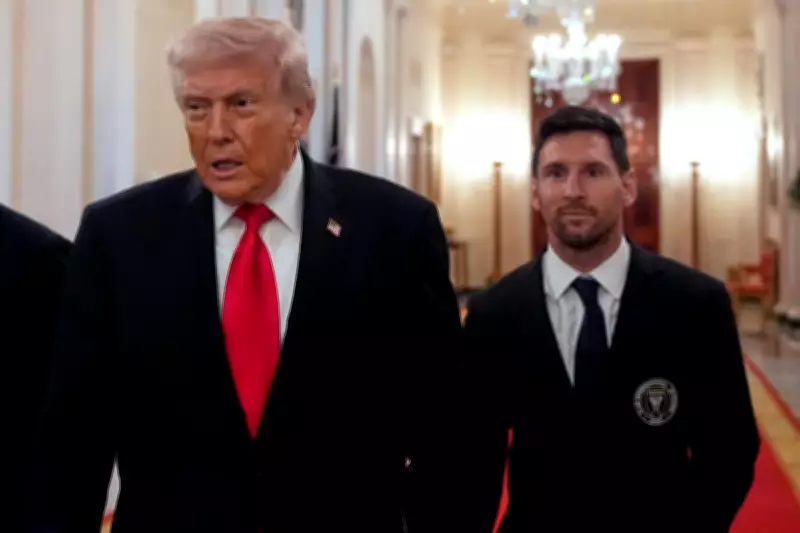
As the team assembled in the ceremonial room, Messi was conspicuously absent from their ranks. Instead, he made a separate entrance alongside President Trump and team owner Jorge Mas Santos, later presenting the bedazzled ball to the former president. Although Messi remained silent throughout the proceedings, his mere presence seemed to communicate volumes for an athlete whose political leanings have remained largely mysterious.

Historical Context and Political Avoidance
Messi's political avoidance has been consistent throughout his career. When Argentina, under his captaincy, secured the World Cup in 2022, the team notably declined to visit then-President Alberto Fernández's Casa Rosada. Argentina's current president, Javier Milei—a Trump ally—has publicly praised Messi but has yet to secure any joint public appearance or photograph with the football legend.
Just one year ago, Messi was invited by the Biden administration to receive the Presidential Medal of Freedom but could not attend due to scheduling conflicts. This pattern of careful distance makes his White House appearance with Trump particularly noteworthy.
Reactions from Argentina and Beyond
In Argentina, the visit generated surprise and even dismay among supporters who had appreciated their national team captain for remaining above political fray—a quality that distinguished him from his predecessor, Diego Maradona. Some observers, however, speculated that his appearance might benefit Argentina as it prepares for upcoming World Cup matches in the United States.
Kirk Bowman, a professor at Georgia Tech's Sam Nunn School of International Affairs who specializes in soccer and politics in Latin America, expressed little surprise at Messi's decision. "He is very 'long-termism' in his career, both as a player but also as someone who has a very strong team building long-term wealth," Bowman noted, referencing Messi's numerous investments, including his equity stake in Inter Miami.
"He's also embedded very strongly in Miami as a community, which is far more conservative as a soccer community than other parts of the United States," Bowman added, providing context for the footballer's calculated approach.
The Maradona Comparison and Political Legacy
The image of Messi alongside Trump inevitably led some fans to recall the anti-American stance of the late Diego Maradona, Argentina's other football icon. Maradona actively supported leaders like Fidel Castro and Hugo Chávez and even sported a tattoo of revolutionary Ernesto "Che" Guevara on his arm.
In stark contrast, Messi has maintained near-total silence on political issues in every country he has called home—Argentina, Spain, France, and the United States. His storied career at FC Barcelona, spanning from adolescence to his 2021 departure, coincided with Catalonia's intense separatist movement. Despite the political tensions dividing Catalonia's five million voters, Messi skillfully avoided statements either supporting or opposing independence, preserving his status as an idol for all Barcelona fans regardless of political affiliation.

Rare Political Glimpses and Future Projections
Fleeting glimpses of potential political leanings emerged during 2011 and 2020 interviews with La Garganta Poderosa, a left-leaning Argentine magazine. In the earlier interview, Messi spoke positively of Guevara, while during the pandemic he identified inequality as one of society's most pressing problems.
Bowman suggests Messi is unlikely to venture further into political territory. "I don't think he's really comfortable being political, but he's not uncomfortable being used in politics as long as the net benefit is positive," the professor observed.
Bowman pointed to Messi's commercial agreement with Saudi Arabia's tourism board and the accompanying "sportswashing" allegations as evidence of his calculated approach. "I think Messi is seen in the same way," Bowman explained, comparing the footballer's strategy to typical "tarnish clauses" in commercial contracts. "He will participate in things as long as it doesn't tarnish Brand Messi."
Team Perspective and Protocol
Inter Miami head coach Javier Mascherano addressed the visit during a media availability, expressing surprise at the political focus. "I thought we would talk about football but I guess I'm not lucky. We were following the protocol that is practically a tradition for a team to visit the White House when it becomes champion," Mascherano stated.
The coach confirmed the team spent several hours at the White House and described the interaction with Trump as limited to what was publicly visible. Messi's representatives and Inter Miami officials did not respond to requests for comment regarding the visit's implications.
As Messi stood beside Trump while the former president commented on Iran, Cuba, and Venezuela—offering polite applause at the conclusion—the football superstar maintained his characteristic silence. His supporters have defended this approach by noting his limited English fluency, which Bowman suggests provides "an extra layer of brand protection" against political interpretation.