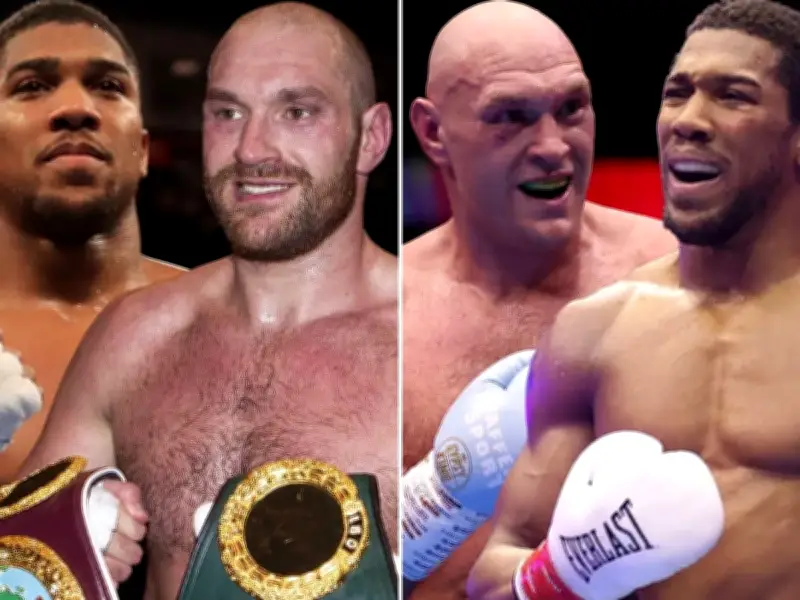
Anthony Joshua and Tyson Fury will finally settle their decade-long rivalry this year. The two British heavyweights will clash in Cardiff on December 11 in an all-British showdown more than 10 years in the making. Neither man will bring a world title to the ring at the Principality Stadium, but both have promised to end the fight early and declare themselves the best heavyweight from these isles in their generation.
Fury will start as the odds-on favourite in Cardiff after Joshua almost caused the fight to collapse again back in July when he was dropped by Kristian Prenga. But the Olympic champion has at least secured home advantage after a bitter fight to wrestle the clash from New York, where it was once headed.
The Infamous Spar and First Interactions
The rivalry traces back to a 2010 sparring session when Fury was a novice pro and Joshua was still two years from his Olympic gold medal. Fury had made an open offer to any heavyweight: if they could knock him out in sparring, he would give them a Rolex or a BMW 3-Series. Joshua later recalled: "I didn't care about his boxing reputation, I just wanted the watch."
Immediately after the session, Fury appeared to concede Joshua had had the better of him. "I went down to Finchley and sparred the UK's top amateur, Anthony Joshua. He came at me for three rounds, and he gave me a beating—I'm not going to deny it," he said. But his story has changed over the years, and he now claims Joshua was ultimately pulled out. "In round three or four, he started putting his knees up in the corner... and then they pulled him out and put somebody else in," he said.
Joshua's then trainer Sean Murphy has since offered perhaps the most reliable account, saying Joshua won the first round before Fury started messing around in the second. Joshua went on to win the third, according to Murphy, before he did indeed pull out his fighter—not because he was exhausted, but because he wasn't being paid.
Fury's first interaction with Joshua was respectful. After Joshua knocked out Kevin Johnson in the second round in 2015, Fury took to social media to call his soon-to-be rival a "machine" while asking "Who can stop this steam train?". But within months, Fury showed his true colours when Joshua accused him of being jealous of his physique. "Jealous of a weightlifter who is fighting for a paper title? Lol you help me! Lol ok, [I] need a gym door man," Fury said. Joshua's response was also a sign of things to come as he fired back: "Keep on praying for my downfall fat boy. I'll see you soon. One Fury at a time."
By the time Joshua had stopped Dillian Whyte in 2015, Joshua formally called out Fury, saying: "I'd fight Tyson Fury now... When I'm ready, I'll make it an easy fight." The speculation ramped up when Joshua won his first world title the following year, at the same time Fury was plunging head-first into a near three-year drink-and-drug-fuelled depression. When Joshua knocked out Wladimir Klitschko in 2017, he took the mic and shouted: "Tyson Fury, where you at baby? Come on, is this what you want to see? ... I love fighting. Tyson Fury, I know you've been talking a lot, I want to give 90,000 people another chance to watch a lovely night of boxing." Fury was quick to respond on social media, saying: "Challenge accepted. We will give the world the biggest fight in 500 years."
All the Belts and Collapsed Negotiations
Boxing loves to marinate a fight; to let it build until it's as big as it can ever be. And then invariably it collapses when one or both men loses. And so we arrive in 2020 when Anthony Joshua and Tyson Fury held all four heavyweight world titles between them—and an undisputed clash was agreed. The deal was for two fights with the first purse split down the middle and the first meeting to be held in Saudi Arabia. The TV networks were on board and an announcement was imminent—until it wasn't.
At the same time Fury was negotiating with Joshua, Deontay Wilder, who had lost his rematch with Fury earlier in 2020, was taking legal action to force a trilogy bout. The American believed he was contractually entitled to a third fight and a judge ruled in his favour, scuppering Fury's clash with Joshua. Fury went on to stop Wilder in their final clash—but another man was about to spoil the party. Enter, Oleksandr Usyk. Having dominated the cruiserweight division, Usyk had moved up a weight class and had his sights set on becoming world champion. He manoeuvred himself into mandatory position to fight Joshua and the Brit accepted the challenge, only to lose first in London and then in the Saudi rematch.
Perhaps sensing a weakness, Fury pounced, offered Joshua a 40/60 purse split for a fight in September 2022 only for talks to break down over how the fight would be broadcast. Eight months later, Fury again called for a fight at Wembley and claimed he had sent a draft contract to the other side; but this was dismissed as a publicity stunt. Fury told Joshua he had "lost his opportunity forever".
It's Here, but Is It Too Late?
It turns out, shockingly, that Anthony Joshua hadn't lost his opportunity forever. Here we are, three years later and just 11 weeks away from the two Brits colliding in the ring. But what will we actually witness on a cold December night in Cardiff? Both men are faded versions of the athletes they were in their prime with Fury also losing twice to Oleksandr Usyk.
He has looked laboured in his wins over Arslanbek Makhmudov and Mariusz Wach this year but Joshua has arguably looked worse in his last few outings. A brutal KO defeat by Daniel Dubois was followed by a bizarre fight with YouTuber Jake Paul before Joshua was dropped by Kristian Prenga in July before recovering to stop his rival.
It could be that two depleted fighters end up giving us a fight for the ages; we may even get a second and third clash next year. But it is difficult not to wonder what might have been.