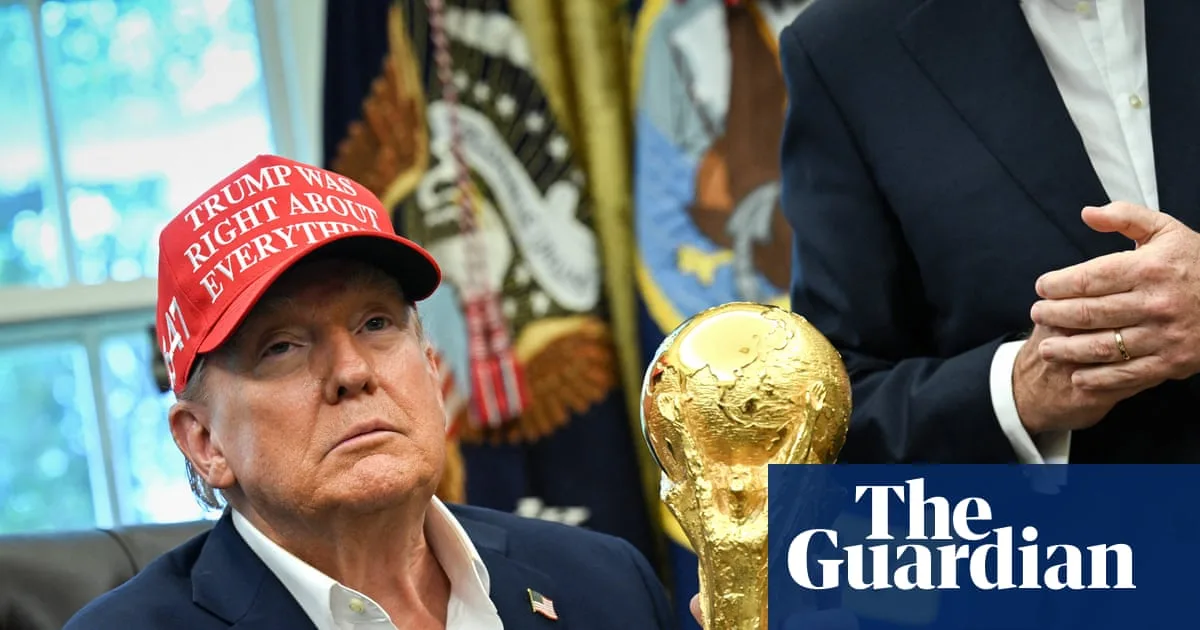
Donald Trump has said he does not care whether Iran will participate in this summer's World Cup, which is being jointly hosted by the United States, Mexico and Canada. The US and Israel began attacking targets in Iran on Saturday, with the conflict in the Middle East spreading to the wider region.
In an interview with Politico, the US president said: "I really don't care. I think Iran is a very badly defeated country. They're running on fumes." Iran was the only nation missing from a Fifa planning summit for World Cup participants held this week in Atlanta, deepening questions over whether the country's team will compete on US soil this summer amid the escalating regional war.
Mehdi Taj, the president of Iran's football federation, said the viciousness of the attacks by US and Israeli forces did not augur well for the World Cup, to be held from 11 June to 19 July. Iran secured a trip to a fourth successive World Cup by topping Group A in the third round of Asian Football Confederation qualifying last year.
The Iranians are in Group G with Belgium, Egypt and New Zealand. Their matches are scheduled to take place in the US, with two fixtures in Los Angeles and one in Seattle. If both the US and Iran finish second in their respective groups, the two countries could meet in a 3 July last-32 match at Dallas Stadium in Arlington, Texas.
Iran is one of two competing countries subject to Trump's most restrictive travel ban, enacted by executive order last June, according to Politico. While the ban carves out World Cup teams and support personnel, decisions on visa exceptions for others are left to the state department on a case-by-case basis. Andrew Giuliani, director of the White House Fifa World Cup Task Force, said in a January interview that security concerns would shape the administration's approach to travel ban exceptions.
In a statement to Politico on Tuesday, Giuliani added: "President Trump's decisive action to eliminate the Ayatollah, the most notorious state sponsor of terrorism in my lifetime, removes a major destabilising threat and will help protect people around the world, including Americans and the millions planning to attend the 2026 World Cup in the United States." In the modern era, no team that has qualified has not taken part in the World Cup finals. Iran would almost certainly be replaced if they withdraw from the tournament.