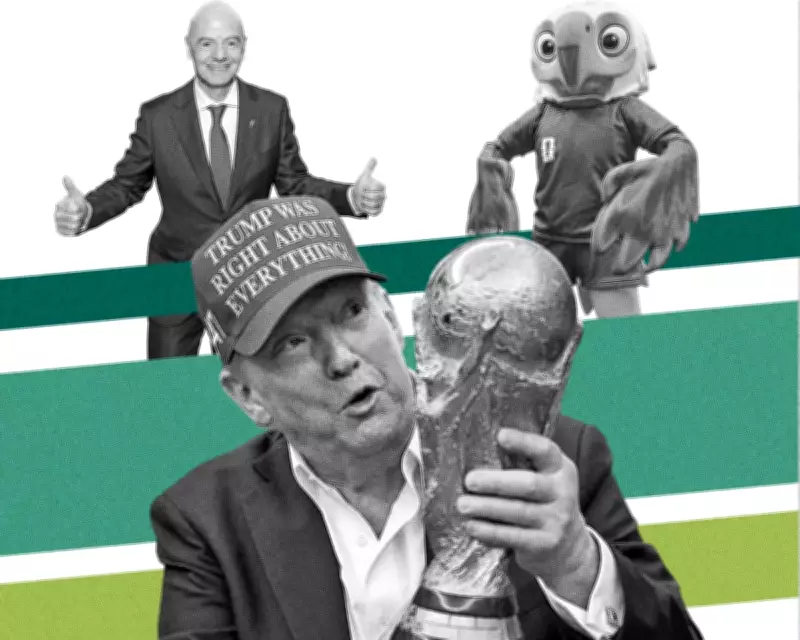
The prelude to this year's World Cup has been overwhelmingly dominated by two figures: FIFA President Gianni Infantino and former US President Donald Trump. Their influence underscores a growing concern about the tournament's vulnerability to political agendas.
The Political Takeover of Global Football
Looking back, the 2018 World Cup in Russia now appears as a subtle but significant nod to Vladimir Putin's regime. The event provided a global platform that validated his leadership and national project during a period of gradual territorial expansion. This summer, however, the build-up has transformed into a monument to Donald Trump, highlighting how the world's most popular sporting event can be co-opted for political purposes.
The situation is set to continue with the 2034 edition awarded to Saudi Arabia, despite its questionable human rights record. This offers Crown Prince Mohammed bin Salman a prime opportunity to reshape both his personal image and that of the kingdom. FIFA has shown reluctance to establish independent oversight for the treatment of migrant workers in Saudi Arabia, raising fears that stadium construction could prove as deadly as it was for the 2022 Qatar World Cup.

A Radical Proposal: Breaking Up the Tournament
It has become increasingly clear that the World Cup requires protection from the various forces constantly pulling at its fabric. The solution? Decentralise the entire competition. Split it into manageable chunks, similar to how one might dismantle a monopoly that has grown too powerful.
Elements of this approach are already emerging. The 2026 World Cup will be shared across three nations, while the 2030 edition will span six countries across three continents. But we should take this concept further. Imagine hosting each group stage in different global cities or regions—one in Paris, another in Rio de Janeiro, others in Tokyo, Sydney, Johannesburg, London, and the Basque Country. The knockout stages could be similarly distributed worldwide, with only the semi-finals, final, and third-place match concentrated in a single location determined through a bidding process.
Addressing Environmental Concerns
Critics will inevitably raise concerns about the carbon footprint. However, participating teams already fly into host nations from across the globe. By strategically locating groups based on the median distance from participating teams, flight emissions might not significantly exceed those generated by forcing 48 teams to crisscross an entire continent. The environmental impact could be carefully managed through thoughtful planning.
The Benefits of a Distributed Model
The advantages would be substantial. The astronomical cost of hosting a complete World Cup has reached levels where only nations with ulterior motives—seeking to leverage the tournament for political or reputational gains—can realistically bid. A decentralised tournament would reduce dependence on any single host nation's whims. Leaders like Trump, Putin, or Prince Mohammed would find it far more difficult to manipulate the event for personal or political ends.
This approach would preserve the World Cup as football's ultimate prize while advancing FIFA's stated objectives: developing the game in more regions, creating a truly global spectacle, and bringing the sport closer to diverse populations worldwide.
Financial Viability and Precedent
FIFA often argues it has a fiduciary duty to its 211 member associations to maximise World Cup revenue for redistribution. This justification has led to exorbitant ticket prices and questionable sponsorship deals with unlicensed prediction markets. However, spreading the tournament need not reduce revenue. Limiting each host city to just three or four matches would create the premium scarcity that organisers value—every game becomes a coveted event.
There is already successful precedent. The 2020 European Championship, postponed to 2021 due to the pandemic, was hosted across 11 European cities. Despite some crowd management issues at Wembley Stadium, the tournament was broadly successful, featuring the highest goals-per-game ratio in Euro history and potentially record attendance without pandemic restrictions. The varied locations added interest and demonstrated the feasibility of a distributed model.

The best way to safeguard the World Cup from its own cultural clout and the social currency it provides may be to deconstruct it. By decentralising the tournament, we can protect its integrity while ensuring it remains accessible, financially viable, and true to the spirit of global football.