Sky Sports' Ref Watch panel has analysed three controversial moments from Chelsea's 1-0 defeat by Sunderland, explaining why a penalty was awarded against the Blues and why they did not receive one themselves.
Former Premier League referee Dermot Gallagher was joined by pundits Tim Sherwood and Jay Bothroyd to review key decisions from the weekend's top-flight matches. Sunderland won at the Stadium of Light on Sunday thanks to an Enzo Le Fee penalty scored in the first half.
Penalty awarded against Chelsea
Brian Brobbey was brought down inside the area by Levi Colwill after the pair tangled, initially pulling each other's shirts outside the box. After entering the area, Brobbey began to pull clear of his marker before going down.
Gallagher said: "They are both grabbing. It starts outside the area, the referee [Jarred Gillett] does not take sides, but once Brobbey gets in front of him and Colwill does not let go, that is when he falls foul of the penalty.
"Once he is in front, he is in the ascendancy and Colwill drags him to the ground, so I think penalty. He does clip his heels as well."
Sherwood and Bothroyd also believed Colwill tripped the Sunderland attacker. Sherwood said: "They are both at it at first, then Brobbey grabs Colwill and puts him on his back like a rucksack and decides to wait for some contact on his legs. He obliges, he goes down and it is a penalty."
Cole Palmer penalty appeal rejected
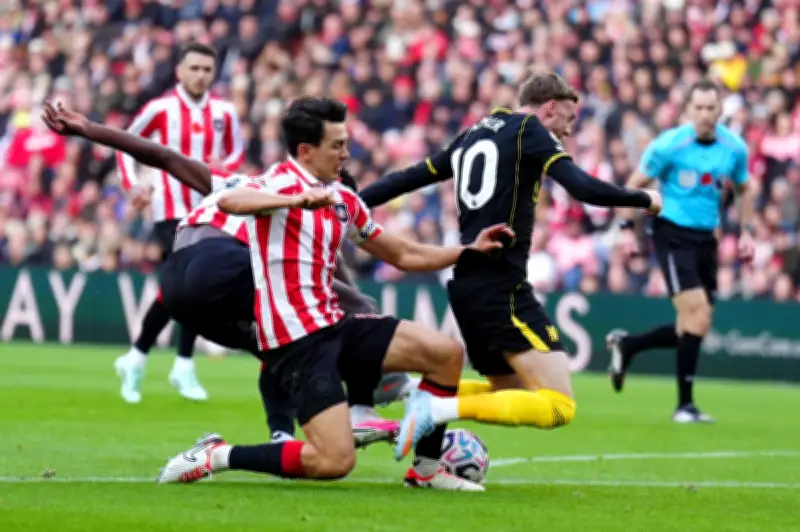
Chelsea fans felt their side should have been awarded a penalty in the same half when Cole Palmer was challenged by Luke O'Nien on the edge of the Sunderland box. Gallagher believed the referee identified Jules Ahoka as the offending player rather than O'Nien.
Any contact from Ahoka would have been outside the box, but closer inspection showed it was O'Nien's boot that brought Palmer down inside the area. No foul was given, and according to Gallagher, VAR could not overrule the on-field official unless there was serious foul play, because Ahoka was deemed the first offending player.
Gallagher explained: "The referee gives a foul against Ahoka. That is what he gives.
"O'Nien completes the action when he is in the box. Once he gives the first foul, that is it. What happens afterwards, he can only take action if he deems there is serious foul play.
"That is what he fed back. What he has to do is, when he is talking to VAR, he has to say who he thinks is the player [committing the foul].
"It is O'Nien's boot in the penalty area. The argument is that if he is on the line, it is a penalty. But it is O'Nien's boot; you can't see the ball.
"O'Nien goes second. VAR said Ahoka went first and he is the first offender. They didn't stop the game. The game went on."
Morgan Rogers incident reviewed
The game's final flashpoint involved Chelsea star Morgan Rogers and Trai Hume. Rogers caught Hume in the head with his knee as he walked past the Sunderland defender, who was on the ground.
Gallagher said of that incident: "When you go on the wide camera, Rogers isn't looking at him. Maybe I'm giving him the benefit of the doubt, but only Morgan Rogers knows his intent. He may have accidentally done it, only he knows."