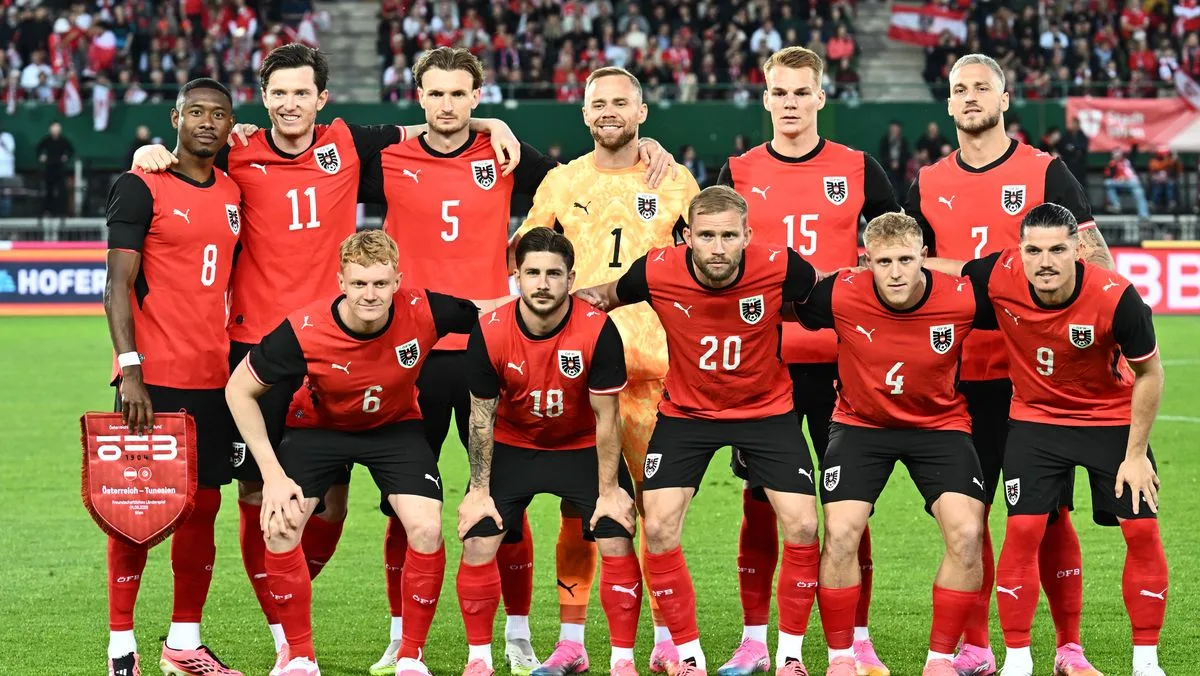
Austria's return to the World Cup stage for the first time since 1998 is one of the summer's most fascinating subplots. For years, the national team was defined by a crippling, ultra-defensive negativity. Under previous regimes, players were actively scolded for crossing the halfway line to press opposition, even when playing minnows like the Faroe Islands. Enter Ralf Rangnick.
The former Manchester United boss has staged a total identity revolution, weaponising a generation of Bundesliga-trained stars into a terrifying, high-intensity Gegenpressing machine. However, behind the scenes, Austria travel to North America wrapped in a bizarre political civil war between a demanding manager and a hostile football association.
To get the inside track on Das Team's spectacular revival and their new dual-national recruits, we sat down with The Other Bundesliga podcast host Tom Middler. For Middler, Rangnick's side are the ultimate tournament disruptors, capable of taking down the world's elite, provided they don't trip over themselves first.
The Austrian General
While long-term injuries at Bayern Munich and Real Madrid have robbed David Alaba of the mobility that once made him a marauding, multi-positional playmaker, his status as Austria's ultimate talisman remains undisputed.
"His importance to the team off the field is every bit as large, maybe even larger, than his importance actually on the field these days," Middler explains. "Even when he's been injured and unable to play, he's travelled to national team camps. He is a big, big figure."
On the pitch, expect to see the multiple Champions League winner deployed stringently at the back rather than pushing into advanced areas. "More as a centre back these days," Middler adds. "He's not the playmaker he once was, but in terms of a talisman, he fits the bill to a T."
The Rangnick Revolution and Backroom War
Rangnick's tactical blueprint has unleashed a squad largely schooled in the Red Bull Salzburg and Leipzig pressing academies. The contrast with Austria's defensive past is night and day.
"The predecessor to Rangnick was famous for defensive football," Middler says. "He would be shouting at players out of possession: 'No, drop back, don't press!' It bewildered everyone. Rangnick has implemented a high-pressure, high-intensity style, and the players are so thankful. They've been saying for years: this is how we play for our clubs."
That said, this transformation has triggered a toxic feud with the Austrian Football Association (UFB), who resent the German manager's constant demands for better facilities and funding. "There's a lot of friction behind the scenes," Middler reveals. "Ralph has had a little battle with the UFB, who don't particularly warm to Rangnick."
"They don't like the fact that a German has come in and is demanding all this change... they want to keep things as they were, they want money for their own regions, not for the national team, which is very strange. Rangnick has been able to affect change, but at a cost."
"There is talk that he'll be kicked out and that the UFB don't want to renew his contract. They were saying when he qualified for the World Cup, which was the big, big goal, they were saying, 'yeah, but with this team of players, anyone could have done it.' So there's friction behind the scenes. But the players love him and the fans love him."
Parachuting in the Passports
In a massive pre-tournament coup, Rangnick utilised his continental connections to secure Austrian passports for two of Europe's brightest young dual-nationals: PSV Eindhoven's Paul Wanner and Borussia Dortmund's Carney Chukwuemeka, formerly of Chelsea and Aston Villa.
"Rangnick was instrumental in bringing them in," says Middler. "Carney Chukwuemeka brings something a little bit different in terms of his ability to carry the ball forward. He's a physical, athletic player who drives against defenders and isn't afraid to take them on."
While parachuting players in just months before a major tournament can sometimes upset a dressing room, the Austrian public has welcomed them with open arms. Middler added: "Austria usually loses a lot of good talents, especially of Bosnian descent, who switch allegiances later. The public here were just really happy to see Austria actually gaining some good talents for a change."
Potential Giant-Killers
Austria find themselves in a highly compelling group alongside Argentina, Algeria, and Jordan. While they open against lowest-ranked Jordan, it is the clash with the world champions that might ironically bring out their best.
"The Argentina game arguably might suit Austria best," Middler notes. "They don't tend to play so well against a low block when they are forced to take the impetus. But when they play against teams who are really going to try and hurt them, this is where Austria come to life. They're not going to sit back against Argentina, they're going to give it a go."
With recent high-profile scalps over Germany, Croatia, the Netherlands and a 5-1 thrashing of Erling Haaland's Norway, Austria possess a terrifying ceiling. "I think people are underestimating them," Middler concludes. "They have the ability to knock out one of the big names, but also the ability to lose to one of the smaller names. If they get through the group, nobody will want to face them in the knockouts."