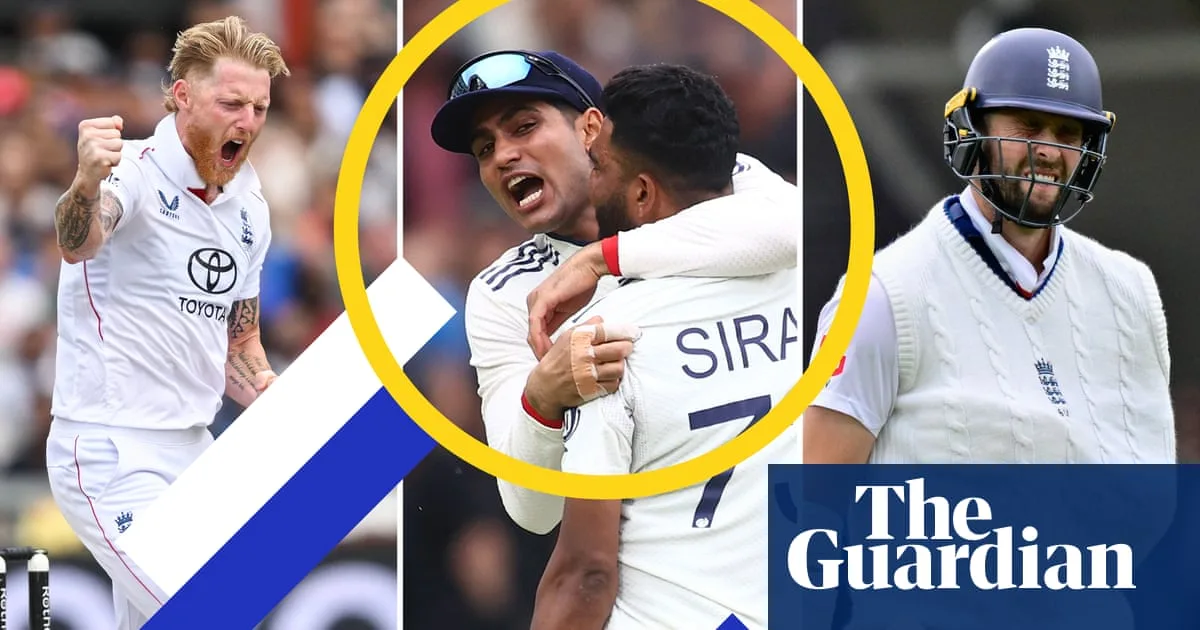
Ben Stokes: 304 runs at 43.4; 17 wickets at 25.2. It is no exaggeration to say that a magnificent series such as this is the product of how Baz McCullum and Ben Stokes have reinvented English Test cricket, a change comparable to Pablo Picasso’s and Georges Braque’s revolution of European art a century ago. The England captain was back to his best as a bowler, moving the ball, finding bounce and going the extra miles. His batting suffered a little, but he signed off at Manchester with a century. His run-out of Rishabh Pant at Lord’s was brilliant in conception and execution, and turned a tight Test England’s way. Most of all, his stamp on the team is so embedded that it seems impossible that England will play any differently in the foreseeable future. That brings a downside but the upside is good for England, good for the game and good for the fans. Just look at the faces in the crowd. Grade A
Zak Crawley: 290 runs at 32.2; six catches. He batted against type in the crucial opening stand of 188 at Headingley that launched England’s extraordinary chase of 371 that won the first Test. Thereafter balls wide of off stump were boomed through extra cover or nicked off to slip, two more half-centuries added amid the inevitable disappointing scores. People have long made up their minds about the cost and benefit of his place in the team, so it’s not interesting to rehash those arguments again. His catching in the cordon was unusually inconsistent, especially in the very tight fifth Test. Grade C
Ben Duckett: 462 runs at 51.3; three catches. As is the case with his opening partner, we know what to expect now: cuts, pulls and drives (but few leaves) to keep the scoreboard moving with the occasional turbo of boundaries boost to spin the tins even faster. He made 62 and 149 in the crucial win that set the series in motion and cashed in with 94 on the dead track at Old Trafford. Grade B+

Ollie Pope: 306 runs at 34.0; two catches. Such are his technical issues that his innings have become painful to watch, the head, hands and feet seldom aligned and every ball looking like a potential stump smasher. He picked up his customary series century – the man has heart – but you fear for what awaits in Australia. As captain, he delivered an epic Test at the Oval, but it seemed that Joe Root and McCullum were, let’s say, very active members of the leadership group. He looks like he needs a domestic summer to recalibrate his game. At 27, he has time on his side. Grade C
Joe Root: 537 runs at 67.1; two wickets at 122.0; five catches. There’s not much left to say about Test cricket’s second-highest run scorer. His game, especially since handing over the captaincy to Stokes – one of the best decisions the England and Wales Cricket Board has ever made (no giggling at the back) – is so grooved that it’s hard not to take it for granted. When he was out in the chase at the Oval, it felt like three wickets not one – when he does eventually put his bat away, it will feel like three batters have gone. Grade A
Harry Brook: 481 runs at 53.4; no wicket for 55 runs; 11 catches. He will infuriate those infuriated by Crawley for many of the same reasons, but it seems churlish to blame the man who gave England the chance of a spectacular series-sealing chase at the Oval for the crime of getting out on 111. The problem is that he’s often so dominant at the crease that any dismissal feels like a wasted opportunity to score twice as many. Should we praise the two centuries, a 99 and another fifty or lament the sometimes wild shots that led to their termination? It seems clear that you don’t have one without the other. His catching, though prolific, was fallible, crucially so in a tight series. Grade B+