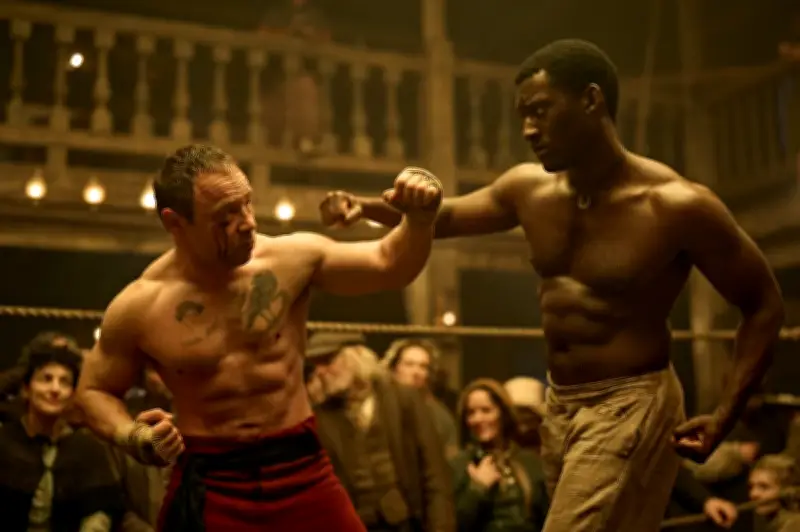
Billed as the world's fastest-growing combat sport, bare-knuckle boxing has stepped out of the shadows and pub car parks to reach TV, TikTok and The O2 in London. At a recent event at Indigo at The O2, a crowd of around 2,000 gathered to watch fighters compete inside a patented "trigon" — a triangle measuring roughly 16 feet per side — where organisers insist there is nowhere to run and nowhere to hide.
Opponents fight over five rounds, each lasting two minutes, though around 90 per cent of fights end long before then with a knockout or technical knockout. The action is relentless, with fighters like Claas "The Operator" Lilie, a 29-year-old German, and Carl "The Giant Killer" Hobley, a 43-year-old with a noticeably podgy midriff, stepping into the trigon without gloves.
From Underground to Mainstream
In popular imagination, bare-knuckle fights take place in seedy underground basements or pub car parks. But over the past decade, the sport has been slowly stepping out of the shadows. In 2015, there were just 21 licensed bouts in the world; today there are more than 1,000, across 21 countries. Throughout America, Mexico and the UK, large crowds flock to major venues to watch it.
BKB, which bills itself as the world's largest bare-knuckle boxing promotion, has struck deals with talkSPORT, Vice TV and — perhaps most significantly — TikTok. It is there that bare-knuckle has found a particularly rapacious audience: one event in July attracted 7.1 million views.
There is serious money circling, too. Rival organiser BKFC, part-owned by Conor McGregor, is reportedly seeking $25 million (£19m) in fresh investment, having previously touted a valuation of $350m. BKB's own finances are less transparent, though its CEO, David Tetreault, has spoken of ambitions to build a billion-dollar business.
Appealing to a New Generation
"Traditional boxing is really anchored in Gen X and Boomers, who are ageing out," explained Tetreault. "Dana [White, CEO of UFC] did incredibly well with the millennial audience. For bare-knuckle, that opens the door for us with Gen Z and Gen Alpha."
Everything about BKB is set up for the limited attention spans of the scrolling generation, from the tiny canvas to the high rates of bloody, violent finishes. It makes a traditional boxing match, which often goes the full 12 rounds, look like test cricket by comparison. Former IBF featherweight world champion Lee Selby, who has made the switch to bare-knuckle, describes it perfectly: "I was a championship fighter from early doors, fighting 12 rounds, so I had to pace myself — it was a marathon rather than a sprint. BKB is closer to a sprint."
Tetreault likes to talk about the "gamification" of the sport, appealing to young fans raised on high-spec video games. "We have a team that's analysing the stats that are coming in: the number of punches landed, the G-forces, types of punches, speed, all of that. And we have graphical overlays that come in that help tell that story," he explains.
Brutal Action and Safety Debate
The action at Indigo came thick and fast. A man known as Luke "Smudger" Smith lasted just over two minutes before his opponent, Paul "Sully" O'Sullivan, caught him with a straight right to the face that sounded like an egg carton being stamped on. Smith's body went limp and started falling like a felled tree; there was still time for another two cracks on the jaw as he went down. Thankfully, Smith got up, his face a mess of bruises, cuts and anguish.
Selby knows what that feels like. "I'd spoken to a few boxers who said they'd rather get hit bare-knuckle than with gloves. They were certainly wrong. The first shot that hit me on the jaw felt like I got hit with a rock. The power was the same, but the surface area was a lot different."
About three people a year die from injuries sustained while boxing. For most people the danger is off-putting; for others it is the appeal. Gloves are what give the act of punching another person in the face a veneer of civility, though according to Tetreault, dismissing bare-knuckle as more barbaric and dangerous is inaccurate. "The optics of the sport confuse many on the efficacy and the safety," he says. "When you look at it from a concussion standpoint, there's significantly less in bare-knuckle compared to the accumulation of punches that a boxer will sustain during the traditional match."
Even Selby admits he was taken aback by the spectacle. "When I first watched it, it did look a little bit brutal, and I've boxed my whole life." The argument is that, even though bare-knuckle generally produces worse lacerations and cuts, there is far less of the steady, thudding punishment that can result in brain damage. While there is some evidence consistent with this argument, the relative dangers of combat sports are hard to prove, particularly when it comes to long-term neurological damage.
A New Champion Crowned
One exception to the quick finishes was a fight between Marko Martinjak, the Croatian knockout artist regarded by some as the greatest bare-knuckle boxer of all time, and Matty Askin, the former British champion at cruiserweight. Like an increasing number of traditional boxers, Askin has been lured out of retirement to give bare-knuckle a try. BKB won't disclose what it pays its fighters, but insists that former world champions wouldn't be signing up unless it was worth it. Selby, for his part, has noticed a difference in how the businesses operate: "In my whole boxing career, I always fought first and got paid afterwards. This is the first time I've ever been paid before I stepped into the ring."
At first Martinjak seemed on top, but Askin still had the reflex to counterpunch effectively, even after eight years out of the ring. By the end of the first round the back of Martinjak's bald head was smeared with blood. Within 30 seconds of the second round, Martinjak was on the floor, one arm hooked over the bottom rope and counted out for 10. Askin was crowned the new BKB bridgerweight world champion.
The crowd erupted. In the trigon, Askin was close to tears. "He had me a few times in there," he said into the microphone. "I had to f***ing graft, and I'm finally a world champion."