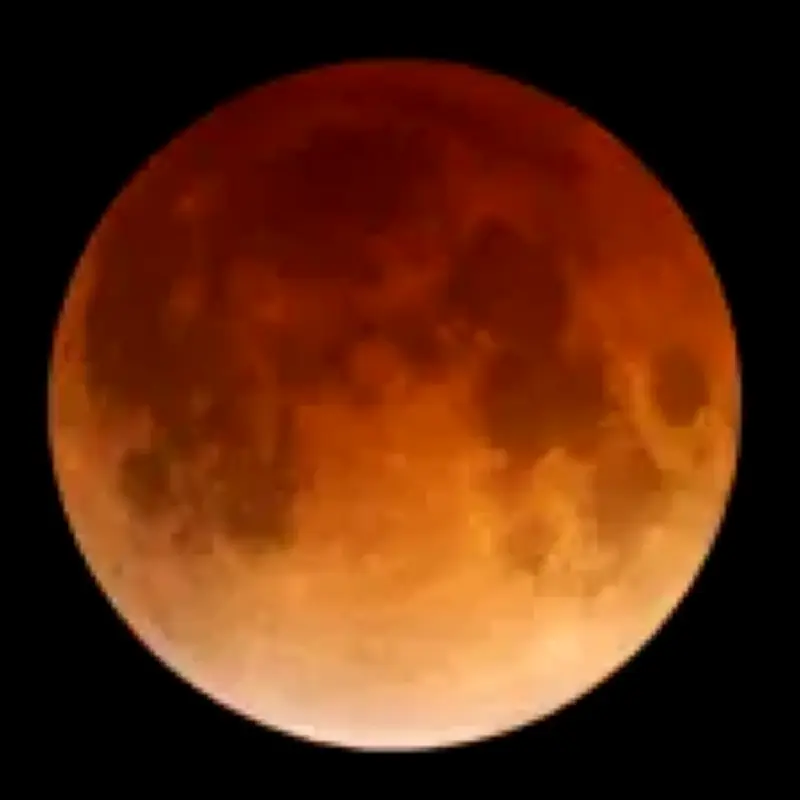
Weeks after a 'once-in-a-lifetime' partial solar eclipse, the UK is being treated to a full moon AND a partial lunar eclipse, all in one evening. The two lunar events will occur at the same time on Friday morning, where the full moon will take on a deep blood red colour as Earth steps between it and the sun to form the lunar eclipse.
The rising full moon is nicknamed the Sturgeon moon, and it's expected to reach its peak just minutes after the partial lunar eclipse reaches its maximum. If you want to know how to see both the full moon and the eclipse, and whether you need any of those rare eclipse glasses to watch it, the stargazers here at Metro have you covered.
What is a lunar eclipse?
The Earth and moon are constantly doing a cosmic tango around the sun and, now and then, align. Lunar eclipses happen when the Earth slides between the sun and the full moon. The darkest part of the planet's shadow, called the umbra, blankets the lunar surface, making it shine crimson instead of the usual dusty white.

There are three types of lunar eclipses: Total, when the umbra swallows the moon whole; Partial, when it takes a small bite; and Penumbral, when only the outermost part of Earth's shadow, known as the penumbra, grazes past our celestial neighbour. This doesn't make the moon red but does darken it. It's why this type of eclipse is often called a blood moon.
Don't worry, the red isn't a sign of the end times. Even though it's nighttime, sunlight still leaks through the edges of the Earth, Jake Foster, an astronomer at the Royal Observatory Greenwich in London, tells Metro. 'Our atmosphere then filters the sunlight that passes through it, allowing mainly red light to reach the moon and illuminating the lunar surface in an eerie red light,' he says.
How red the moon becomes partly depends on how many particles like clouds or dust storms are floating in our skies. This is in contrast to a solar eclipse, which happens when the moon elbows itself between the sun and our planet. Lunar and solar eclipses always occur about two weeks apart – the amount of time it takes for the moon to move from one side of Earth to the other.
'If you were standing on the moon during a total lunar eclipse, you would see the sun disappear behind the Earth, and a glowing ring of red light surrounding the Earth where the sun's light passes through our atmosphere,' says Dr Megan Argo, a reader in astrophysics at the University of Lancashire. 'Effectively you would be seeing all of Earth's sunrises and sunsets at once.'
What time is the partial lunar eclipse?
A big difference between a lunar and solar eclipse is that, unlike a solar eclipse, lunar eclipses occur at the same time for everyone. They also happen slowly. Penumbral – when the moon begins to pass Earth's shadow – will start from 2.23am and last until 8.01am.
Around 94% of the full moon will be covered by the Earth's shadow at 5:12am, turning it a coppery red, with only a small sliver of silver left. Minutes after, at 5:18am, the Sturgeon full moon is expected to reach its peak. Due to its position in the sky, it'll cause a phenomenon known as the moon illusion, which makes it look bigger than usual in the sky.
Do I need glasses to see the lunar eclipse?
Unlike a solar eclipse, you can look up at this eye-catching spectacle without the need for protective eyewear, like those rarer-than-gold-dust eclipse glasses. Lunar eclipses can be seen with the naked eye, but binoculars or a telescope will help you get a better view. You also don't need a solar filter to see the blood moon with professional viewing equipment.
'Simply look towards the southwest to spot the moon,' Foster says. 'It will be fairly low during maximum eclipse, so a clear view of the southwestern horizon is recommended. The moon will set below the horizon around one hour after the eclipse's maximum, meaning UK viewers will miss the latter part of proceedings.'
Though how much, if any, of the blood moon you see will depend on how clear the night sky is. And, in a classic UK way, it's not looking too good. Timeanddate.com says that most major cities, including London, Cardiff and Glasgow, will be cloudy or rainy. You won't need to wait too long for the next one – a penumbral lunar eclipse will take place between February 20 and 21 next year.

What is the Sturgeon full moon?
The lunar eclipse will be accompanied by the rise of the Sturgeon full moon, the ninth full moon of the year. If you haven't been following, all full moons that rise throughout the year are given unique names, and August's – known as the Sturgeon moon – is no different.
The names of full moons originate from the Native Americans, who used each month's moon as a calendar system to help them keep track of the seasons, like last month's Buck moon. The Sturgeon moon is the Native American name for August's full moon, named after the fish species that usually appear in larger numbers throughout the month. Other names for the moon include the green corn moon, the grain moon, and, due to the eclipse, the red moon.
If you don't catch August's full moon, don't worry. There are four more full moons happening this year, including two that peak during more sociable hours: The harvest moon on September 26 (5.49pm), the hunter's moon on October 26 (4.12am), the beaver moon on November 24 (2.53pm), and the cold moon on December 24 (1.28am). And if you're looking for more cosmic fun, Saturn will reach its closest point to Earth in October, days before the gorgeous Draconid and Orionid meteor showers begin, so there's plenty to look forward to.