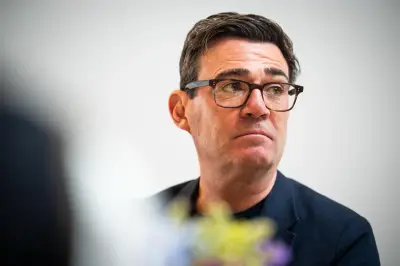
The Manchester Evening News was given exclusive behind-the-scenes access to No 10 North, the new northern base where Andy Burnham intends to spend at least one day a week during his premiership.
It is part of his radical devolution agenda – or 'rewiring the state' as he calls it. It was from here that he chaired the first meeting of the revived National Economic Council at the end of his first week as Prime Minister.
A new seat of power in Manchester
Downing Street said the new hub means 'decisions about the country's economic future will no longer exclusively be made in Westminster'. The widely reported long-term plan is for the operation to move to the Manchester Digital Campus in Ancoats, although that will not be fully open until 2032. However, sources close to Mr Burnham suggest another location is being sought.

Heron House makes sense in the meantime, as the six-storey 1980s office block is already the northern base for GCHQ, the UK's intelligence and cyber-security agency. From the outside, it looks remarkably ordinary. It faces a busy public square, above a Slug & Lettuce bar, a branch of Greggs – which even renamed its sausage, bean and cheese bake in honour of the Prime Minister after he namechecked it in an interview – and a collection of trendy cafes serving Vietnamese drip coffee and Japanese matcha lattes.
Shoppers sit on benches opposite the low metal barriers and police guards at the front door. There's even a registry office for births and deaths. On the Prime Minister's first day at Heron House in July, couples were going inside to tie the knot – but sadly for them, they didn't bump into the main man himself. Round the back is Wing's, a Chinese restaurant that opened up in Lincoln Square in the mid 2000s. Little did the owners know that, one day, the entrance would be metres away from the back door to the northern seat of power in Burnham's Britain.
Security and the replica door
But it is deceptively secure. I am buzzed in through the back door after which security officials behind a glass screen ask for my ID before letting me in through yet another door that leads into the security room. Officials and political advisers don't have to go through quite the same rigmarole. Having been cleared for security previously, they go through a separate door.
Louise Haigh, the First Secretary, arrives with her aides, dressed in a tailored navy dress and sporting red nails. It's remarkable, given that No 10 North was reportedly assembled in June, with many of those close to Burnham not even being aware of it. No 10 North's director general is Sam Lister, who was reportedly appointed only on the Friday before Heron House opened to staff on Monday, July 20.
A lift brings me onto the third floor, opening up to the makeshift reception area, where there is a black backdrop with the branding 'No 10 North'. There's even a big shiny door that is a replica of the one at 10 Downing Street. The replica was created for an art installation in support of the GREAT Britain Campaign in 2015 and has LED technology embedded in it.
While Downing Street has Larry the cat, Heron House has to make do with a cardboard cut-out of the chief mouser. Presumably mice can't scurry all the way up here, unlike in the rickety old building in SW1.
'It's absolutely not a gimmick'
It's not long before we are escorted into the Prime Minister's office. There's a table which can seat around 10 people, a small grey sofa and a coffee table on which is a copy of 'There's gonna be a show', by Jimmy Mulville. Written by the Everton-supporting comedian who studied at Cambridge University, the memoir is about how the love for a football team can bring a prodigal son home, back to the city and family he never stopped loving.
There's also a chair that looks rather like a throne. Appropriate, perhaps, for the self-styled King of the North. Mr Burnham's wingback chair was a parting gift from his colleagues at the Tootal Buildings on Oxford Road, his office while he was mayor of Greater Manchester. The glossy fabric is patterned with Manchester's iconic worker-bee symbol and the city's motto, 'we do things differently here'.

And that's precisely the aim of No 10 North, he tells me. "It's absolutely not a gimmick," he says, pre-empting the question. Is this really a different way of doing government, or simply Downing Street with a Manchester postcode? "I like the balance," he replies carefully. "It was always about balanced decision making."
Does it feel a bit strange having to walk past a Greggs and Chinese restaurant to get in? "It's how it should be," he smiles. "But it doesn't diminish the importance of Downing Street. It's where the country has always been run from. That will always be the case. But it's about bringing what happens there a bit closer to people."
Rough sleeping admission
Mr Burnham also has to admit that he 'may not succeed' in trying to get rough sleepers off the streets in time for Christmas. Earlier that week, the Prime Minister announced a national drive to end rough sleeping, backed by increased funding of £102 million, with a combined package of £442 million geared towards ending the crisis in England.
But when asked if he is confident he can achieve his goal, Mr Burnham gives a candid answer. "I will do my best to give everybody an offer," he tells me. "And I may not succeed. Let me just put my hands up and say that. I'd rather try, because that's who I am. I want to bring those values to the way I go about this."
When we speak, on a Friday morning, Mr Burnham seems different from the man who many people in Greater Manchester will remember. There is a more guarded energy, something I first observed during the Makerfield campaign. He seemed serious, less the informal 'Andy' that people in the region are familiar with.
But now, sitting in his northern office, the Prime Minister talks about those years and what he learned from them. "I'm trying to change the country through what I learned in my time as mayor. And I am grateful to the MEN for the way you challenged me over the years, and you pointed out where I got things wrong and you helped me learn," he says. "I'm bringing all of that learning to the service of the country and, hopefully, we can make some changes as a result."
Observing a virtual meeting
The interview is only 15 minutes long. There is not enough time to grill him on every policy, every decision and every controversy that comes with the job. That will have to be done another time, though it's unclear exactly when. There is a perception that, so far, Mr Burnham has avoided significant scrutiny. But we do get to observe a meeting he is chairing with the country's regional mayors and ministers, who have appeared on a giant screen.
The MEN is allowed to sit in for the first five minutes, as Mr Burnham makes his opening remarks. Ben Houchen, Tory mayor of Tees Valley, is on the screen. Bev Craig, the new mayor of Greater Manchester, is beaming in 'from abroad'. The housing and sports ministers also join the call. Angela Rayner appears from what might be her home. She makes a bizarre reference to 'dad dancing' before Burnham reminds the Housing Secretary that members of the press are listening.
The First Secretary, or 'Lou' is sitting at the table near Chancellor John Healey. Opposite them is Caroline Simpson, Mr Burnham's chief of staff who was previously the group chief executive of Greater Manchester Combined Authority. The meeting is intended to happen monthly, or at least every six weeks, the Prime Minister says.
He comes out with the buzz phrases we will all be familiar with from his campaigning: shared endeavour, getting things done, changing the way things are done, growth in every postcode. "When you have a growth project you obviously will have to come down to London and go round Whitehall departments and the outside agencies and it can be a hard process, a frustrating process."
No 10 North, he claims, will change that and make it 'more dynamic'. "You've got one black door… not so much in the south anymore but up here in Manchester to knock on."
I understand the symbolism, but is there a reason this virtual meeting couldn't have happened from London, I later ask a civil servant. It's a fair comment, they say, but it's also about sending a strong signal to officials and the public. No 10 is about building a 'model of collaboration'.
Around 50 civil servants are currently based here, with the number expected to reach around 150. Some are currently commuting from as far as Bristol and Darlington. Later that morning, Mr Burnham announces that Whitehall officials will be posted into mayors' offices on secondments lasting from six to nine months.
A tour of the building
Before long it's time to begin our tour. Our phones are taken from us and stored in a secure place. To get through the doors, staff need to swipe their cards and type in a code, which ensures maximum security. "It's like a standard open plan office … except the Prime Minister is here," says one civil servant. "It's like being in the corporate world but on steroids."
The building itself is part homage to Manchester and part tribute to the organisation that occupied it before Mr Burham arrived with his staff. In the canteen, shared with GCHQ, there is a framed poem by Tony Walsh. 'This is the place' became a symbol of defiance overnight when Walsh read it at a vigil for the victims of the Manchester Arena terrorist attack in 2017.
There are also references to the suffragettes, Alan Turing and Manchester's history. But there is also a glass case containing GCHQ mugs, a puzzle book produced by the spy agency and steel water bottles. There is even a King Edward oven for baked potatoes. It is lunchtime by now but there aren't any spuds inside.
There is a mini GCHQ museum, too. One telephone lets you pick it up and listen to audio from Jodrell Bank. There are several glass cases dedicated to Alan Turing, who helped with the code-breaking effort during the Second World War. Inside are his top-secret report from his time at Bletchley Park, the court report from his 1952 conviction for 'gross indecency' (because he was gay), the Enigma machine, a Turing £50 note and a special edition of Monopoly.
The atmosphere certainly feels different from the mental picture of Whitehall. There is a lady going around with a trolley, offering staff hot drinks and biscuits. If I am not mistaken, I spot M&S's Dutch Shortcakes, the ones half-dipped in chocolate. The tea lady – whose name I can't publish – normally works in Downing Street but has been seconded here for a few days each week while someone is hired on a permanent basis. "The set-up time was quick," she tells me. "In the long term they will be recruiting someone local."
As we're on the same floor as GCHQ I spot a couple of people who may be spooks. There are special doors for their staff: opaque cylindrical pods with two sets of curved sliding doors, leading into corridors and, presumably, places even the civil servants are not going to see.
The communal area, just past reception, has a plush grey sofa and a view to die for. Through the inch-thick glass, you can see Albert Square and Manchester Town Hall. But here's the thing. We can see out, but no one can see in. It's another reminder that the ordinary-looking office block is anything but. Below us, people take selfies in front of Heron House, apparently unaware that they are being watched from above.
In the breakout area are framed Stanley Chow portraits of some of the city's most famous figures, including LS Lowry, Emmeline Pankhurst and Marcus Rashford. Close to the PM's office there is a whiteboard headed 'Priority Projects', with a list of mayoral demands, including the Northern Powerhouse Rail, Atom Valley, and Victoria North. The announcements have all entered the public domain, so we can publish what is written on the board.
The auditorium and the Chancellor
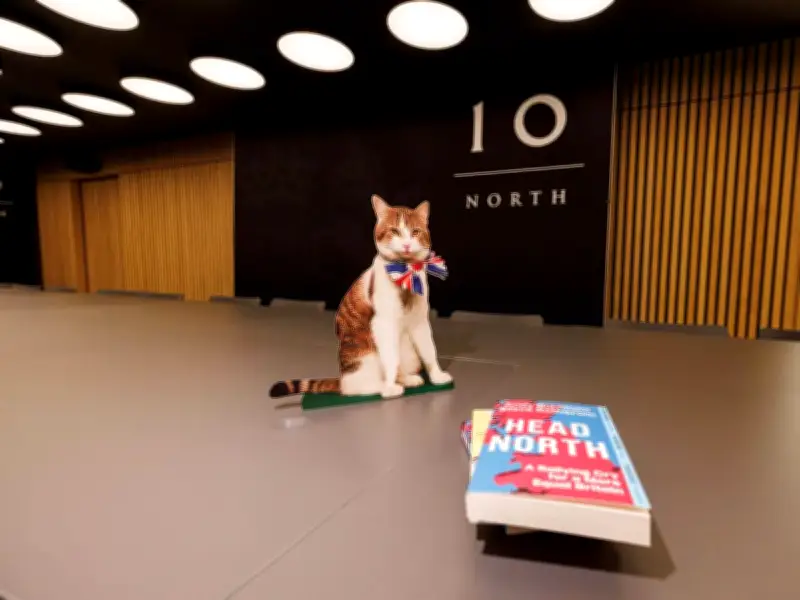
Then we are taken to the auditorium. A staff member scans her ID card and types in a code. The huge black door swings open like a vault inside a bank. Inside is a long table with around 30 chairs. Cardboard Larry has been plonked on it beside copies of Head North, Burnham's book co-written with Liverpool mayor Steve Rotheram.
And then the Chancellor appears. Although the Budget is looming, we aren't privy to what is inside the big red briefcase John Healey is carrying. In late October, whatever is announced will either be a nice surprise or a nasty shock. But in the meantime Healey does share one thing with the MEN. "Andy is happy in this job and he's happy in himself," he says.
Even Ben Houchen, the Conservative mayor of Tees Valley, reportedly said to Mr Burnham: "If you can't do this, then no one can". It suggests he might be hopeful, despite their party political differences.
There is a sense inside No 10 North that this is an experiment for the whole country, not simply for Manchester. Those working here insist that civil servants have to let go of some of the things they have been holding on to, and get on board. But there is an acknowledgement that No 10 North has to make clear that it is not simply 'No 10 Manchester'. It's also supposed to serve places beyond.
One publication dismissed the base as Burnham's 'Manc-a-Lago' – a play on Donald Trump's Florida residence. Except in Heron House there are no gold fixtures, swimming pools or golf courses nearby. The contrast is almost the point. No 10 North is trying to look ordinary. But it is designed to change something that has rarely been ordinary in British politics – where power lives.
For Mr Burnham, No 10 North has to become more than a symbol or mere gimmick. It has to prove that moving some of the machinery of government away from Westminster can make a real difference to the way decisions are made. Not just for the sake of his devolution agenda, but for his own credibility.