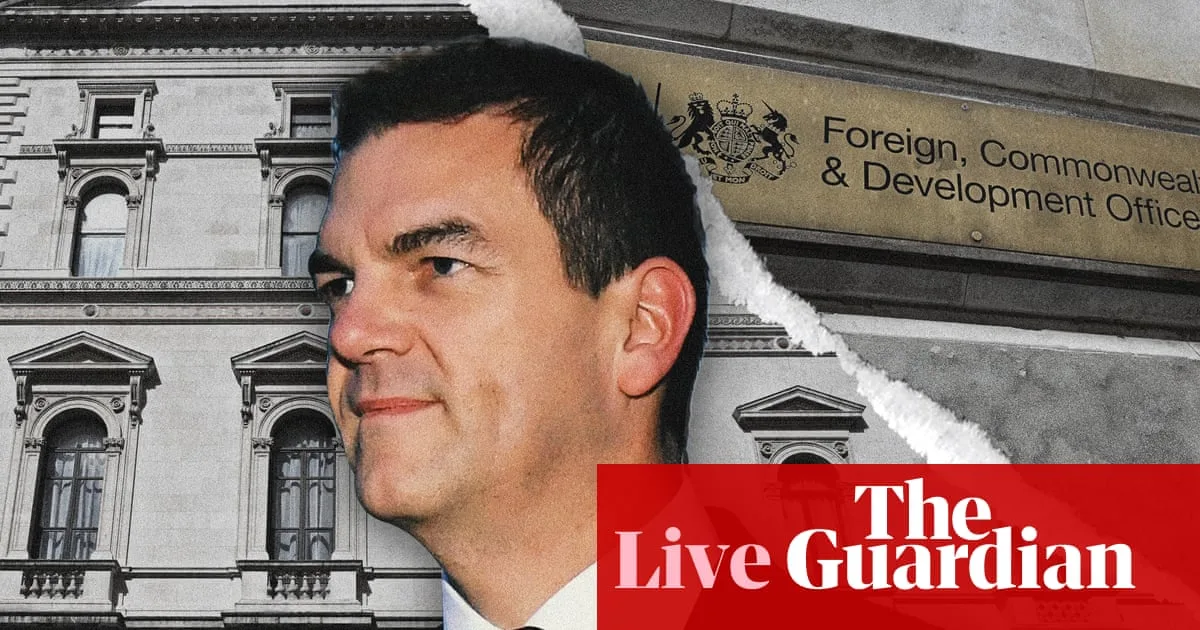
Former Foreign Office Chief Claims Olly Robbins Was 'Thrown Under the Bus'
Ex-Foreign Office Chief: Olly Robbins 'Thrown Under the Bus'

Former Foreign Office Chief Claims Olly Robbins Was 'Thrown Under the Bus'

Lord Simon McDonald, the former permanent secretary at the Foreign Office, has publicly stated that Sir Olly Robbins was "thrown under the bus" when he was dismissed from his role as the most senior civil servant in the department. This dramatic assertion comes in the wake of Sir Olly's sacking this week, following a loss of confidence from Prime Minister Sir Keir Starmer and Foreign Secretary Yvette Cooper.

A Political 'Scalp' Amid Vetting Controversy

Lord McDonald, who served as permanent secretary from 2015 to 2020, described Sir Olly as a "scalp" for Number 10. This follows revelations that the Foreign Office overruled security concerns during the vetting process to appoint Lord Peter Mandelson as the British ambassador to Washington. The department has faced criticism for clearing Lord Mandelson in January 2025, despite him failing a secure vetting procedure.

Speaking on BBC Radio 4's Today programme, Lord McDonald emphasised the severity of the situation, stating, "I think this is the biggest crisis in the diplomatic service since I joined it in 1982." He highlighted that Sir Olly was required to resign within the same news cycle that the story broke in The Guardian on Thursday morning, suggesting a rushed and unfair process.

Wide Pickt banner — collaborative shopping lists app for Telegram, phone mockup with grocery list

Prime Minister's Fury and Security Oversight

The Government has disclosed that Prime Minister Sir Keir Starmer only learned on Tuesday that Lord Mandelson was approved for the Washington role against the advice of security officials. Sir Keir expressed being "absolutely furious" and described the failure to inform him as "staggering." This lack of communication has intensified the political fallout, raising questions about transparency and accountability within the Foreign Office.

Lord McDonald challenged the use of the word "failed" to describe the vetting outcome, noting that such processes are often "murkier" and involve incomplete information, hesitations, and required mitigations. He argued that if there had been a definitive failure, it would have been conveyed to the political level, but the absence of this indicates a more complex scenario than Number 10 has portrayed.

Confidentiality and Legal Compliance

Details of security vetting reports are "very closely held" and typically not shared with Number 10 or the prime minister, according to Lord McDonald. He explained that Sir Olly was obligated under the Constitutional Reform and Governance Act 2010 to "maintain confidence" on such details, likening the process to the confidentiality of medical records. Lord McDonald asserted that Sir Olly was following legal procedures and applying his judgment appropriately, as expected in sensitive vetting cases.

Impact on the Foreign Office and Future Steps

The dismissal of Sir Olly Robbins represents a significant blow to the Foreign Office, particularly during a "complicated, difficult, important time internationally." Lord McDonald stressed the urgent need for a new head, advocating for a quick and internal replacement process to ensure credibility and qualifications from day one. He noted that there are a couple of immediately available candidates who could step into the role, helping to stabilise the department amidst this crisis.

This incident underscores broader issues of partisanship and policymaking within Whitehall, as political pressures appear to have influenced civil service decisions. The fallout continues to resonate, highlighting the delicate balance between security protocols, political oversight, and diplomatic integrity in the UK government.

Pickt after-article banner — collaborative shopping lists app with family illustration




