

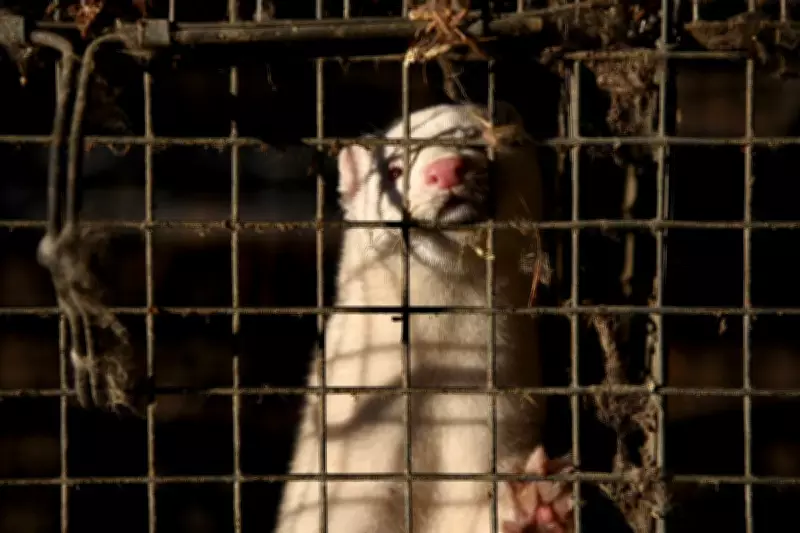
Every year, millions of captive animals are gassed or electrocuted and turned into expensive fur coats. Although the industry has shrunk considerably, it poses a disproportionate risk to human health. There is a real chance that the next pandemic could be incubated within the cramped confines of a fur farm, and banning this cruel practice could be one of the most consequential public-health measures in decades.
The Inhumane Conditions of Fur Farms
Fur farms are hellish environments. Like other factory farms, they confine thousands of animals in tight spaces, crammed into tiny wire cages. Often, the animals can barely move, living out their sad, stationary lives atop pools of their own waste. Some species, like red foxes, begin chewing the tails off their young or even killing them. Others develop nervous tics. Chinchillas, for example, are known to tear out their own hair, a behavior so common that some have explored mass-administering the antidepressant Prozac to the animals. A fur farm assessment for the European Commission concluded that, in most cases, neither prevention nor substantial mitigation of the identified welfare consequences is possible in the current system.
A Hazard to Human Health
Fur farms are not only inhumane but also hazardous. Mink, the most common captive species, act like viral sponges, picking up respiratory pathogens from humans and other animals. When thousands of inbred mink are packed into crowded, stressful settings, viruses spread like wildfire, with numerous opportunities to replicate, mutate, and grow more dangerous before jumping back to humans. Farming mink is essentially a dangerous genetic experiment conducted without necessary protective measures.

The risk is not hypothetical. In 2020, hundreds of people in Denmark, then the fur-farming capital of the world, fell ill with mink-related coronavirus strains. Health officials warned that continued mutation could jeopardize vaccine development, with one cautioning that Denmark could become a new Wuhan. In response, the government ordered the slaughter of 17 million farmed mink, effectively wiping out the national industry, though only temporarily.
Economic and Policy Considerations
It is bad enough that we have deemed this game of pandemic roulette acceptable. Worse, taxpayers are unknowingly keeping a dying industry on life support. The European Union was once a world-leading producer of farmed fur, but by 2024, the bloc's thousand-odd farms produced a record-low 6 million pelts, generating just 180 million euros in sales, comparable to the market for video and DVD rentals. With prices in freefall and leading fashion brands rallying around fur-free fashion, the industry can no longer stand on its own. European farmers now rely on government subsidies, and the United States might be headed in the same direction. Last month, the House Committee on Agriculture advanced a version of the farm bill that would authorize taxpayer support to help domestic mink producers expand into international markets.
It is long past time to end the fur trade, starting in the European Union, where there is already strong support for a total ban. Eighteen member states have so far restricted fur farming, including Poland, once the continent's top producer. In 2023, 1.5 million citizens petitioned the European Commission to enact a continent-wide ban on the production and sale of fur. However, the commission has delayed issuing a decision on an EU-wide ban that was supposed to be released last month after years of deliberation. Leaked internal communications indicate that it plans to reject it entirely due to economic concerns. The European Commissioner for Health and Animal Welfare, Olivér Várhelyi, has instead floated a weaker slate of reforms, as desired by the fur industry. That would be a mistake. Fur farms only employ a couple thousand workers across the bloc; they should be fairly compensated and supported through a transition period, not used as an excuse to avoid enacting commonsense policy.

Risk of Relocation and the Need for Cultural Change
If Europe finishes the job, there is some risk that the industry relocates to places with weaker regulations, including the United States. Domestic mink production has already shrunk to about 770,000 pelts a year, produced by fewer than 70 farms, down roughly 80% since 2015. A federal bill called the Mink Virus Act, introduced by Representative Adriano Espaillat, would phase out mink farming within a year and compensate farmers for the full value of their operations, helping them exit an increasingly unprofitable business. That is the right approach. At the same time, we need to reduce domestic demand; the US remains one of the world's largest importers of fur. A few state-level initiatives could go a very long way: California banned fur sales in 2023, and New York, now the US's largest fur market, has introduced legislation that would follow suit.
While we must seize the policy opportunity available right now to ban fur farming, we must also recognize that cultural change is needed too. Practices once considered normal, such as force-feeding geese through a tube to grind their fatty livers into foie gras, are increasingly viewed as disgraceful relics of the past. We already recognize, in both law and moral principle, that cruelty to certain animals is unacceptable. Every US state treats the intentional killing of dogs and cats as a felony. Why then do we tolerate industrial-scale abuse of other mammals in the name of luxury, especially when it poses a catastrophic threat to society?
If we are serious about preventing the next pandemic, we must recognize that the costs of capturing, breeding, and slaughtering wildlife for the pleasure of a few are borne by the rest of us.





