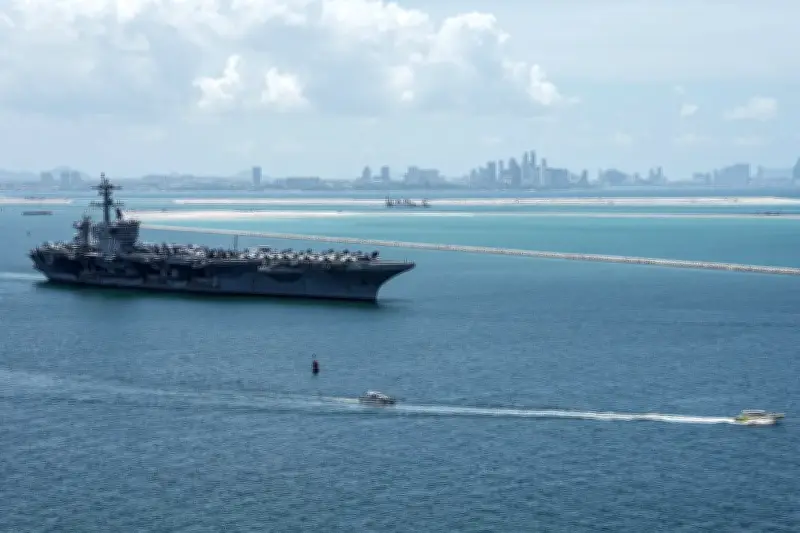
The USS Abraham Lincoln, the US aircraft carrier deployed for nearly a year and spending months supporting US military operations against Iran, is scheduled to dock in San Diego on Thursday afternoon.
This marks the end of a deployment described as “one of the most operationally intense and consequential of the modern era” and characterised by a record-stretch at sea, repeated deployment extensions, and reports of supply shortages, deteriorating morale, and mental health issues among some crew members.
Deployment journey and redirection
The Lincoln left San Diego last November, initially bound for the Pacific. It was redirected to the Middle East after the US and Israel launched their war with Iran in late February. The carrier remained there until late August, when it was relieved by the USS George Washington and began its journey home.
Earlier in August, the deployment faced scrutiny as reports surfaced about poor living conditions aboard the ship, including shortages of supplies and water, plumbing problems, low morale, and worsening mental health among the roughly 5,000 personnel on the carrier. Two leading military newspapers also reported two attempts by sailors to jump overboard, causing concern among families and military health experts.
Official responses and concerns
The reports prompted outrage from Democrats, while senior officials in the Trump administration pushed back. Pete Hegseth, the US defense secretary, called the reports “completely misrepresented”, and when reporters asked Donald Trump if he thought the deployment had gone on too long, he responded: “Not nearly long enough” – a comment that angered some naval families.
In a statement at the time, Adm Brad Cooper, who heads US Central Command, claimed that of the US navy’s 11 active aircraft carriers, the Lincoln had “among the lowest number of cases related to mental health”. But, he said that “this doesn’t mean that all is perfect”. Cooper said that a long deployment at sea “is uniquely challenging and tough, and every single one of us, including me, reacts to stressors in different ways”.
Homecoming and accountability demands
Two weeks ago, as the Lincoln headed back to San Diego, Hung Cao, the acting Navy secretary, acknowledged that eight service members from the Lincoln and its accompanying strike group attempted to take their own lives.
Sara Jacobs, a Democrat representing California’s 51st district who visited the Lincoln in late September, said in a statement last week that while she is “relieved that the USS Abraham Lincoln will soon be back in San Diego” and “looking forward to welcoming them home” her “demand for accountability won’t end when they make port”. “I will continue pushing for an OIG investigation into these conditions and a House Armed Services Committee field hearing in San Diego to hear directly from these service members” she said. “We need to prevent this crisis from happening ever again, and ultimately end the Iran war and bring all our service members home.”
On Wednesday, Hegseth visited the Lincoln ahead of its return, and praised the crew. He acknowledged that their deployment hasn’t been “easy”. “When you greet your families tomorrow, just pass my gratitude from the president and myself,” Hegseth said. “Let them know that their long wait, we believe, was in service of a righteous and historic mission.” During his remarks, Hegseth announced that those onboard the vessel would be awarded the presidential unit citation, which, according to the US military, is conferred on units of the armed forces “for extraordinary heroism in action against an armed enemy”.