Andy Burnham has announced that the UK is “open” to Germany joining an international coalition to build the next generation of fighter jets. Speaking during his first visit to Berlin as Prime Minister, Mr Burnham said he had “indicated” to German Chancellor Friedrich Merz Britain’s “openness” to the country joining the Global Combat Air Programme (Gcap).
Gcap coalition expands
Gcap, initially a pact between the UK, Italy and Japan to build a sixth generation fighter jet, welcomed Canada as an “observer nation” in July. Informally dubbed “Tempest”, the new jets will be equipped with technology including AI and next generation sensors, as western nations seek to maintain air superiority over threats from rival powers like Russia and China.
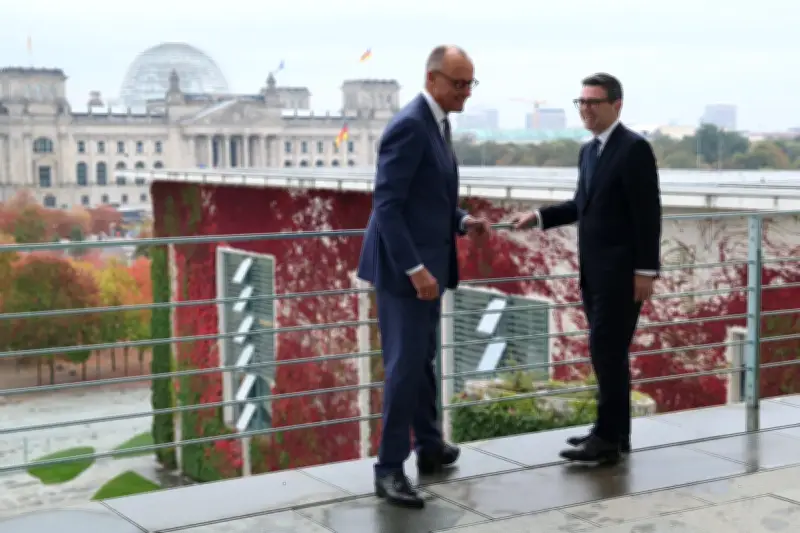
Mr Burnham travelled to Berlin on Thursday for talks with Mr Merz focused primarily on security, including the launch of a new security partnership aimed at hybrid threats. The pair also ratified the UK-German Kensington Treaty, which was signed in July last year and commits the two nations to deeper co-operation on science, technology, defence, security and growth.
Talks on defence collaboration
Speaking alongside Mr Merz at the German Chancellery, Mr Burnham said: “We are talking today about defence collaboration, and I’ve indicated to the Chancellor, in our discussion prior to this ratification, our openness to Germany joining Gcap, the next generation of fighter aircraft. And that is something that we seek to progress in the coming period, working with our partners Italy and Japan, in relation to that as well.”
In brief remarks to journalists, the Prime Minister also stressed the importance of countering hybrid attacks, saying it was something both countries were “facing on a regular basis”.
Hybrid threats and regional growth
Last month, the British Government summoned a senior Russian diplomat to protest over an “egregious and reckless attack” at Germany’s Leipzig airport, a major international freight hub used for providing support to Ukraine. A drone carrying explosives was found near Ukrainian cargo planes in August, but failed to explode and was subsequently defused. Investigators suspect a second drone collided with a cargo aircraft nearby and a third drone was reportedly found near the airport 10 days later.
On Thursday, Mr Burnham said: “It makes sense to face these threats together and to support each other in countering them, as well as countering interference in our democratic processes as well, and being stronger together when we face these threats.”
The Prime Minister and Chancellor later convened a UK-Germany regional growth forum, bringing together British and German chief executives and focused on unlocking investment, strengthening industrial partnership and ensuring that the benefits of growth are felt in communities across both countries. Mr Merz said a new UK-Germany industrial tech corridor will help growing artificial intelligence companies bring their technology into large-scale industrial use.
Future EU relations
Addressing the wider relationship with Germany and Europe, Mr Burnham said he was “committed to securing deeper co-operation” with the EU at a summit with the bloc “towards the end of the year”. He said: “We’ve had an excellent discussion today, and we will look to see if we can turn the summit into a good outcome for the EU, but also for the UK as well.”
Mr Merz, speaking at the start of the regional growth roundtable, said he was “personally extremely happy” that Mr Burnham had reopened the question of Britain’s future relationship with the bloc. The German leader said: “From our German side, I can assure you that we will do anything we can do to bring the UK closer and closer back to Europe, to the European continent, to the European Union.”
In his speech to the Labour Party conference last month, Mr Burnham said Brexit had done “more harm than good” and left the door open for a bid to rejoin the EU, saying he would “set out the options” for relations with the bloc after the summit. The date for the summit remains uncertain after it was postponed from July owing to Sir Keir Starmer’s resignation as prime minister.