

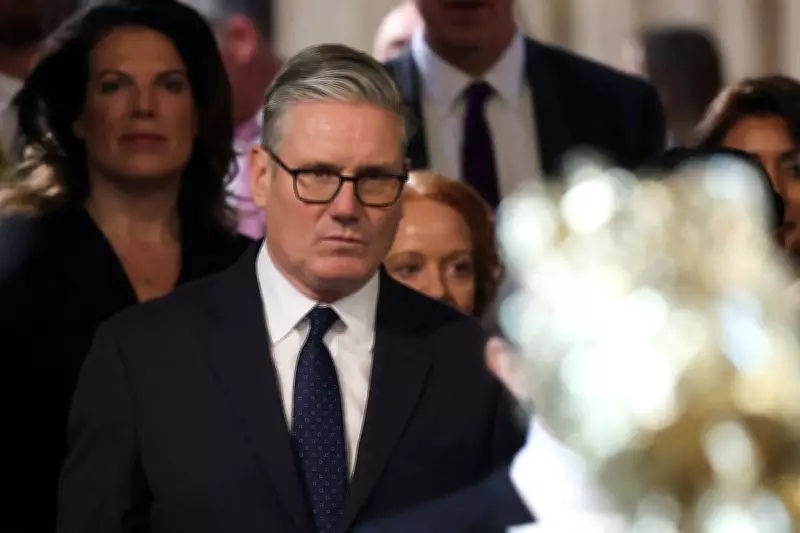
It isn’t only in the UK that the damage done to Keir Starmer by last week’s disastrous local elections is being dissected. Commentators abroad have been even quicker to note the scale of the carnage, and even more forthright in their judgement of the implications. Their near-unanimous verdict is that the UK has been weakened, whether or not the PM survives.
These judgements aren’t coloured by the schadenfreude over Brexit that tends to accompany European views of developments in the UK. The consensus is that a supportive voice had been quietened, even lost, and at a crucial time. The damning nickname “Never here Keir”, coined in the UK, has another side. He might not have been here enough, but when he was not here, he was “there”.
One of the reasons, admittedly, is a negative one: until now, and despite his personal unpopularity in the polls, Starmer – with his huge Commons majority – has looked considerably more secure and capable of enacting legislation and honouring undertakings than the leaders of, say, either France or Germany. Emmanuel Macron’s power has been circumscribed by his lack of a majority in the National Assembly, and the presidential election early next year. Within a year of becoming chancellor, Friedrich Merz has beaten all records for unpopularity. His own coalition may be in danger of collapse.

Now, Starmer finds himself pretty much in the same boat. On the continent, they have been quicker to see how badly this may play out. Starmer’s lawyerly presentation seems to make a better impression there than it does here. His strong support for Ukraine is built on that of his prime ministerial predecessors. But it has accorded him the leadership position UK leaders customarily claim internationally, where he became – jointly with Macron – effective leader of European support for Ukraine after Washington had passed most of the responsibility on to Europe.
It is fair to say that the UK has long traded on being among the first and most fervent supporters of Ukraine’s resistance to Russia, even though it now lags behind in the volume of military and financial support it supplies. Its pledges to increase defence spending as a proportion of GDP also lack the size and urgency of most other European Nato members. While this is noted from time to time by others, the UK still talks a good talk. The English language may be helping. This country’s confident support for Ukraine has undoubtedly given Europe a stronger voice on Ukraine than it might otherwise have had. That, and the ability to rally others that came with it, could now fade.
A weakened government – and prime minister – in the UK also has implications for European defence, at a time when US commitment has been declining, in words at least. The recent US warning that it could start reducing its troop presence in Germany and perhaps elsewhere, in response to the refusal of most European countries to become involved in Iran, has given a boost to Macron’s concept of Europe’s “strategic autonomy”. Serious discussions are in the offing about how a self-reliant European defence might work – and who would be in the driving seat.
The UK’s assumption has been that it would be a leading, if not the leading, player in such an arrangement. Revelations about the decline in UK troop numbers and naval capacity – as graphically illustrated by comparing the availability of French and UK contributions at the start of the Iran war – are one factor in casting doubt on this leadership claim, but instability at the top of government could be another.
A new theme, reinforced in the King’s Speech at the state opening of parliament, is the UK government’s intention of aligning itself more closely with the EU. Given how heavily such a plan would rely on impetus from this prime minister, whose brainchild it largely is, and the likely ferocity of opposition from a wider constituency than just Brexiteers, a weakened Starmer or, indeed, a vacuum at the top of government, could bring it to a halt before it had even begun.

One intriguing way out being broached in some foreign policy quarters is the appointment of Starmer as foreign secretary in any new government. How better to “bank” this prime minister’s relative success abroad than to offer him the Foreign Office? It could at once signal continuity and leave reasonably intact the regard Starmer has built up among his peers.
Such a scenario, however, makes several surely wishful assumptions: that a new PM would offer him the job; that he, as a spurned PM, would serve in a new government; that he would accept a job that amounts to a demotion, and – then – that he would command the same authority as foreign secretary as he has earned (abroad) as PM.
There are – mostly inexact – precedents: Alec Douglas-Home, William Hague, and David Cameron have been mentioned. But Starmer’s adamant refusal to leave No 10 gracefully suggests, at very least, that for him to continue his career as foreign secretary would be a risk, both for the smooth running of government, given that he summarily sacked the last head of the Foreign Office over the Peter Mandelson appointment, and for a new PM wanting a united team. Nor, in the light of recent history, would a senior ambassadorial nomination seem the way to go.
Few in the UK seem likely to shed a tear for Keir Starmer. Yet on the continent, they appreciate his talents. His would-be usurpers may soon learn just how impossible his job has been. At least, with regards to Europe, he has made a success of it.





