

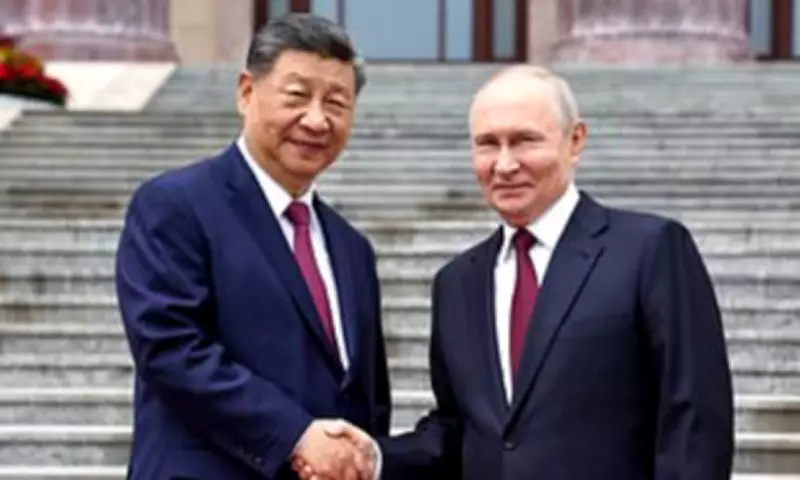
Russian President Vladimir Putin praised his close ties with Chinese leader Xi Jinping as they opened bilateral talks Wednesday during his trip to Beijing. 'My dear friend,' Putin said. 'We are truly delighted to see you. We keep in constant touch, both personally and through our aides in the government.'
Xi also stressed the 'political mutual trust and strategic cooperation' between the countries, according to Chinese state media. The two leaders have praised each other profusely in the past, with Xi at one point describing Putin as his 'best and most intimate friend.'
Agenda and Symbolism
Xi and Putin's agenda centers on energy and security, but the visit primarily serves to strengthen ties and project Chinese global influence. This diplomatic push was on full display at the Great Hall of the People, where Xi welcomed Putin only days after hosting US President Donald Trump.

Experts say the back-to-back summits highlight Beijing's growing role as an international superpower. 'The optics matter,' said Steve Tsang, director of the SOAS China Institute at the University of London. 'The message is clearly one that China maintains friendship and strategic partnership with whichever power it likes, and the USA is just one of them.'
Putin and Xi both need to use their close ties to prop up their images at home, said Willy Lam, a senior China fellow at the Jamestown Foundation. Putin 'needs to tell his countrymen and the world that Russia has China's support in terms of buying its oil and gas and other tangible and intangible financial support,' Lam added.
Kremlin Response
Meanwhile, the Kremlin said that there was no point comparing the ceremony in China for the visits of President Putin and President Trump, and that people should focus on the content. 'There is a point in comparing the content,' Kremlin spokesman Dmitry Peskov told state television reporter Pavel Zarubin when asked about comparisons with the Trump visit. 'It is not always easy to compare the content as not everything is shown on the surface. However, the main value lies in the content, not in the ceremonial aspects,' Peskov added.
Energy and Trade Focus
Xi and Putin were set to focus on energy and security as well as their overall ties. The two sides agreed to extend a friendship treaty first signed in 2001, Chinese state media reported. China became Russia's top trading partner after Moscow's full-scale invasion of Ukraine in 2022. Beijing has said it is neutral in the conflict while maintaining trade ties with the Kremlin despite economic and financial sanctions by the US and Europe.
China is the top customer for Russian oil and gas supplies, and Moscow expects the war in Iran to increase demand. In his meeting with Xi, Putin stressed their countries' economic ties. 'The driving force behind economic cooperation is Russian-Chinese collaboration in the energy sector,' Putin said. 'Amid the crisis in the Middle East, Russia continues to maintain its role as a reliable supplier of resources, while China remains a responsible consumer of these resources.'
Xi stressed the need for 'complete cessation of hostilities' in the Middle East, according to Chinese state media. 'An early end to the conflict will help reduce disruptions to energy supply stability, the smooth flow of industrial and supply chains, and international trade order,' Xi said. A Russian presidential aide said earlier Russia's oil exports to China grew by 35 per cent in the first quarter of 2026 and that Russia is one of the biggest exporters of natural gas to China.
Foreign Policy Alignment
Putin also stressed China and Russia's cooperation in foreign policy as 'one of the key stabilizing factors on the international stage.' 'In the current tense situation on the international stage, our close cooperation is particularly in demand,' he said.
In February 2022, just weeks before Russia's invasion of Ukraine, China and Russia announced a 'no limits' partnership during a trip by Putin to Beijing. Beijing says it is neutral in the conflict, though in practice it supports Moscow through frequent state visits, growing trade and joint military drills. China has also ignored demands from the West to stop providing high-tech components for Russia's weapons industries.

Agreements and Prospects
The two leaders are scheduled to sign cooperation agreements during Putin's two-day visit. Putin noted earlier this month that Moscow and Beijing have reached 'a very substantial step forward in our cooperation in the oil and gas sector.' 'Practically all the key issues have been agreed upon,' he said. 'If we succeed in finalizing these details and bringing them to a conclusion during this visit, I will be extremely pleased.'
Putin also praised their bilateral relationship as a crucial, balancing force in international relations. 'Interaction between such nations as China and Russia undoubtedly serves as a factor of deterrence and stability,' he said. Moscow welcomes China's dialogue with the US as another stabilizing element for the global economy, Putin added. 'We stand only to benefit from this, from the stability and constructive engagement between the US and China,' he said.
Trump's Visit Context
Meanwhile last week, Trump's meetings and tours with the Chinese President provided the US President with ample opportunity to level with Xi. Trump lavished praise on his 'friend' Xi, calling him 'a great leader.' But Xi 'very elegantly referred to the United States as perhaps being a declining nation,' Trump said, adding that the Chinese President was not talking about his tenure, but that of his predecessor, President Joe Biden.
The Chinese leader struck a much less positive tone - noting in a readout 'I have agreed with President Trump on a new vision of building a constructive China-US relationship of strategic stability.' 'The two countries should expand exchanges and cooperation in areas such as the economy and trade, health, agriculture, tourism, people-to-people ties and law enforcement,' Xi added.
Taiwan Question
Looming over both countries is the 'Taiwan question' - regarding China's claim that Taiwan is Chinese territory and the US's position that Taiwan is independent. Xi said that is the 'most important issue in China-US relations,' that could lead to 'clashes and even conflict' if handled improperly. 'The US side must exercise extra caution in handling the Taiwan question,' Xi said. Complicating that matter is an $11 billion weapons package, the largest ever arms sale, for Taiwan that Trump approved in December. Though it has been approved, the weapons have yet to be delivered.
Trump did not address Taiwan during the visit - even when pressed on the matter when making a stop on Thursday to the Temple of Heaven. Instead, Trump pivoted and noted China's beauty.
Economic Developments
On the economic front, Xi stated that China's door 'will only open wider' to US businesses. Making good on that promise, China announced that it would purchase 200 new planes from Boeing, though it was far less than the expected 500 aircraft deal that had reportedly been under consideration. Trump noted that progress was made on China-US discussions on the Iran war. 'We did discuss Iran,' Trump told reporters. 'We feel very similar about (how) we want it to end. We don't want them to have a nuclear weapon. We want the straits open.'





