

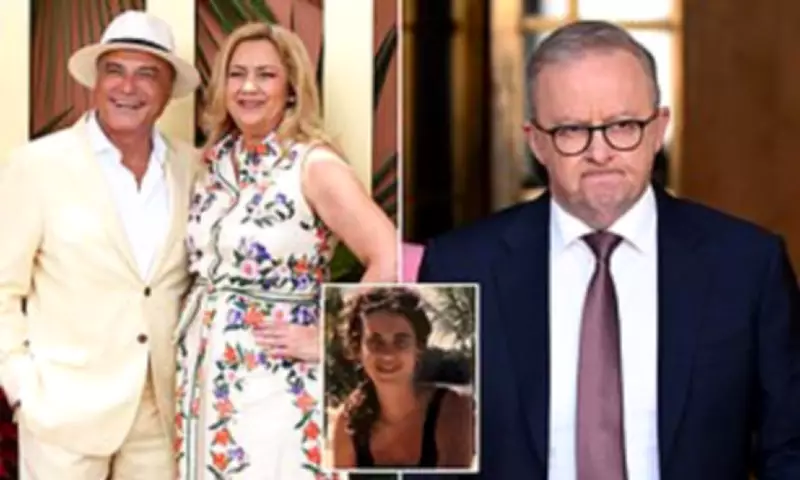
Annastacia Palaszczuk has urged Anthony Albanese to 'get out of the office' and reconnect with voters amid the rise of One Nation, as the former state leader reveals why she decided to step down and leave politics for good.
Speaking to the Daily Mail about her newly released memoir, The Politics of Being Me, the former Queensland Premier said countering Hanson-style populism could not be achieved through polling, messaging strategies or political manoeuvring. Instead, she said it requires reconnecting directly with voters who feel increasingly disconnected and under relentless pressure in their daily lives.
No Return to Politics
Asked whether she would ever consider a return to public office in a federal role, Palaszczuk dismissed the idea without a second thought. 'No,' she said. 'I'm very happy with my life. I'm no Bob Carr.' Former NSW premier Bob Carr returned to politics in 2012, serving as a federal senator before becoming Foreign Minister in the Julia Gillard government. For Palaszczuk, any such move to Canberra is firmly off the table.

Her priorities, she said, now lie elsewhere. 'I'm chairing a couple of boards, I'm an adjunct professor, and I want to mentor more people, especially women, to give them confidence to pursue their careers,' she said.
One Nation and Voter Discontent
When asked about One Nation's renewed appeal, Palaszczuk warned mainstream leaders against underestimating the depth of voter frustration. 'One Nation has been through highs and lows before,' she said. 'But right now there is a lot of discontent. People are feeling cost-of-living pressures, housing stress, job insecurity. They're just trying to get through day by day.'
Palaszczuk worked as a senior staffer under former Labor premier Peter Beattie during One Nation's explosive breakthrough in 1998. She later led Queensland Labor to victory in 2017, even as One Nation's polling surged but failed to translate into lasting parliamentary gains.
Her advice to Albanese was blunt: 'Get out of the office. The best way to deal with this is to get out into the community and talk to people one-on-one. Hear it first-hand,' she said. 'You see it at the supermarket checkouts, people watching every dollar. People feel uncertain about what's happening in the world and in their own lives.'
Personal Struggles and Abortion Reform
One of the most confronting chapters details the struggles of her IVF journey and the lack of support she received when the treatment failed. 'At the time there was no pre-counselling, no exit counselling,' she said. 'You sit in these clinics with photos of babies on the wall and think, "That will be mine one day". And when it doesn't happen, there's very little support.'
Palaszczuk said the experience fundamentally shifted her view on abortion reform. Decriminalising abortion in Queensland in 2018 was one of the most significant and controversial pieces of social legislation passed during her premiership. In the book, Palaszczuk writes that as a young woman she didn't identify as a feminist, and initially opposed abortion, influenced by her Catholic faith. 'My views changed dramatically,' she said. 'I wanted a respectful debate, not one driven by passion. I was very proud when that legislation passed.'
COVID-19 Leadership
Reflecting on her leadership during the Covid pandemic, she defended Queensland's response, including its controversial border rules and exemptions. In her book, Palaszczuk recounts a heated phone call with then prime minister Scott Morrison following Queensland's refusal to grant Sarah Caisip an exemption to attend her father's funeral after she travelled from the ACT, a Covid hotspot at the time. Ms Caisip, 26, was ultimately allowed to view her father's coffin in full protective gear, following several days in hotel quarantine and widespread public backlash.
'What might have been the case in the ACT was not the case in Queensland,' the former premier wrote. 'People were uncertain because the rules weren't consistent across the country.'

Palaszczuk also defended her government's handling of hotel quarantine and the controversial Wellcamp quarantine facility, which cost taxpayers $223 million. 'I went through hotel quarantine myself - it's tough,' she said. 'Wellcamp was about learning from places like Howard Springs and not having people stuck in CBD hotels during a pandemic.'
Despite the high cost, the facility only took around 600 people over a year, drawing sharp criticism from the LNP Opposition at the time, which branded it 'Wastecamp'. Still, Palaszczuk said such regional facilities could yet prove their worth. 'If there was another pandemic, you wouldn't have to put people in hotels in the centre of our cities,' she said. 'They'd be in regional areas.'
Leadership and Legacy
While The Politics of Being Me details crisis leadership, it largely avoids the factional tensions that marked her final years as premier. Asked about the omission, Palaszczuk brushed aside suggestions of instability. She said the polling she received as premier echoed the party's performance at the 2024 election, when Labor was swept from office by the LNP, led by David Crisafulli. 'A year out from the election, the two-party polling was exactly the same,' she said. 'I could have contested again, but I thought it was the right time to go.'
Palaszczuk said stepping aside was a deliberate decision. 'As a leader, you've got to ask yourself: do you have the energy to contest a fourth election?' she said. 'Leaders need breaks.' She added that Steven Miles and Cameron Dick were doing a 'very good job' in their current roles as premier and deputy leader.
Palaszczuk said she is 'very blessed' to now share her days with her partner Dr Reza Adib, his two children and their dog, Winton. 'We're very happy,' she said. 'I'm very blessed to have Reza and his two children in my life, and Winton the groodle, who kind of completes everything.'
Her message, she said, is simple: she is focused firmly on the future. The Politics of Being Me is available for purchase now.





