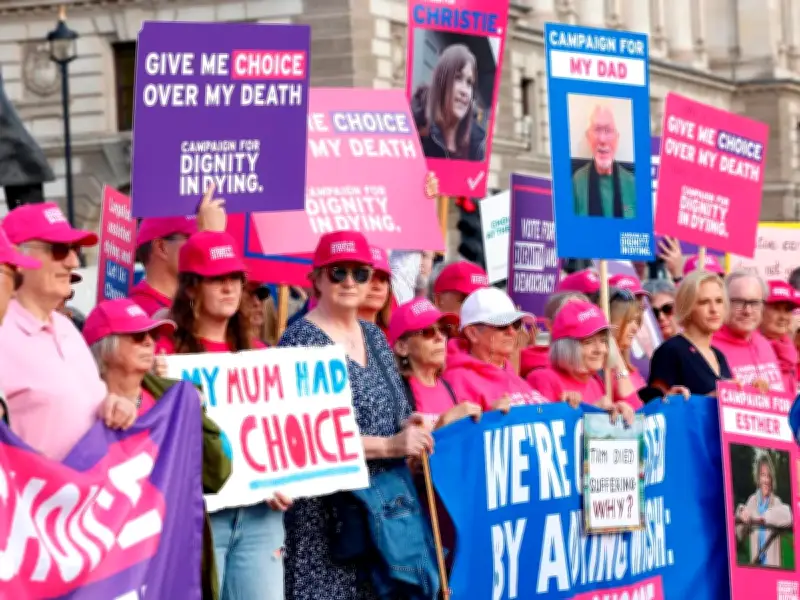
Fifty senior Labour figures, including 11 former Cabinet members, have called on Prime Minister Andy Burnham to include assisted dying in his upcoming Ten Year Plan for the country.
The letter, signed by Liz Kendall, Lord David Blunkett, Baroness Margaret Hodge, Jess Phillips and Steve Reed, urges Mr Burnham to make the change alongside the creation of a National Care Service. Mr Burnham is expected to unveil the plan next month, and the signatories want a clear proposal to give terminally-ill people a legal process to end their lives.
Letter urges action on assisted dying
The letter states: "Many of us believe that offering choice for terminally ill people, and those whose suffering cannot be alleviated even by the very best palliative care at the end of their lives in particular, can and should be done at the same time. It is not a case of either/or."
It adds: "We are firmly of the view that, certainly by the end of ten years and hopefully sooner, it will be possible to deliver on both."
The letter also cites polling: "The evidence from reputable, independent polling and from the British Social Attitudes survey shows that the public consistently support the principle of assisted dying by very significant majorities in all parts of the country."
Previous votes and current stance
Kim Leadbeater, whose assisted dying bill was passed by MPs last year but failed in the House of Lords, said: "Assisted dying is unfinished business for Parliament and we owe it to all those who are depending on this vital change to the law not to let them down again."
Mr Burnham has previously indicated he supports assisted dying in principle, but said earlier this year that the UK's palliative care system must be sorted before a decision can be made. He has pledged to set out proposals for a free-to-use National Care Service ahead of the next election.
In June last year, MPs backed assisted dying by 314 votes to 291, only for the legislation to fail in the House of Lords. On September 11, a near-identical bill was struck down in the Commons by a margin of just 16 votes.
Constituent and campaigner responses
Cancer patient Brian Griffin, who lives in Mr Burnham's constituency, said failing to offer assisted dying would not pass the PM's so-called 'Makerfield Test'. He told The Mirror: "I'm living with myeloma, an incurable blood cancer, and fixing social and palliative care would make a real difference to people like me. But even the very best care can't ease every death."
He added: "The Prime Minister talks about the Makerfield test, making sure places like ours get a fair deal. So I'd ask him this: Would making people have an unnecessarily painful death pass the Makerfield test?"
Sarah Wootton of campaign group Dignity in Dying said: "Three quarters of the public back a change in the law. They do not see better end of life care and assisted dying as competing ambitions, and nor should the government."
Opponents have argued that changing the law would have dangerous impacts on the vulnerable and disabled, warning that safeguards in the bills put to Parliament were not strong enough. Former Paralympian Baroness Tanni Grey-Thompson said in September: "You cannot say somebody has a genuine choice if an assisted death is available but the care and support they need to live is not."
A No10 spokeswoman said: "The government's longstanding position is that it is neutral on the question of assisted dying. It is for Parliament to decide if and how the law should change, and the government will respect its wishes."