Senate Majority Leader John Thune is on a collision course with Donald Trump, and the question on everyone's mind is whether he can survive the crash. Thursday's showdown in the Senate was significant, writes John Bowden, but would the majority leader dare being labeled disloyal to King MAGA?
The Bind Thune Faces
With the midterms bearing down on the Republican caucus and an increasingly unfavorable electoral map putting his majority in danger, a member of party leadership like Thune would typically be fixed on one objective: protecting incumbents. However, over the course of 2025 and early 2026, one painful reality has emerged for Republicans: Donald Trump is now undoubtedly the greatest obstacle in their path.
A year ago, Senate Republican leadership expected their new majority would be safe for at least one election cycle, providing the president a much-needed shield from his Democratic enemies and any impeachment pushes. Trump, however, has personally intervened in ways that could end the careers of three incumbent GOP senators — or more. This week, Trump re-engaged Congress, to the Senate's extreme distaste.
The Reconciliation Bill Controversy
With the Hill preparing the politically delicate task of concocting a second budget reconciliation package to get around a Democratic filibuster of ICE funding, acting Attorney General Todd Blanche dropped a bomb: The president wants to see $1.776 billion in funding for a fund to benefit targets of the DOJ under Joe Biden and Barack Obama that even Republican senators are already calling a 'slush fund.'
As Trump increasingly makes John Thune's political life a minefield — and with his counterpart in the House, Speaker Mike Johnson, firmly cowed by the MAGA king — it's hard to see how this ends without the president and majority leader in a head-on collision.
The reconciliation bill in and of itself is a monument to the current dynamics in Washington. Born out of necessity after Republicans withdrew entirely from negotiations over ICE reforms with Democrats that the White House refused to agree to, the filibuster-proof Hail Mary legislation represents the last hope for the White House to secure total funding for its mass deportation effort without cutting a deal with the other side. But it's also quickly expanding, as the president has also tried to tack on $1 billion in funding, supposedly for security, for his new $400 million-construction White House ballroom in addition to the nearly $1.8 billion 'slush fund' his DOJ is seeking in a settlement of the suit he brought against his own government.
Republicans in the Senate were spared a direct confrontation with the White House, or at least put one off, over the ballroom this week when the Senate parliamentarian stripped that language out of the bill. But the Senate GOP views the weaponization fund money as even more politically toxic at perhaps the worst possible time, when voters are beginning to pay attention to the dysfunction and chaos playing out in Washington over the backdrop of war with Iran coming to the home-front in the form of skyrocketing gas and consumer prices.
Tensions Boil Over
On Thursday, those tensions boiled over at a lunchtime meeting with Blanche and GOP senators where Sen. Lisa Murkowski, leaving the meeting, hinted at its tenor: 'Nobody held back.' But it was the former leader of the Senate GOP, 84-year-old Kentucky Sen. Mitch McConnell, who was once again chosen Thursday to deliver the caucus' rare rebuke of the president as Republicans skipped town and abandoned plans to begin a 'vote-a-rama' on the ICE spending bill.
'So the nation's top law enforcement official is asking for a slush fund to pay people who assault cops? Utterly stupid, morally wrong – Take your pick,' McConnell said. Coming from the longtime majority leader, the message was clear. The 'slush fund,' as it stands, is dead on arrival in the Senate, where the Republican caucus is drawing a line in the sand. Even some of Trump's most loyal supporters in the chamber, like Alabama Sen. Tommy Tuberville, conceded that the reconciliation package was short of 51 votes with the weaponization fund included.
Will the GOP Resistance Extend?
The situation is no better in the more lockstep House — hours after the Senate scuttled votes for the day, the House did as well, when it became clear that the administration would lose a War Powers vote meant to restrict Trump's authority in Iran. It certainly looks, to some on the Hill, like some semblance of a spine is evolving amongst the congressional Republican caucuses. But putting a definitive answer to that question is impossible.
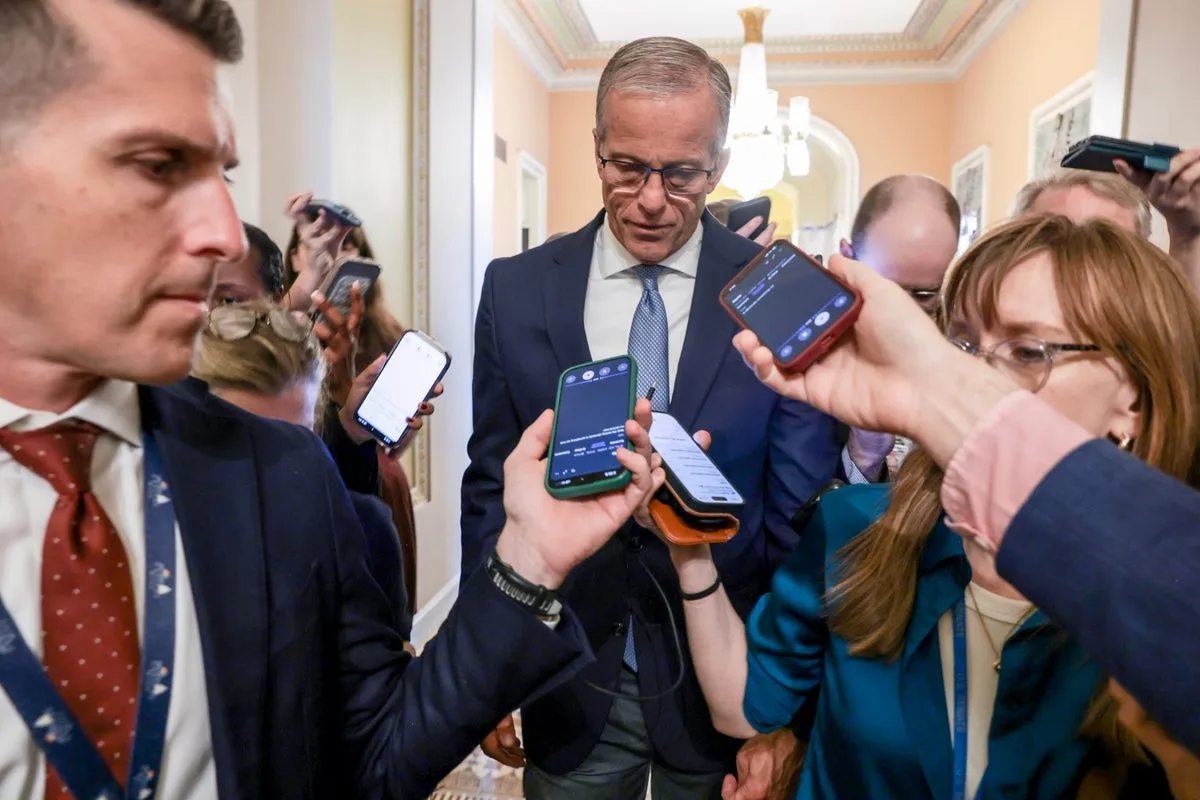
Thune was noncommittal about any future plans for the ICE funding package or his discussions about the 'slush fund' with the president as he hurried from Thursday's luncheon to the Senate floor to gavel out the chamber, then departed himself. Murkowski, asked directly on Thursday if this was the moment when Senate Republicans would begin standing up to the president and asserting their independence, didn't give a direct answer to reporters as the elevator doors closed in front of her.
Those in the know say that Thursday's revolt in the Senate was coming for months, the result of the White House treating Congress as it has the entire federal government — by disempowering deputies and centralizing all policymaking in the West Wing. 'When it comes to Congress they've never cared. They would dangle something in front of [Speaker Mike] Johnson and a few senators and hope that would be enough to carry the day,' one former veteran GOP Senate staffer told The Independent.
Thune's Precarious Position
One significant dynamic remains working firmly against Thune: He is an old-school Republican in Donald Trump's MAGA-run GOP. The South Dakota senator has watched Trump endorse against two sitting Republican senators this cycle, John Cornyn and Bill Cassidy, and the president has already notched one scalp on that list. He's also disparaged Susan Collins, running in a must-win Senate race in Maine, and forced Sen. Thom Tillis into retirement through his threats of a primary challenge in North Carolina. Republicans could be pushed into the minority almost entirely thanks to Trump's own actions, yet Thune could be the one taking the fall when it comes time for Republicans to decide if he'll keep his gavel.
Trump's greatest sin, in Thune's eyes, also happens to be the president's greatest strength: While he is endorsing against incumbents and causing Thune's allies to waste millions defending them, Trump is also proving that he retains a cultural dominance over the GOP that transcends state lines. Other efforts to purge wayward Republicans in Indiana and Kentucky, where Rep. Thomas Massie lost his race this week, have hammered home that reality for Republicans. Their political survival, in most cases, depends on him.
What Happens Next?
What happens next may simply be the most obvious result: The president, realizing his defeat, walks back his demand for funding of the 'slush fund' and finds some other, possibly illegal, means of funding it — or perhaps forgets about it entirely. But the Senate majority leader is increasingly coming to terms with the fact that his party's devotion to Trump over party, or even moral, values is worth little when it comes to restricting the president's worse impulses, which in 2026 seem to have overtaken any Republican efforts to protect their colleagues.






