

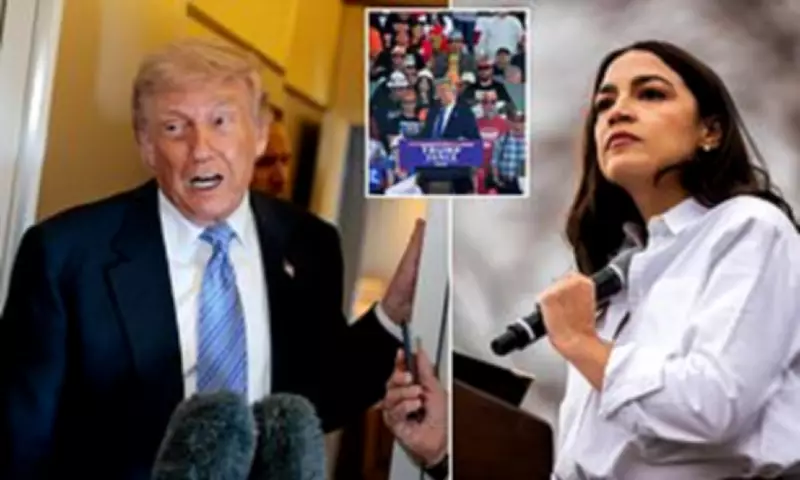
The Republican Party is poised to deploy a $347 million campaign war chest and send Donald Trump on the campaign trail in a bid to preserve their majorities in both chambers of Congress. Although redistricting could alter the electoral landscape, Democrats remain favorites to reclaim the House of Representatives, with Polymarket assigning them a 79 percent probability.
Economic and Foreign Policy Concerns
With the economy and the conflict with Iran weighing heavily on voters' minds, Republicans intend to use the funds—sourced from a Trump-aligned political action committee—to highlight what they describe as the risks Democrats pose to the nation's financial stability. The GOP's argument will center on the notion that an already unpopular Democratic Party would further impede economic improvement.
Republicans will also leverage perceived Democratic weaknesses on border security and Joe Biden's immigration policies, which they argue helped Trump secure the presidency in 2016. GOP pollster Neil Newhouse told The Wall Street Journal: 'You want to remind voters how bad Democrats are, and the numbers indicate voters are in a mood to accept that.' However, Newhouse acknowledged the challenge, noting that 'until we see some settling down of inflation and gas prices coming down, that is what Americans are going to be focused on.'

Trump's Record and Democratic Strategy
The GOP will also seek to remind voters of key achievements from Trump's second term, including tax cuts opposed by Democrats, tax breaks for seniors, and the elimination of taxes on tips. Meanwhile, progressive Congresswoman Alexandria Ocasio-Cortez outlined her party's counter-strategy in an interview with New York Magazine. She advocated for a progressive 'affordability' agenda similar to that proposed by socialist New York City Mayor Zohran Mamdani, which has garnered endorsements from 100 fellow progressives.
Ocasio-Cortez stated: 'It's the Progressive Caucus's pitch on the party's plan. What it signifies is that the party is making a turn towards really seeing that these proposals that maybe a long time ago were seen as radical are actually pretty common sense, and they're not just things that are supported by Democrats.' She admitted the party has suffered a public relations setback and needs to appear more relatable: 'We gotta fight for people, and we gotta speak English in a way that people understand. We, as a party, have a lot of catching up to do.'
Targeting Key Senate and House Races
Republicans are focusing on pivotal swing Senate seats, as they currently hold only a 56 percent chance of retaining control of the upper chamber. Key Senate races in North Carolina, Maine, Michigan, and Georgia are priorities, along with 29 House races nationwide under the 'MAGA Majority' program. The Trump-aligned super-PAC MAGA Inc. is expected to deploy the full $347 million. Spokesman Alex Pfeiffer affirmed: 'MAGA Inc is committed to retaining and building the GOP majorities in the House and Senate.'
Sources told The Wall Street Journal that Trump has occasionally expressed indifference about the midterm outcome due to frustration with the GOP's lack of support for his agenda. However, a person familiar with the plans said Trump will attend at least 30 campaign events with candidates before the election. Susie Wiles stated late last year that the president will 'campaign like it's 2024' to avert a midterm disaster. A midterm Republican convention is also planned for September in Dallas to promote candidates.
Historical Context and Challenges
The Republican Party has historically performed better with Trump on the ballot. In 2016 and 2024, Trump's presence led to GOP control of the White House and Congress. In 2020, despite losing, Trump's candidacy limited Democrats to a slim Senate majority and a nine-seat House edge. Without Trump on the ballot in 2018, Democrats gained over 40 House seats, and in 2022, they prevented a predicted 'red wave' by gaining a Senate seat. Wiles aims to replicate Trump's turnout among low-propensity voters, many of whom are Trump supporters.

All 435 House seats and 35 Senate seats are up for election in 2026, including vacancies left by JD Vance and Marco Rubio joining the Trump administration. Republicans must defend 22 Senate seats to the Democrats' 13, with Maine and North Carolina seen as particularly vulnerable. House Minority Leader Hakeem Jeffries remains confident about Democratic chances.
Trump's Stance on Iran and the Economy
Trump told Fox News on Friday that the Iran War, not the economy or redistricting, will determine the midterm outcome. 'I think a bigger difference would be if I win quickly [in Iran], as opposed to after [the elections], but again, I'm not going to let the election determine what's going to happen with respect to Iran, because they cannot have a nuclear weapon,' he said. He acknowledged that lower gas prices would help but added: 'I hate to do this to you, but I'm going to screw up your numbers for a little while, because we have to stop the nuclear weapon stuff with Iran.'





