

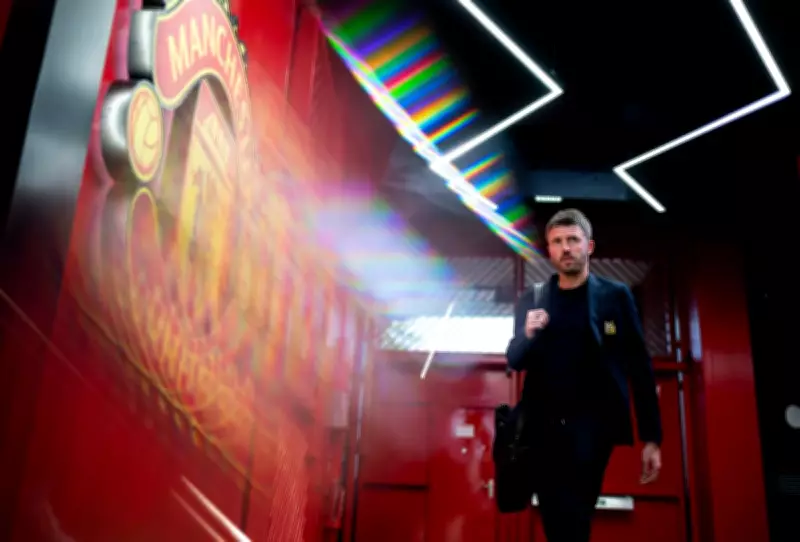
Michael Carrick has earned the right to bring equilibrium to Manchester United. Under his interim charge, the team has become a fine counterattacking side, securing 33 points from 15 games and topping the form table. Rivals have been beaten, Champions League qualification guaranteed, and a third-place finish is highly likely. Yet, there remains equivocation about making him permanent.
The Case for Carrick
Some sceptics cite the Ole Gunnar Solskjær experience as evidence against giving Carrick the job full-time. However, since Alex Ferguson retired, United have contrived failure with every possible type of manager. Sweating what happened with a different man and a different team is born of fear, not rationale.
Solskjær arrived at a post-Josécalyptic United, so improvement was inescapable. Carrick's players were less emasculated, so it wasn't enough to just not be him: he effected change by quickly implementing fresh ideas.

Alternatives Considered
Julian Nagelsmann would be an expensive and potentially disastrous risk due to his pernickety style and abrasive personality. Cesc Fàbregas and Xabi Alonso would be difficult to hire for parochial reasons. Andoni Iraola's chaotic game-model may not scale up for a team seeking to control games, and it's uncertain if he has the force of personality to deal with pressure.
Carrick, however, has proved himself capable. His playing career, defined by composure, accords him charisma of status. As Kobbie Mainoo put it: "You want to follow him and fight for him and die for him."
A Functioning Structure
Over the past 12 years, United have slavishly replaced managers with their near-opposites. Now, with a functioning structure in place, there is opportunity for continuity. A failed appointment is no longer disastrous, and should Carrick be sacked, his replacement will inherit a balanced squad.
After a terrific first two games, levels declined for a period, but given limited defenders and an imbalanced midfield, how could things have been any different? Carrick didn't panic, keeping ideas simple and the framework loose. His trust in players is a major reason United are doing so well, enabling them to win games in assorted ways.
Strategic Flexibility
Carrick and his staff have devised different strategies for different games and game-states, making the team unpredictable without deviating from fundamental principles. The plan is to buy reinforcements that facilitate greater dominance. With Carrick, United have already become a superb counterattacking outfit; the sense is that he envisages a side that controls possession with tempo and aggression.
Though United's schedule has been sparse, that is not necessarily advantageous. The worst performance under Carrick followed a 24-day break. Carrick has acknowledged that improvements are needed out of possession and in game management, but his less prescriptive style means flaws won't be terminal.
Conclusion
To reject a head coach who has both won and entertained, to speculate on an unproven replacement after 13 years of struggle, would be foolish. Carrick has earned the chance to do his work.






