

The Independent's journalism is supported by our readers. When you purchase through links on our site, we may earn commission. Comment
To survive, the BBC must be Farage-proofed – here’s how. Not only must new director-general Matt Brittin defeat Donald Trump’s billion-dollar defamation lawsuit, he must also protect the BBC against its most vociferous critic – the man who might be the next prime minister, says James Moore.
Monday 18 May 2026 16:27 BST

BBC chairman says director-general Tim Davie 'shouldn't have stepped down'
Welcome to the worst job in the world, Matt Brittin. Only kidding. Being director-general of the BBC is not quite that, whatever some people might have you believe, Gordon Brown included. Brittin, a former Google executive, reportedly consulted the former prime minister before taking the plunge. And still he decided to take it…
Yet the challenges Brittin faces are profound. First, there is the question of the BBC’s tarnished reputation. In the past year alone, it has faced a barracking over – in no particular order… – its handling of the Scott Mills affair; its failure to edit out anti-semitic chanting during punk rap duo Bob Vylan’s Glastonbury set, as well as the N-word during its Baftas coverage; an Ofcom investigation into a Gaza documentary ruled “materially misleading”; bullying allegations at Strictly Come Dancing (not to mention the sudden departure of its long-standing co-hosts); and a $10bn defamation lawsuit from US president Donald Trump over the way Panorama edited his speech.
Then there is the perennial question-mark over the BBC’s relevance in a digital age. As viewer habits continue to be reshaped by a proliferation of subscriber streaming services, how sustainable is their more traditional linear broadcast model, and how easily can it be transformed? It’s a question that leads neatly into the biggest structural issue of all – how the BBC is funded. Last month, the cost of a licence fee rose to £180, at the moment the BBC began negotiations with the government over its royal charter, which enshrines the broadcaster as a public corporation, guarantees its editorial independence from the government – and outlines its public obligations and increasingly idiosyncratic funding structure. At a time when millions of viewers happily pay a monthly subscription for digital services, surely more than a century after the licence-funded BBC began broadcasting it is time to revisit the annual fee?
And there’s one very good reason why that is so: Nigel Farage. No friend of the corporation – despite being one of its most regular guests on Question Time, having been invited on some 38 times – the Reform UK leader has called the BBC “institutionally biased” against right-wing views in general (and Brexit in particular), while accusing its journalists of being “out-of-touch metropolitan liberals”, and claiming it promotes a “woke ideology” by suppressing dissenting views on immigration and national identity. Were he to win the next election, Farage has promised to scrap the licence fee altogether.
But to many, it already looks like it’s on the way out. The number of households paying for a TV licence has long been in steady decline – but, according to the BBC’s own figures, only around 80 per cent of households now pay it, even though 94 per cent of us still use BBC services in some form. Lots of people – younger viewers especially – shun the corporation’s output altogether, preferring platforms such as Netflix, YouTube or TikTok. In that context, how might an embattled BBC – one that has yet to have that potentially ruinous Trump lawsuit thrown out of court – set about “Farage-proofing” itself?
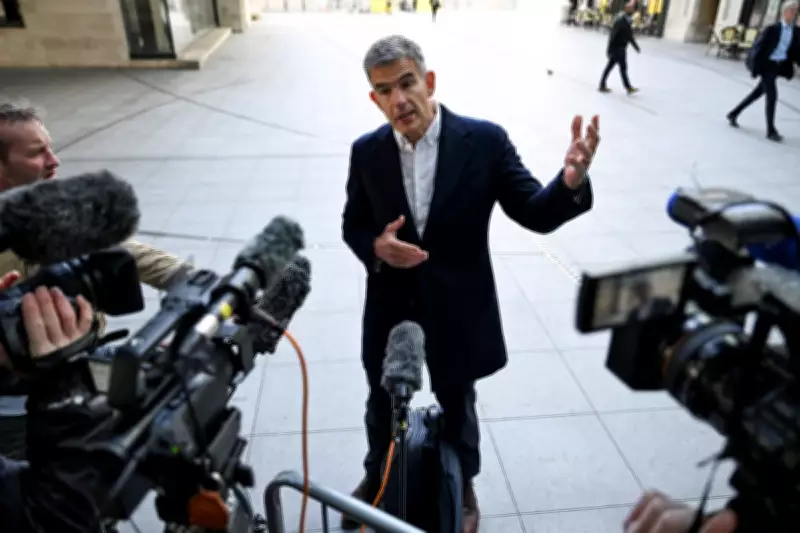
The licence fee is one of the challenges facing Matt Brittin as he starts his new job as director general of the BBC (Reuters). New DG Brittin is a wealthy man, from a lanyard class that is increasingly seen as out of touch with the general public. He needs to learn to read the runes fast. If he does, he will urge the government to put the licence fee to bed, and wrongfoot the BBC’s opponents by suggesting a brand new funding model.

The licence fee represents the fourth-highest public-broadcasting charge in Europe, at a time when the public’s appetite for paying more tax is strictly limited. There is the cost-of-living crisis, a sluggish economy and, above all, the increased burden people have already been asked to carry. Replacing the licence fee would certainly take some of the wind out of Farage’s sails. And, let’s be honest, it is really a poll tax, because everyone with a TV set is liable to the charge, and it takes no account of an ability to pay.
The BBC has initially suggested it would support replacing the licence fee with a universal “household tax”, meaning every home would pay a fixed charge whether they use the BBC or not. But the idea is a non‑starter, because it amounts to funding the BBC through general taxation – something culture secretary Lisa Nandy has previously ruled out, because it might open up the broadcaster to interference from the politicians holding the purse strings.
What would make sense would be to free up the corporation to generate more of its own revenue. Last year, the BBC generated £2.1 billion from commercial and other activities, such as grants, royalties and rental income. It has proved adept at fostering partnerships with deep-pocketed streaming services to help defray the cost of its pricier dramas. This has not always worked – witness what a mess came from its tie-up with Disney to co-produce Doctor Who – but there are plenty of instances where it has.
Separately, Brittin also has to find £500 million in savings. That will inevitably mean cutting staff, some of whom are already striking. One of the BBC’s enduring problems is its tendency to axe people at the sharp end of services that audiences genuinely value while protecting a bloated corps of middle managers and people in luxury functions peddling luxury beliefs.
The BBC matters in a world in which lies, damned lies and fake statistics are coughed up by social-media algorithms and fed to us on an industrial scale. Never has it been easier for bad actors to manipulate public opinion. In that milieu, a genuinely impartial news service would have real value – in both senses, as being trustworthy as well as a global moneyspinner.
The funding question, then, is likely to be answered by some sort of hybrid system. Big audience-pleasers like Strictly and Doctor Who could be put behind a paywall, if it meant the licence fee could be scrapped and most other content free-to-air. Or it might mean advertising breaks, but with the option of a paid-for subscription for those who’d rather watch without interruption – similar to the model streaming services have already adopted. Just imagine the revenues available from a global event such as the World Cup. It has enormous appeal to brands seeking a mass audience. Ad revenues would help preserve jobs. The same goes for some of the BBC’s most popular programming, much of which people still watch through scheduled broadcasts.
Brittin should start on the front foot by being bold and advocating for that future. If he does, his contribution to public life might outstrip anything he achieved at Google, where he helped scale its operations outside the US, while also navigating European countries’ complex tax and regulatory regimes and spearheading initiatives that trained more than 100 million people in digital skills. The question is whether he is willing to make the case.





