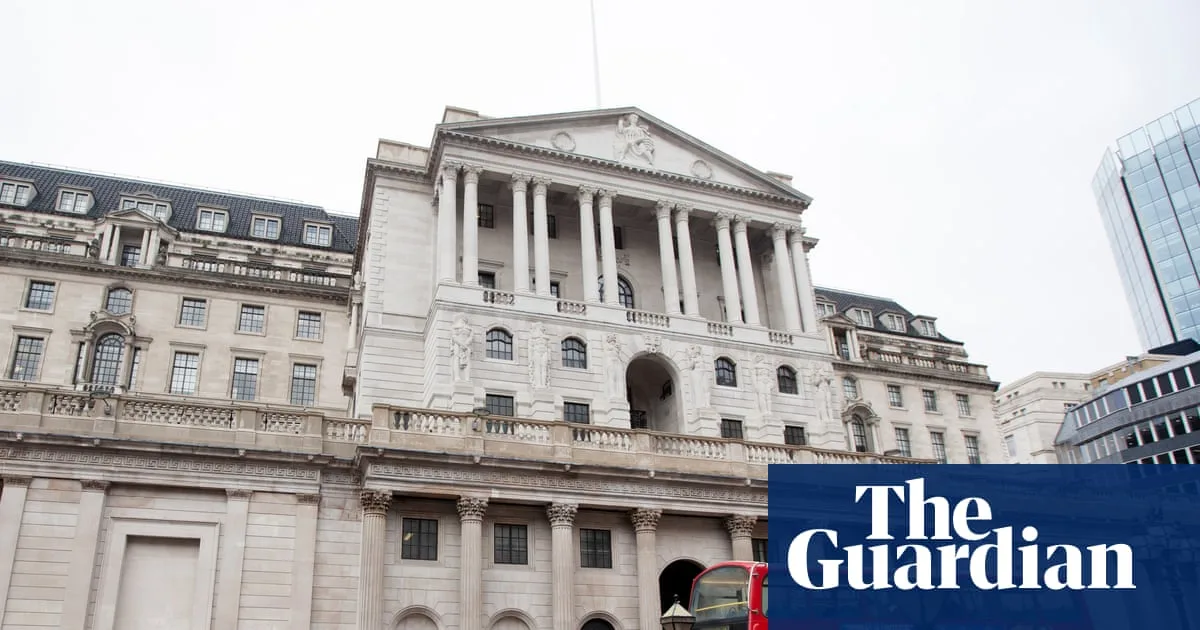
UK interest rates are unlikely to be cut this year and could even rise next summer, according to financial markets, in a dramatic reversal of forecasts before the US-Israel war on Iran. Markets data on Monday showed that investors predict the Bank of England will most likely keep its base rate on hold at 3.75% for the remainder of the year, and would raise them to 4% next June.
Before the Iran war began, a rate cut at the Bank’s next meeting on 19 March had been an 80% chance, but policymakers are now expected to wait to see how the conflict develops, with a 99% probability of a hold at the meeting and no rate cuts for the rest of 2026, markets indicate. Statements from the Iranian leadership and Donald Trump at the weekend showed both sides in the conflict were prepared to fight for several more months, leading financial markets to register sharp falls.
UK two-year bond yields rose to 4.129%, up from 3.52% in the days before the conflict started and the highest since April 2025. The yield was on course for the biggest one-day increase since Liz Truss’s mini-budget in 2022. The potential interest rate rise raises the prospect of higher mortgage rates for longer for UK homeowners. On Monday, data from Moneyfacts showed the average two-year fixed residential mortgage rate was 4.87%, up from 4.84% on Friday, while the average five-year fix was 4.98%, up from 4.96%.

European stock markets slumped after opening on Monday. The UK’s FTSE 100 was down 200 points or 1.9% at 10,087 points before recovering to 10,170 at 10am. Germany’s Dax also regained some lost ground after dropping 548 points or 2.3% at 23,043 points in early trading, while the Paris CAC fell by the largest percentage – down 2.5%.
Chris Beauchamp, the chief market analyst at IG, said stock markets had woken up to the implications of the Iran war, which has left the strait of Hormuz, through which about 20% of the world’s oil supply travels, in effect closed, potentially for a long period. Brent crude hit $119 a barrel on Sunday night before falling back to $104 after it was announced that G7 finance ministers would meet on Monday online to discuss opening emergency oil reserves.
Investors fear that rising oil prices will push up inflation in the UK and Europe, which import most of their energy and fuel. A rise in inflation could force central banks to freeze interest rates and even push them up again next year. Anna Titareva, an economist at UBS Investment Bank, said a majority of the Bank’s monetary policy committee will be concerned about higher energy prices. She said only two of the nine member committee are likely to vote for a cut that was expected before the crisis hit.