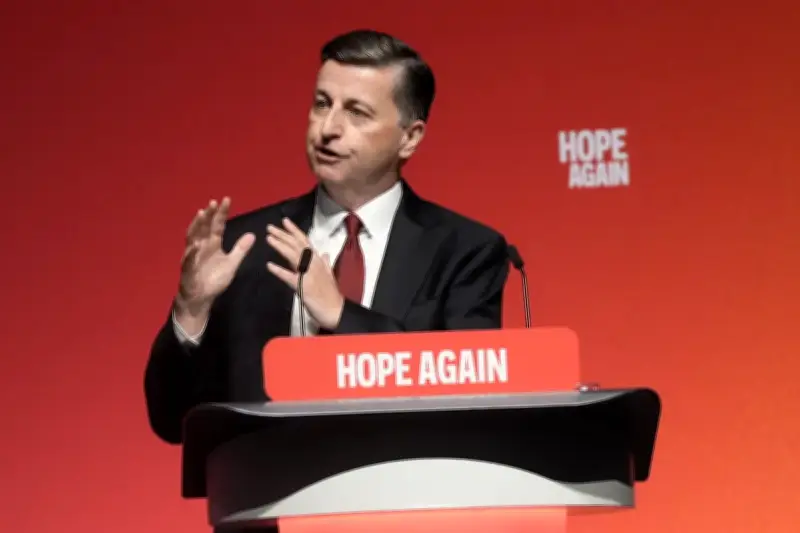
Scottish Secretary Douglas Alexander is expected to tell a conference in Italy that Scotland's relationship with Europe comes from "interdependence, not independence".
Speaking at the UK-Italy Pontignano Conference in Rome on Friday, Mr Alexander is expected to describe the recent deal struck between Britain and the EU as a "floor" rather than a "ceiling on our ambitions".
Partnership and pooling resources
Mr Alexander, an opponent of Scottish independence, is also expected to contrast revisiting the country's relationship with Europe with the question of Scotland leaving the UK.
He will tell attendees: "For Scotland and the United Kingdom, partnership means pooling and sharing our resources.
"That is how Scotland stands taller in the world, as part of a country with a permanent seat on the UN Security Council, a leading place in Nato, and one of the world's largest economies.
"I'm often asked why we want to return to the question of Europe but not that of Scottish independence.
"The answer is simple. Fixing our relationship with our neighbours is fundamentally different from breaking up our own country.
"Scotland's story in Europe runs through interdependence, not independence."
Brexit as a failed reality
Scotland's support for the EU, with 62% backing Remain in the 2016 referendum, comes from "something old and deep in who we are", he will say.
He is expected to add: "Brexit is no longer an abstract idea or a series of impossible promises. It's our reality. We now know it has failed even on its own terms.
"The choice today is whether to settle for that diminished status quo, or seek to change it by giving our people more power, more control, and more hope for a better future.
"What was agreed in Brussels last week should be regarded as a floor – a proof of concept, not a ceiling on our ambitions.
"We're not interested in reopening old wounds from a decade ago.
"We're simply being pragmatic and patriotic about what Britain and its people need in our fast-changing and increasingly dangerous world.
"We cannot deliver the change Britain needs over the next decade without changing our relationship with Europe.
"When the status quo is not working, you don't stand still. You move forward. When the status quo is broken, you don't ignore it. You fix it."
Deal details and next steps
The Prime Minister secured a deal with the EU last week that aims to remove trade barriers and put a stop to most post-Brexit checks on food and drink products, as well as a youth experience scheme.
MPs will be given a chance to vote on the deal next month after draft legislation to implement it was tabled in Westminster on Thursday.
Minister for Europe Stephen Gethins said: "Leaving the EU has been hugely damaging for Scotland and the UK.
"That is why we opposed the damaging isolationism of a Brexit imposed on Scotland against its will.
"We therefore support any immediate steps towards a reset of the partnership with our neighbours in the rest of Europe, that strengthen our economy and help people and businesses struggling with everyday costs.
"Many of us will endorse the intention to start repairing some of the significant damage caused by Brexit, but that must be delivered with respect for devolved responsibilities.
"In the past, powers returning from Brussels were centralised in London – that must not be repeated.
"Scotland has distinct areas of responsibility and interests, so we expect to see strong protections for those, as well as appropriate powers for Scottish ministers and a formal role in future UK-EU decision making."