
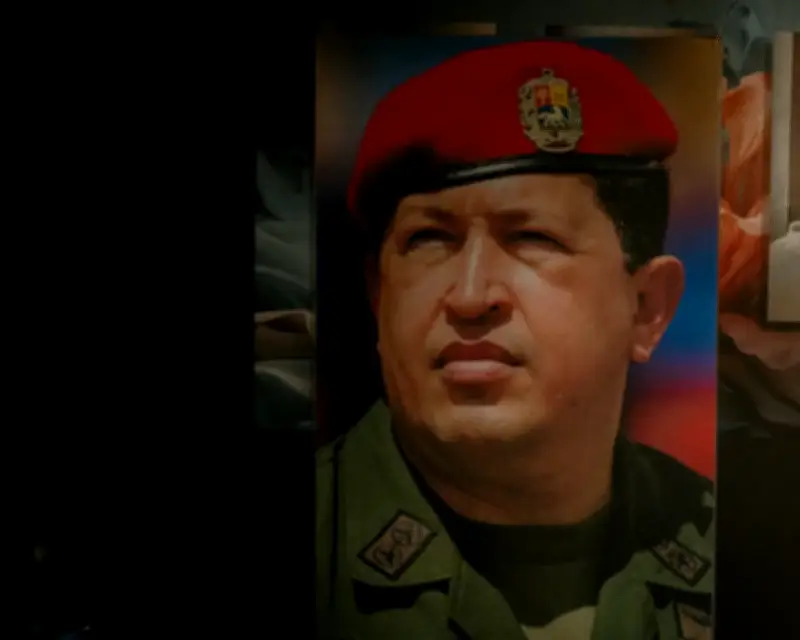
Mario Silva, a fervent propagandist for Hugo Chávez’s Bolivarian revolution, has seen his state-funded show cancelled and now rails against the direction of Venezuela’s interim government under Delcy Rodríguez. Silva, who spent more than two decades hosting The Razorblade on state TV, often with Chávez’s portrait behind him and the late leader’s signature tattooed on his left wrist, expressed deep disappointment.
“A lot of disappointment – depressed … and sometimes I wake up and feel like the world is collapsing around me,” the 66-year-old said during an interview at his home studio in the mountains outside Caracas. He has been using YouTube to berate those he blames for Venezuela’s “shameful and utterly illegitimate surrender” to the US.
Surrealism and Surrender
Since January, a parade of high-ranking US officials, including the head of the CIA, the chair of the joint chiefs of staff, and energy secretary Chris Wright, have visited Caracas. Trump recently trumpeted striking “the biggest oil deal in world history” with Rodríguez’s regime. Last week, Rodríguez and Trump met on the sidelines of the UN general assembly, posing for a photograph that left diehard Chavistas aghast.
“I thought it [the photo] was artificial intelligence or something like that. But it’s surrealism, utter surrealism … It’s impossible to understand,” Silva fumed on YouTube, with a red flag emblazoned with the faces of Karl Marx, Friedrich Engels, and Vladimir Lenin hanging behind him. “They have surrendered this country and surrendered it the most vile and despicable way,” he added. “Honestly, they are dragging the country’s name through the mud. They are dragging Chávez’s name through the mud.”
Chavista Discontent
Silva is not alone. Elías Jaua, a vice-president and foreign minister under Chávez, said, “What I hear from comrades across the country is bewilderment, disagreement and indignation.” He believes Trump’s oil deal “amounts to an act of pillage against an entire nation”. Juan Barreto, a former mayor of Caracas and ex-member of the ruling Socialist party, said the agreement would have been unimaginable when the revolution began after Chávez’s 1998 election. He noted that Chavistas, who once vowed “Not a drop of oil to the empire if Venezuela is attacked!”, were now effectively saying: “All of the oil reserves [for the US], for as long as you want!”
Rodríguez has defended the deal, claiming it will create more than $209bn (£158bn) in revenues to improve healthcare and education. “We are thinking of Venezuela’s future,” she said in a recent TV broadcast. Héctor Rodríguez, another prominent Chavista politician, has sought to deflect criticism by recalling how Chávez made a tactical retreat after his failed coup attempt in 1992.
Government Support and Uncertainty
Last week, as Rodríguez met Trump in New York, thousands joined a pro-government rally in Caracas, chanting “Delcy avanza, tú tienes mi confianza!” (“Move forward, Delcy. I trust in you!”). Interior minister Diosdado Cabello told the crowd, “No matter how much they kick and scream, there’s nothing they can do to try to cover up the success of President Delcy Rodríguez’s visit to New York.” Unlike previous marches, there was scant mention of Maduro or calls for his release.
The depth and potential consequences of Chavista anger remain unclear. Orlando Pérez, a Latin America expert from the University of North Texas at Dallas, acknowledged indignation among some. “There are Chavistas that are pissed off, there’s no question about it,” he said. “There are Chavistas who see this as a betrayal of Hugo Chávez and the betrayal of the movement.” However, Pérez believed many Chavistas in power see working with Washington as “a necessary evil” to keep the opposition out.
“If that means negotiating with Trump, if that means dealing with the CIA etc, it’s fine,” he said. “Beyond whatever ideological position they might have … I suspect most of them are gritting their teeth and just going along with this process as long as they can stay in power and keep their jobs.” Pérez warned that Rodríguez’s government would need to demonstrate “tangible benefits to the cooperation” to avoid a backlash. “They’re going to have to show that these things have a material consequence to the lives of their social base … if you don’t deliver, then it is going to get very volatile,” he said.
So far, there has been no sign of significant resistance. But Silva claimed the government’s new direction and economic policies could eventually trigger a social uprising. “Worsening economic conditions will degrade [people’s] quality of life, and that pressure is bound to explode. It has to explode – it’s not just wishful thinking. This isn’t a prediction born of desire, it’s an inevitability,” said the broadcaster, who has claimed he is facing investigation for alleged acts of “aggravated defamation and slander against the interim government”.
Silva recalled the early hours of 3 January 2026 when, as US troops swept into Caracas, he realised the revolution he had defended for over 20 years was not going to defend itself. He moved from one strategic point to another before calling the commander at his assigned post. “I said: ‘Hey, what happened? Where are the weapons?’” Silva recalled. “Go to sleep, Mario,” he was told. Silva paused. “You have no idea how disappointed I was.”




